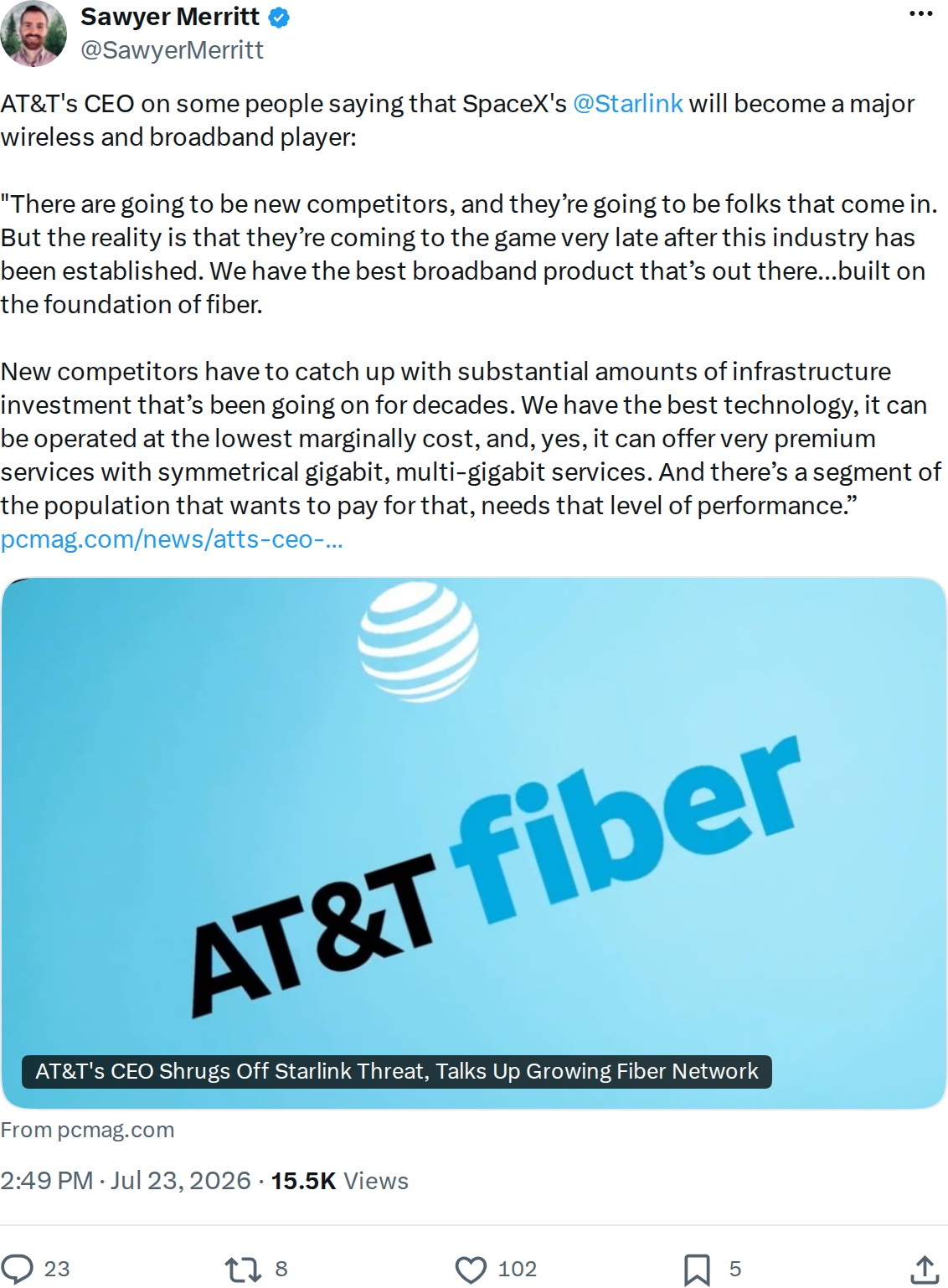
AT&T Chairman and CEO John Stankey pushed back this week on the idea that SpaceX's Starlink poses a serious threat to established carriers — calling satellite competitors 'very late' to an industry built on decades of terrestrial infrastructure. It's a confident dismissal. But Starlink's own growth trajectory raises a harder question: late by whose clock?

What Stankey Actually Said
Speaking on July 22, Stankey acknowledged that new competitors are entering the wireless and broadband space, but framed satellite operators as fundamentally disadvantaged. His argument: you cannot economically replicate the fiber and wireless infrastructure that AT&T has spent decades and billions building. He stated that AT&T already handles over 98% of its converged customer traffic on its own network, with partnerships expected to cover remaining edge cases by next year. He also ruled out a wholesale Starlink deal, saying AT&T doesn't need a satellite partner as a primary distribution vehicle.
It's a coherent position for a legacy carrier to hold. It's also the kind of thing incumbents tend to say right before a market shifts under them.
The Numbers Behind Starlink's 'Late' Entry
Starlink confirmed 12 million active customers across more than 160 countries as of June 2026 — up from 9 million nine months prior and 10 million in February. That's not the growth curve of a company struggling to find footing. According to earlier 2026 reports, approximately 2.7 million of those subscribers are in the U.S., which already places Starlink among the top 10 U.S. internet service providers by subscriber count.
| Metric | Figure | Context |
|---|---|---|
| Global active subscribers | 12 million | +3M in ~9 months |
| U.S. subscribers | ~2.7 million | Top 10 U.S. ISP |
| Satellites in orbit | 10,300+ | Target: 20,000 |
| Network capacity | 600+ Tbps | Post V2 Mini rollout |
| 2025 estimated revenue | ~$11.4 billion | 2026 projection: $15.5B+ |
| Typical U.S. download speed | ~184 Mbps | Max plan: 400 Mbps |
| Direct-to-Cell satellites deployed | 663+ | Voice/data service coming |
Revenue estimates vary — some analysts project 2026 figures exceeding $18 billion — but even the conservative end puts Starlink on a trajectory that most telecom startups never approach. The constellation itself now exceeds 10,300 operational satellites, with over 12,340 launched and a stated target of 20,000.
Where Stankey Has a Point
The AT&T CEO's argument isn't without merit in specific contexts. Dense urban environments remain a genuine constraint for satellite internet. Capacity per square kilometer is a physics problem, not a capital problem — and no amount of satellite launches fully resolves that in Manhattan or downtown Chicago. Analysts broadly agree that Starlink's clearest long-term opportunity lies in underserved rural and suburban markets rather than displacing fiber in high-density corridors.
Latency is also a real differentiator. Starlink's median U.S. latency sat at 39 ms in Q1 2026 — competitive for most use cases, but still behind fiber for latency-sensitive applications. And the pricing structure ($120/month for residential standard, plus a $499 hardware kit) creates friction that cable and fiber bundles don't always face.
Where the 'Very Late' Framing Gets Complicated
The more interesting strategic development isn't Starlink's residential broadband push — it's Direct to Cell. SpaceX has deployed over 663 DTC satellites, and the FCC approved SpaceX's acquisition of roughly 65 MHz of nationwide spectrum from EchoStar in May 2026 for direct-to-phone 5G connectivity. T-Mobile customers are already expected to gain ubiquitous coverage via Starlink's satellite service in 2026 through an active D2C partnership.
That's not a company competing with AT&T's fiber network. That's a company embedding itself into the wireless coverage layer that AT&T's own customers depend on when they're outside terrestrial range. The FCC also adopted its plan to auction 160 MHz of Upper C band spectrum in July 2027 — a proceeding Starlink could participate in to deepen its terrestrial wireless footprint further.
Stankey's framing positions this as a late entrant trying to replicate what AT&T built. The more accurate read may be that Starlink is building something different — a coverage layer that sits above and around terrestrial networks, not directly against them. Whether that eventually pressures AT&T's subscriber base depends less on who got there first and more on how fast Starlink's capacity scales into suburban and urban markets where the real subscriber density lives.
Twelve million customers and a $15 billion revenue run rate suggest the clock is moving faster than 'very late' implies. For our SpaceX coverage, keep watching this space.
Sources & reporting notes
The links below identify the material source records used for this report.
- @SawyerMerritt on X (2026-07-23T14:49:37.000Z) — Direct source
Source links are preserved as published or accessed. See our editorial standards and corrections policy.
The BASENOR Editorial Desk covers Tesla, SpaceX, and related technology, curating reporting from primary sources — official accounts, regulatory filings, and software release data. Every article passes source-record and fact-checking review before publication. About the newsroom.
This report was curated by the BASENOR Editorial Desk from the sources listed above. Read our editorial standards or email editorial@basenor.com to report an error.