

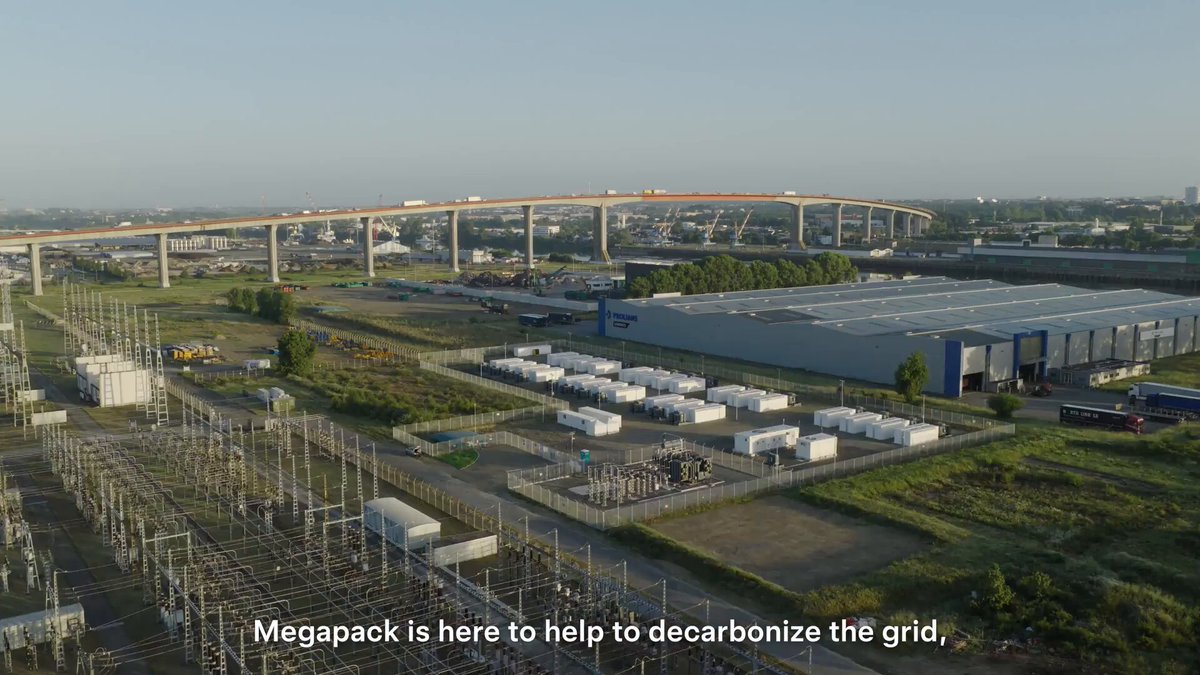
Tesla's Autobidder platform is now optimizing one of Europe's more symbolically charged energy projects — a 100 MW / 200 MWh battery facility built on the ruins of a French coal power station. The Cheviré Battery Energy Storage System (BESS), developed by Harmony Energy in Nantes, went commercial in late 2025 and is already being held up as a template for how grid-scale storage can replace fossil fuel infrastructure on the same ground it once occupied.

1. It sits on a former coal plant that ran for over 30 years
The Cheviré site in Nantes Saint-Nazaire Harbour housed a fossil fuel power station from 1954 to 1986. That history matters beyond the symbolism — the site already had the grid interconnection infrastructure, land permits, and industrial footprint that new greenfield battery projects spend years acquiring. Repurposing it compressed the development timeline significantly and gave the project a ready-made narrative for regulators and the public alike.
2. At 100 MW / 200 MWh, it's France's largest operational battery storage facility
According to Harmony Energy, the Cheviré BESS holds the title of France's largest operational battery storage facility. The 100 MW power rating means it can respond to grid frequency events almost instantaneously, while the 200 MWh energy capacity gives it two hours of sustained output at full power. That 2-hour duration is itself a first for France at large scale — the country previously lacked a commercial battery facility capable of sustained multi-hour discharge at this size.
3. It can power an estimated 170,000 homes for two hours
Harmony Energy puts the project's output potential at enough electricity to supply roughly 170,000 homes for two hours. In grid terms, that translates to meaningful peak-shaving capability during demand spikes — exactly the use case Autobidder is designed to monetize. The facility can charge during periods of low-cost renewable surplus and discharge when grid prices spike, capturing the spread automatically.
4. Tesla's Autobidder handles the revenue optimization in real time
Autobidder is Tesla's AI-driven energy trading platform that continuously monitors wholesale electricity markets and dispatches battery assets to maximize revenue. Rather than operating on fixed schedules, it responds to real-time price signals, frequency regulation calls, and ancillary service markets simultaneously. For a project the size of Cheviré, the difference between manual dispatch and algorithmic optimization can represent millions of euros in annual revenue — which is precisely why Swiss energy company Alpiq, which acquired the operational facility from Harmony Energy in January 2026, chose to keep Autobidder running post-acquisition.
5. Construction started in summer 2024 and the project was energized by August 2025
The Cheviré BESS moved from groundbreaking to energization in roughly 12 to 14 months, according to project records. Construction began in summer 2024, the facility achieved energization in August 2025, and a formal inauguration followed in December 2025. That timeline reflects both the maturity of Tesla Megapack as a deployable product and the advantage of building on an already-permitted industrial site. Harmony Energy continues as asset manager under Alpiq's ownership.
6. The project is projected to avoid nearly 364,000 tons of CO₂ over 20 years
Harmony Energy's lifecycle analysis puts the avoided emissions figure at approximately 364,000 tons of CO₂ equivalent over the facility's 20-year operational life. That figure accounts for the clean energy the battery enables by smoothing renewable intermittency and displacing gas peaker plant dispatch on the French grid. For context, France's grid is already among the lowest-carbon in Europe due to its nuclear base — which means the marginal emissions savings here come primarily from reducing reliance on gas-fired peakers during demand peaks, not from replacing coal directly.
The Cheviré project is a useful data point for the broader European energy storage market. It demonstrates that a major grid-scale BESS can move from construction to commercial operation in under 18 months, that repurposed fossil fuel sites offer a viable fast-track development path, and that algorithmic dispatch via platforms like Autobidder is now standard practice rather than a differentiator. Watch for similar coal-to-battery conversions across the UK and Germany, where decommissioned thermal sites are increasingly being evaluated for exactly this kind of second life.
Sources & reporting notes
The links below identify the material source records used for this report.
- @Tesla_Megapack on X (2026-07-30T16:12:27.000Z) — Direct source
Source links are preserved as published or accessed. See our editorial standards and corrections policy.
The BASENOR Editorial Desk covers Tesla, SpaceX, and related technology, curating reporting from primary sources — official accounts, regulatory filings, and software release data. Every article passes source-record and fact-checking review before publication. About the newsroom.
This report was curated by the BASENOR Editorial Desk from the sources listed above. Read our editorial standards or email editorial@basenor.com to report an error.






