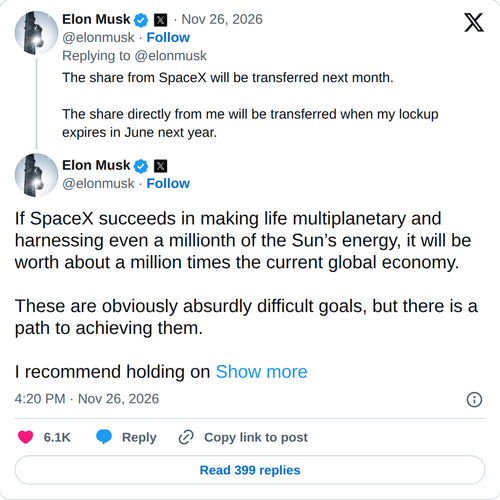

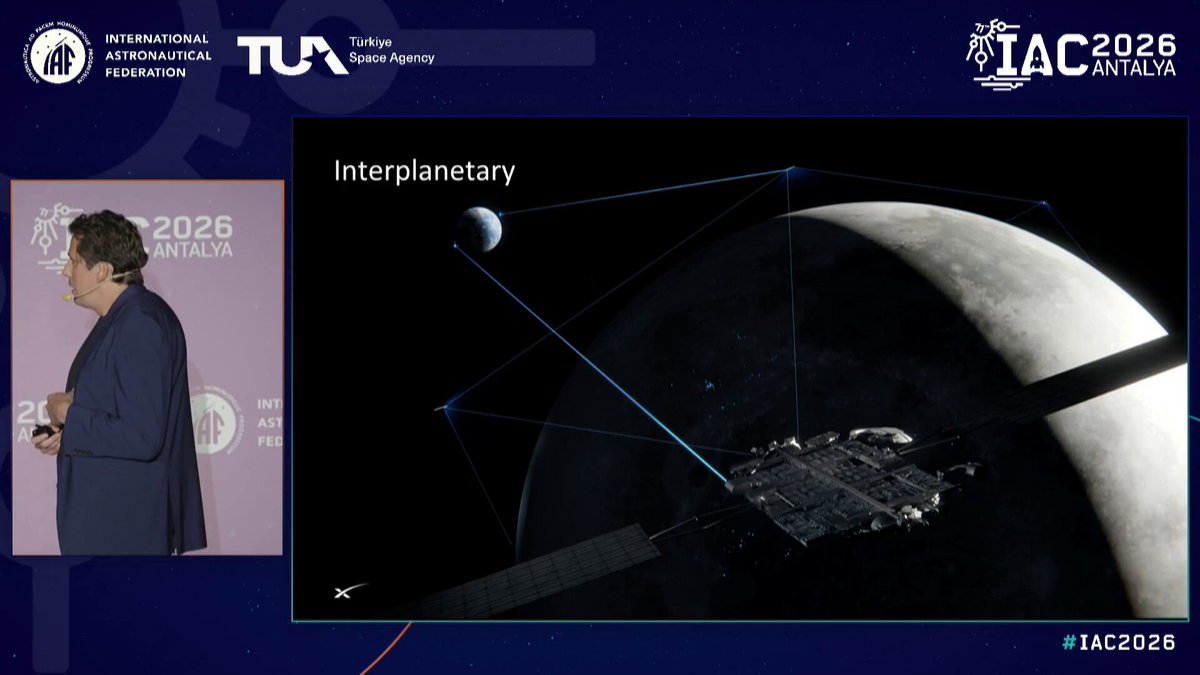
Elon Musk posted a single sentence on October 6 that would sound like science fiction from almost anyone else: SpaceX will provide connectivity throughout the solar system and beyond. Coming from the company that already operates the world's largest satellite constellation, it's worth unpacking what infrastructure actually backs that claim — and how far along SpaceX already is.

1. Starlink Already Has Nearly 10,000 Active Satellites
The foundation for any interplanetary network is the Earth-based constellation, and that foundation is substantial. According to orbital tracking data, Starlink had 9,839 active satellites in orbit as of September 2026. SpaceX holds FCC authorization for up to 12,000 satellites in its first deployment phase, with filings covering up to 42,000 in subsequent phases. A separate application for an additional 100,000 next-generation "Gen3" satellites is also pending with federal regulators. The sheer scale of the existing network is what makes the longer-term vision credible rather than theoretical.
2. Starmind — Up to 1 Million AI Satellites — Is Already FCC-Filed
Beyond the core Starlink constellation, SpaceX has plans for a separate system called Starmind: up to 1 million AI-capable orbital satellites designed to handle broadband and supercompute workloads. The FCC accepted SpaceX's filing for this program in February. Each cluster of roughly 10 Starmind satellites will be interconnected with approximately 10 terabits of bandwidth. Production is planned at SpaceX's "Gigasat factory" in Bastrop, Texas, with initial deployments of thousands of units targeted to begin as early as late 2027. This is the layer of the network that starts to make deep-space data infrastructure look plausible on a real timeline.
3. Starship Is the Multiplier That Makes Deep-Space Coverage Possible
Current Falcon 9 launches deploy V2 Starlink satellites. Starship is designed to carry the far more capable V3 generation — and according to SpaceX's own projections, a single Starship launch will add more than 20 times the network capacity of a Falcon V2 mission. Starship is also being developed as the vehicle for long-duration missions to the Moon, Mars, and beyond, meaning the same rocket that builds out the constellation is the one that eventually needs that constellation to function. The two programs are deliberately co-dependent.
4. Mars Connectivity Is the First Practical Waypoint
Musk's multiplanetary ambitions have always framed Starlink as more than a terrestrial broadband business. The stated goal is high-bandwidth communication on Mars and other celestial bodies — a prerequisite for any sustained human presence there. Starlink revenue, which is expected to reach over 25 million active users by end of 2026 up from roughly 10 million, is explicitly positioned as the financial engine funding Starship development and Mars colonization. In other words, every Starlink subscription today is, in Musk's framing, a contribution toward making Mars reachable and connected.
5. The Stated Endgame Goes Beyond the Solar System
Musk has described a concept involving a mass driver on the Moon launching AI satellites into deep space "one after another" to explore neighboring star systems. This is the furthest-horizon element of the vision and the one with the least near-term infrastructure behind it. But it follows a consistent logic: build the constellation, fund it with Earth subscribers, use Starship to extend it to Mars, then use the Moon as a launch platform for interstellar probes. Each step is dependent on the previous one, which is why the current 9,839-satellite count is more relevant to this long-term story than it might appear.
Whether the full solar-system vision materializes on any specific timeline remains an open question. But the regulatory filings, factory construction, and satellite counts confirm that SpaceX is building toward something considerably larger than a broadband business. For more on SpaceX's ongoing milestones, see our SpaceX coverage.
🚀 Following the Starship program? See every test flight, official outcome and the next launch window in our SpaceX Starship Tracker.
Related coverage
Sources & reporting notes
The links below identify the material source records used for this report.
- @elonmusk on X (2026-10-06T20:22:51.000Z) — Direct source
Source links are preserved as published or accessed. See our editorial standards and corrections policy.
The BASENOR Editorial Desk covers Tesla, SpaceX, and related technology, curating reporting from primary sources — official accounts, regulatory filings, and software release data. Every article passes source-record and fact-checking review before publication. About the newsroom.
This report was curated by the BASENOR Editorial Desk from the sources listed above. Read our editorial standards or email editorial@basenor.com to report an error.