
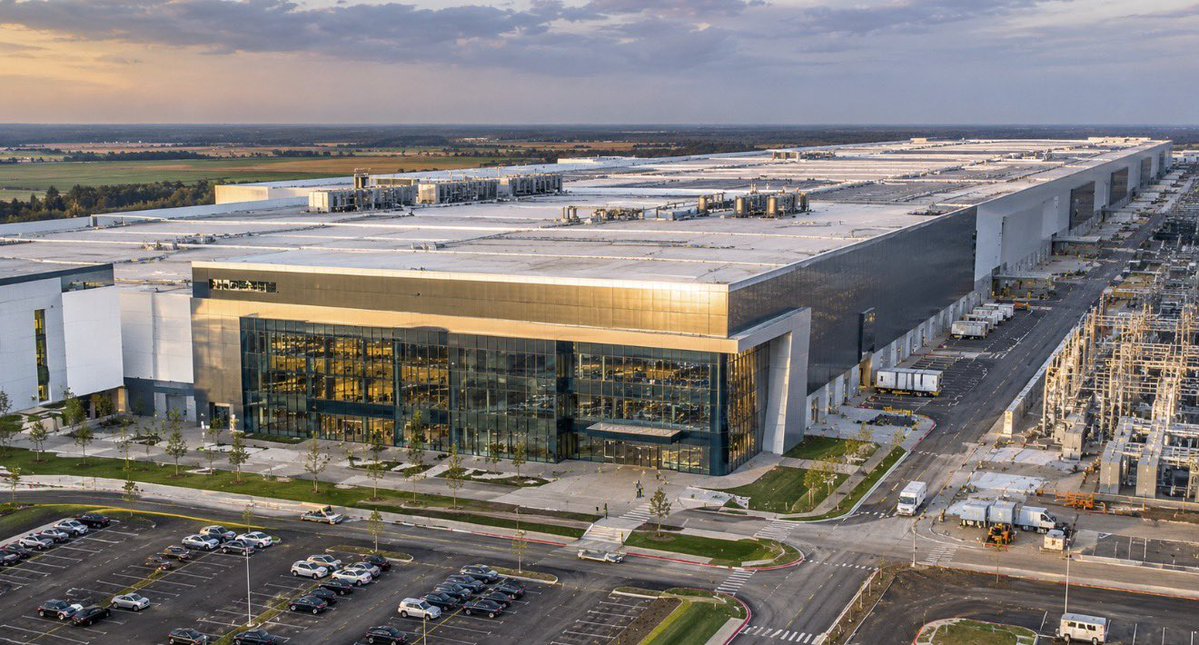
Elon Musk's Terafab — the Tesla-SpaceX-xAI joint venture to build what Musk has described as the world's largest semiconductor manufacturing complex — is sharpening into a concrete timeline. According to posts circulating this week on X, Musk is targeting first test chip production around June 2027, with volume production ramping by late 2028. At full build-out, the Texas complex is projected to span more than 100 million square feet, a scale that would make it the largest building footprint on Earth and a cornerstone of Tesla's vertical-integration push for FSD, Cybercab, and Optimus.
The project was officially launched by Musk on March 21, 2026, and first confirmed on Tesla's January 28, 2026 earnings call. For readers catching up, our earlier breakdown in our Terafab coverage walks through the structure of the joint venture and how Intel's role as technology partner came together.

The Scale Numbers
The figures circulating this week are what make Terafab unusual even by Musk's standards. @cryptowalax summarized the planned scale against familiar landmarks: an area equivalent to roughly 2,300 football fields, with output projections that dwarf today's leading-edge fabs.
| Metric | Terafab Target | Context |
|---|---|---|
| Footprint | 100M+ sq ft | ~2,300 football fields |
| Wafer output | 1M wafers/month (target) | Roughly 25× Intel Fab 52, per @cryptowalax |
| Test chips | ~June 2027 | Musk-stated target |
| Volume production | Late 2028 | Described by Musk as extremely aggressive |

Treat the wafer and compute figures as ambitions rather than committed capacity. Published reports around Terafab's launch framed one million wafers per month as a long-horizon ceiling for the complex at full build-out, not a Day One number. Even so, a fab targeting that trajectory would change the global semiconductor landscape — and it is why the project pulled in Intel as a technology partner on design, fabrication, and advanced packaging.
Two Sites, Two Phases
Terafab is being built in two physical phases, and the distinction matters for how you read the 2027 and 2028 dates.
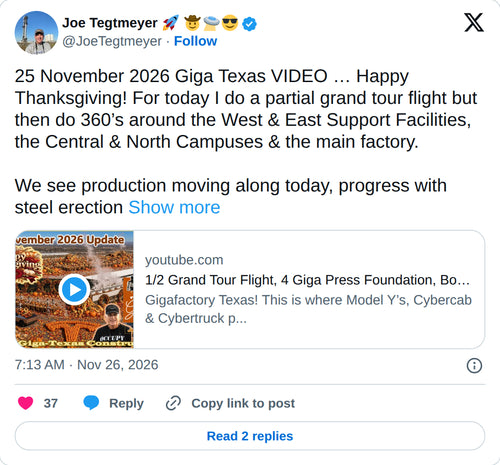
The first phase is a prototype fabrication facility at the North Campus of Gigafactory Texas in Austin. Groundwork there began in mid-April 2026, with foundations poured in the fall. This is the facility most likely to produce the June 2027 test chips. The broader North Campus buildout — covered in our Giga Texas expansion piece — now includes the chip fab alongside Optimus giga presses and the Cortex 2 compute cluster.
The second phase is the permanent, full-scale complex in Grimes County, Texas, about an hour northwest of Houston. That site was publicly revealed via SpaceX's S-1 IPO filing in May 2026 and formally confirmed on August 6, 2026. The 100-million-square-foot figure refers to the Grimes County complex at full build-out, not the Austin prototype fab.
Separating the two helps parse the timeline: test chips in Austin by mid-2027 is plausible given foundations are already in the ground. The Grimes County mega-complex is a longer arc, with volume production in late 2028 covering the first operational blocks rather than a completed 100M sq ft footprint.

Why Tesla Needs This
The strategic logic is straightforward: every major Tesla and SpaceX product line in development is compute-bound.
- FSD and Cybercab: Each generation of the Tesla inference chip has required more silicon area and more power. Scaling a robotaxi fleet to meaningful volume means securing chip supply Tesla controls.
- Optimus: Humanoid robots at the volumes Musk has floated require their own high-volume inference silicon. The Optimus production push at Giga Texas is a direct neighbor to the prototype fab.
- SpaceX orbital servers: The company is building toward a satellite-based compute constellation. The FCC's recent clearance for SpaceX to launch up to one million Starmind data center satellites — covered here — only sharpens that chip demand curve.
- xAI training clusters: Following SpaceX's acquisition of xAI in February 2026, training-cluster silicon sits inside the same corporate family that will own Terafab.
Musk's own framing, echoed by @AIXSIXRI, is that most companies scope ambitions to what suppliers can deliver. Terafab inverts that — start with the compute footprint Tesla, SpaceX, and xAI need in 2028 and beyond, then build the capability to produce it. It is the same logic that led Tesla to build its own battery cells and SpaceX to build its own engines.
Execution Risk Is the Story
Musk himself has described the timeline as extremely aggressive, and that language is worth taking seriously. Even mature chipmakers routinely slip fab timelines by a year or more. TSMC's Arizona fabs and Intel's Ohio project both faced multi-year delays. Terafab is attempting to compress a buildout that would normally span a decade into roughly two and a half years from launch to volume production.
The Musk playbook here, per the public reporting, is to start with existing semiconductor manufacturing equipment, push suppliers to customize, and build tooling internally where the supply chain won't deliver. That approach has worked at Tesla and SpaceX, but semiconductor equipment is uniquely consolidated — a handful of suppliers (ASML, Applied Materials, Lam Research, Tokyo Electron) control the critical tools, and even Intel and TSMC wait in line.
What to Watch Next
- Equipment move-in at the Austin prototype fab. First tool deliveries would be the clearest signal that June 2027 test chips remain on track.
- Grimes County permitting and vertical construction. The 100M sq ft figure only becomes real once steel starts going up.
- Hiring signals. Process engineers, lithography specialists, and fab operations leadership moving to Austin and Grimes County will foreshadow the ramp pace.
- Tesla earnings calls. Expect Terafab capex and capacity targets to become a regular line item through 2027.
For Tesla owners, the near-term implication is indirect but real: the roadmap items that define the next five years — FSD at scale, Cybercab commercial service, Optimus in volume — all rest on chip supply that Tesla is now choosing to build rather than buy. Whether Terafab hits its 2027 and 2028 marks or slips a year, the bet itself tells you where Musk thinks the constraint lies.
🚕 Following the Robotaxi rollout? See every operating city, launch date and announced market in our Tesla Robotaxi Tracker.
🤖 Tracking Tesla's humanoid robot? See every Optimus production milestone and appearance in our Tesla Optimus Tracker.
Related Gear
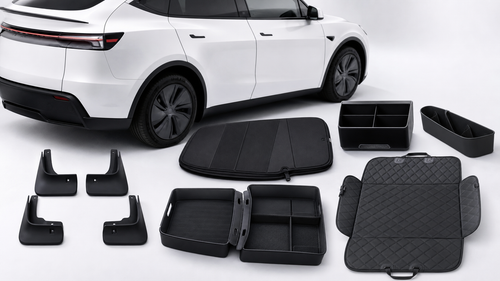
Gear up your Tesla with tested, custom-fit BASENOR accessories — shop Tesla accessories →
Sources & reporting notes
The links below identify the material source records used for this report.
- @Teaseryy on X (2026-11-19T11:09:06.000Z) — Direct source
- @cryptowalax on X (2026-11-22T11:57:26.000Z) — Direct source
- @AIXSIXRI on X (2026-11-24T05:15:00.000Z) — Direct source
Source links are preserved as published or accessed. See our editorial standards and corrections policy.
The BASENOR Editorial Desk covers Tesla, SpaceX, and related technology, curating reporting from primary sources — official accounts, regulatory filings, and software release data. Every article passes source-record and fact-checking review before publication. About the newsroom.
This report was curated by the BASENOR Editorial Desk from the sources listed above. Read our editorial standards or email editorial@basenor.com to report an error.