China's government has officially ended an 11-year tax-free run for lithium-ion batteries. Starting September 1, 2026, a new consumption tax will hit the technology that powers virtually every electric vehicle on the road today — while deliberately carving out exemptions for the next generation of cell chemistries. The policy signals where Beijing wants the industry to go next.

The Policy, in Plain Terms
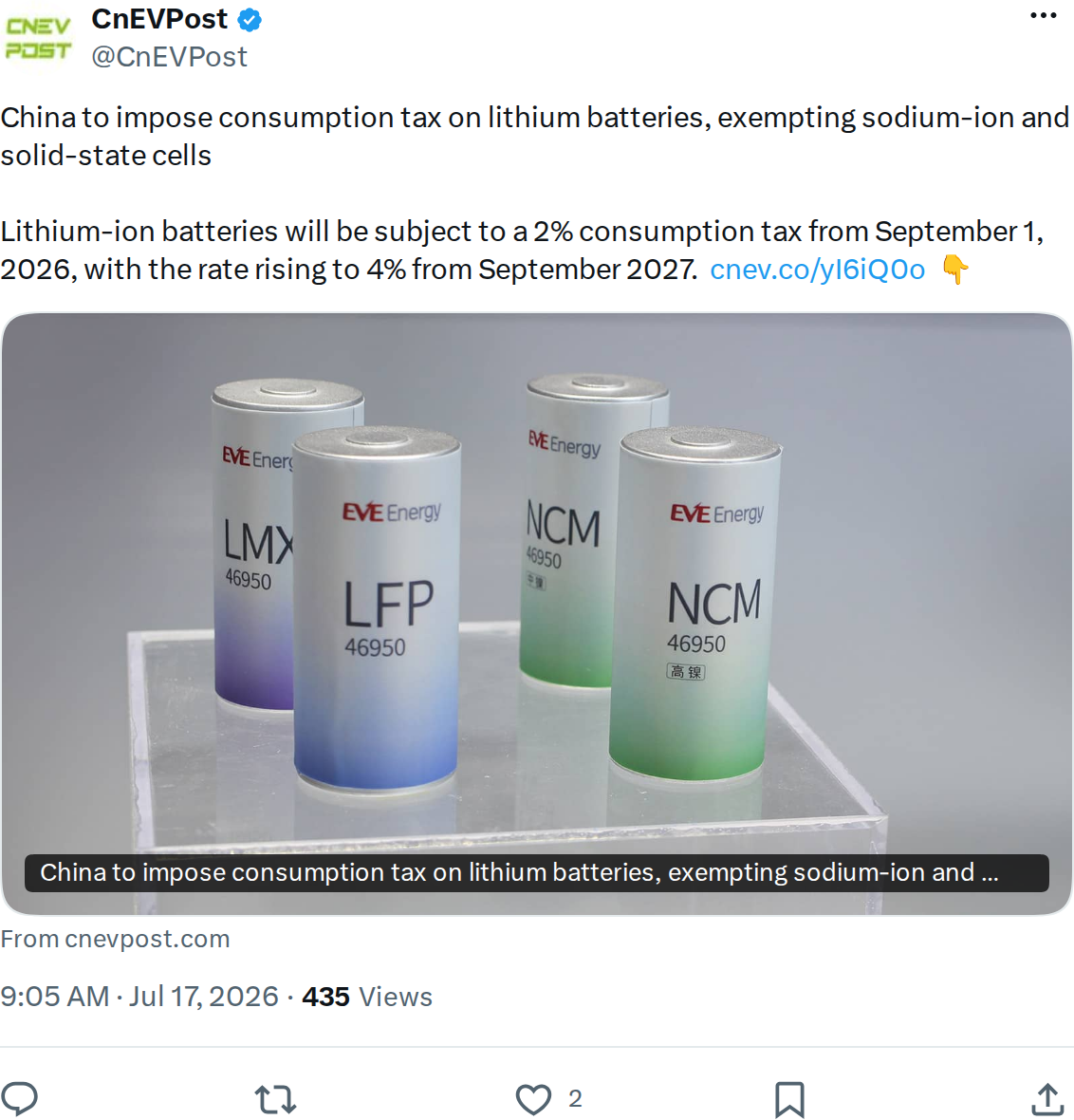
According to CnEVPost, China's Ministry of Finance, the General Administration of Customs, and the State Taxation Administration jointly announced the change on July 17, 2026. The tax applies at the manufacturing or import stage and follows a two-step escalation:
🇨🇳 Consumption Tax Schedule
| Effective Date | Tax Rate |
|---|---|
| September 1, 2026 | 2% |
| September 1, 2027 | 4% |
Lithium-ion batteries aren't the only chemistry affected. According to the announcement, mercury-free primary batteries, nickel-metal hydride (NiMH) batteries, lithium primary batteries, and all-vanadium redox flow batteries will face the same rates on the same timeline. The policy is broad — this isn't a targeted measure aimed at any single product category.
Who Gets a Pass — and Why That Matters
The more strategically interesting part of the announcement is what's exempt. From September 1, 2026 through December 31, 2028, the following technologies will pay no consumption tax:
- Sodium-ion batteries
- Solid-state batteries
- Fuel cells
- Perovskite solar cells
- Tandem solar cells
- Gallium arsenide solar cells
Read that list as a roadmap. Beijing is using the tax code to accelerate the transition away from conventional lithium-ion toward chemistries it considers strategically superior. Sodium-ion cells use no lithium or cobalt — two materials China imports or sources under geopolitical pressure. Solid-state batteries are widely seen as the next leap in energy density and safety. Exempting both from taxation while taxing today's dominant chemistry is a deliberate nudge to manufacturers and investors.
For Tesla specifically, this has layered implications. Tesla's Shanghai Gigafactory is the company's highest-volume production site globally, and it sources cells from CATL and other Chinese suppliers. A 2% cost increase on lithium-ion packs starting in six weeks isn't catastrophic — but it's not nothing, either. At scale, even a modest per-kWh increase compounds quickly across hundreds of thousands of vehicles per year. Whether suppliers absorb that margin hit, pass it downstream to automakers, or split the difference will likely be negotiated quietly over the coming weeks.
The Broader Supply Chain Picture
China manufactures the overwhelming majority of the world's lithium-ion cells. A consumption tax at the source — applied at manufacturing or import — effectively touches any product that uses Chinese-made batteries, whether it's assembled in Shanghai, Germany, or Texas. Export-oriented battery makers face a more complicated calculation: the tax applies domestically, but competitive dynamics in international markets may limit how much of that cost can be passed on to foreign customers.
The solar industry faces a parallel shift. Conventional photovoltaic cells will be taxed at 2% from April 1, 2027, rising to 4% from April 2028 — a slightly later timeline than batteries, but the same structural logic. Next-generation perovskite and tandem cells are exempt through the end of 2028.
The 11-year exemption that's now ending was itself a policy tool — it helped Chinese battery manufacturers scale aggressively and achieve the cost curves that made EVs commercially viable. Ending it now, at a moment when Chinese battery makers hold dominant global market share, suggests Beijing believes the industry no longer needs that particular subsidy. The exemptions for emerging chemistries suggest the same playbook is simply being rerun one technology generation later.
What to Watch
The September 1 effective date is less than seven weeks away. Expect pricing discussions between cell suppliers and automakers to move quickly. Tesla's Shanghai operations will be among the first to feel any ripple effects, given the volume involved. Longer term, the exemption window for solid-state batteries through 2028 could accelerate commercialization timelines — manufacturers now have a tax incentive, not just a technical one, to get next-gen cells into production sooner rather than later.
Related Gear
Gear up your Tesla with tested, custom-fit BASENOR accessories — shop Tesla accessories →
Sources & reporting notes
The links below identify the material source records used for this report.
- @CnEVPost on X (2026-07-17T09:05:45.000Z) — Direct source
Source links are preserved as published or accessed. See our editorial standards and corrections policy.
The BASENOR Editorial Desk covers Tesla, SpaceX, and related technology, curating reporting from primary sources — official accounts, regulatory filings, and software release data. Every article passes source-record and fact-checking review before publication. About the newsroom.
This report was curated by the BASENOR Editorial Desk from the sources listed above. Read our editorial standards or email editorial@basenor.com to report an error.