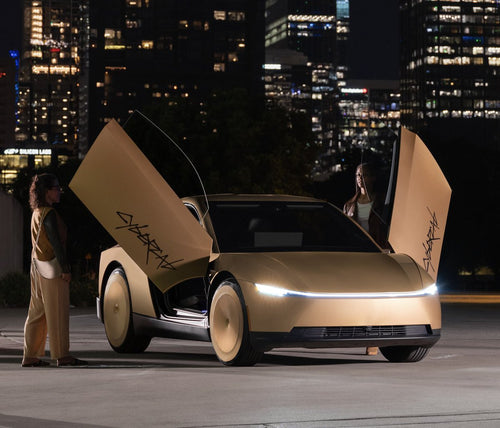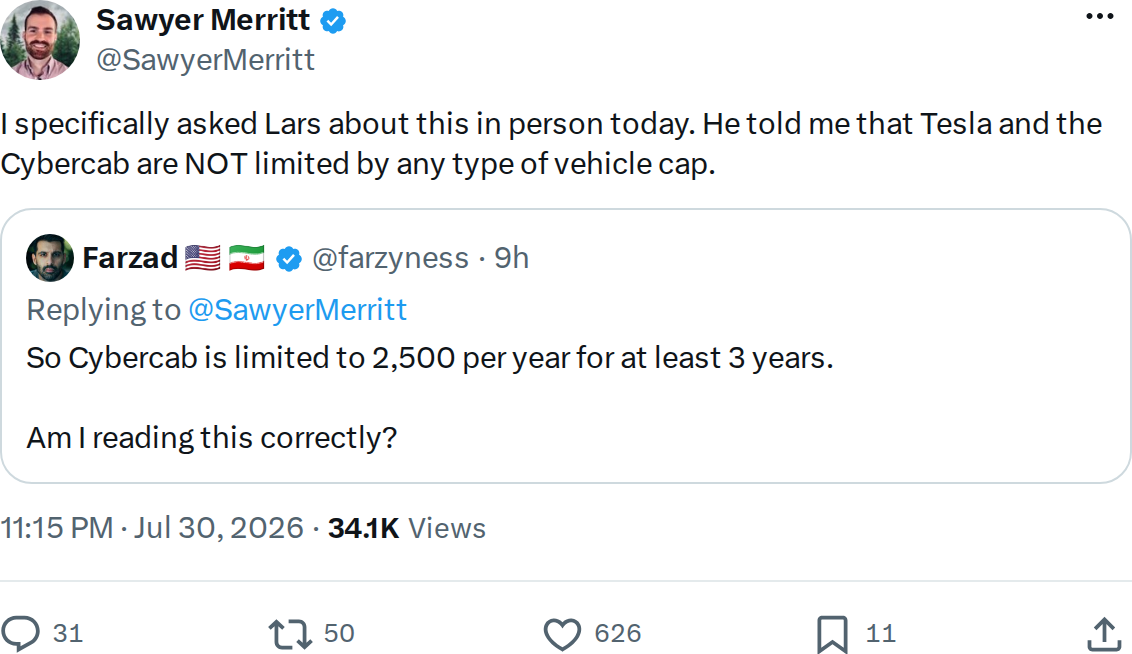
Tesla's Cybercab just got a significant regulatory green light — not from a government agency, but from Tesla's own engineering leadership. Sawyer Merritt reported Wednesday that Lars Moravy, Tesla's VP of Vehicle Engineering, confirmed in person that the Cybercab program is not subject to any vehicle production cap. For a robotaxi service that needs to operate at scale to be economically viable, that's a foundational piece of the puzzle falling into place.

1. There Is a Cap — Tesla Just Isn't Subject to It
The U.S. NHTSA imposes an annual production limit of 2,500 vehicles on autonomous vehicles that don't comply with standard Federal Motor Vehicle Safety Standards (FMVSS). That cap exists because non-compliant vehicles require a special exemption, and NHTSA limits those exemptions to protect public safety during early deployment. Most autonomous vehicle programs have had to navigate that ceiling carefully. Tesla's position is different.
2. Self-Certification Is the Key Mechanism
Rather than seeking an exemption from FMVSS — the route that triggers the 2,500-unit cap — Tesla designed the Cybercab to meet existing federal safety standards directly. This process, known as self-certification, is the same compliance pathway used by every conventional passenger vehicle sold in the U.S. If your vehicle meets the standards, you certify it yourself and there is no production ceiling. According to reporting from Tesla North, drone footage of Gigafactory Texas has already captured Cybercab units bearing official federal compliance stickers, covering safety, bumper, and theft prevention standards — physical evidence that the self-certification strategy is operational, not theoretical.
3. Moravy's Confirmation Is More Than a Restatement
Moravy had previously responded to a direct question about the 2,500-unit limit on X in April 2026 with a simple "No." Wednesday's in-person confirmation to Merritt carries more weight: it's a deliberate, on-the-record statement from the executive overseeing vehicle engineering, made as production is actively ramping. It signals that Tesla's legal and engineering teams are aligned on this position and that the company is confident enough in its compliance approach to state it publicly without qualification.
4. Production Has Already Started — and the Ramp Is Designed to Accelerate
Elon Musk confirmed during Tesla's Q1 2026 earnings call that Cybercab production had officially commenced at Gigafactory Texas. He described the initial trajectory as an "S-curve" — slow at first, then accelerating sharply. His exact framing: it would "ramp up and go kind of exponential towards the end of the year." With no regulatory ceiling constraining output, the limiting factors for how many Cybercabs Tesla can put on the road become purely operational: manufacturing throughput, fleet management infrastructure, and the pace of geographic expansion for the robotaxi service.
5. The Steering-Wheel Question Is Settled — For Now
The Cybercab is designed without traditional driver controls — no steering wheel, no pedals. Tesla has acknowledged it would add those controls if regulations required them, but Moravy's statement confirms that no such requirement is currently in play. The self-certification path means the vehicle's design, as it stands, satisfies federal standards. That's a notable contrast to other AV programs that have had to retrofit or redesign vehicles to meet regulatory demands. For Tesla, the engineering and the regulatory strategy appear to be moving in the same direction at the same time.
The absence of a production cap doesn't guarantee a smooth rollout — manufacturing execution, safety performance in the field, and public trust will all shape how quickly the Cybercab service actually scales. But removing the regulatory ceiling on unit volume is a prerequisite for any serious robotaxi business, and Tesla appears to have cleared that bar before the ramp has even begun in earnest.
🚕 Following the Robotaxi rollout? See every operating city, launch date and announced market in our Tesla Robotaxi Tracker.
Related Gear
Gear up your Tesla with tested, custom-fit BASENOR accessories — shop Tesla accessories →
Sources & reporting notes
The links below identify the material source records used for this report.
- @SawyerMerritt on X (2026-07-30T23:15:48.000Z) — Direct source
Source links are preserved as published or accessed. See our editorial standards and corrections policy.
The BASENOR Editorial Desk covers Tesla, SpaceX, and related technology, curating reporting from primary sources — official accounts, regulatory filings, and software release data. Every article passes source-record and fact-checking review before publication. About the newsroom.
This report was curated by the BASENOR Editorial Desk from the sources listed above. Read our editorial standards or email editorial@basenor.com to report an error.