During Tesla's most recent earnings call, VP of Vehicle Engineering Lars Moravy gave a notably direct answer to one of the most consequential regulatory questions hanging over the Cybercab program: Are there any remaining federal hurdles? His answer — a flat no. Here's what that confirmation actually means, and what's still left to sort out before Robotaxi operations scale nationally.

What exactly did Lars Moravy confirm?
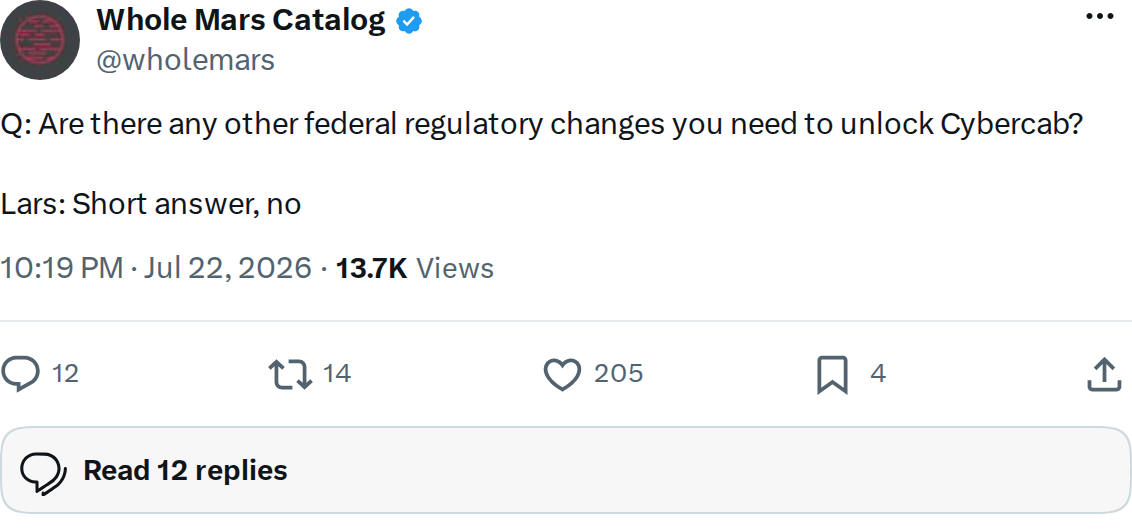
On the earnings call, an analyst asked whether Tesla needs any additional federal regulatory changes to unlock Cybercab operations. Moravy's response, as captured by @wholemars: "Short answer, no." That's a significant statement — it means the federal pathway for deploying the Cybercab as a commercial Robotaxi is, in Tesla's assessment, already clear.
How did Tesla clear the federal production cap that blocked other AV makers?
The key obstacle for most autonomous vehicle manufacturers has been NHTSA's 2,500-vehicle annual production cap for AVs that don't meet standard Federal Motor Vehicle Safety Standards. Tesla sidestepped this entirely by engineering the Cybercab to comply directly with updated FMVSS through self-certification — the same process used for conventional vehicles. No special exemption from NHTSA was required, which means no production ceiling applies.
Has the Cybercab also cleared environmental compliance?
Yes. According to public records, the Cybercab received an EPA Certificate of Conformity for the 2026 model year, effective May 26, 2026. It's classified as a battery-electric Zero Emission Vehicle, confirming full compliance with federal Clean Air Act emissions standards. That box is checked at the federal level.
If federal approvals aren't the issue, what could still slow the rollout?
State and municipal permitting remains the primary variable. Robotaxi operations require approval from individual state DMVs and, in many cases, city-level permits — a patchwork that varies significantly across the country. Tesla has already expanded unsupervised Robotaxi service to Miami, Orlando, and Tampa in Q2 2026, adding to existing operations in Austin, Dallas, and Houston, but each new market still requires local authorization. Federal clearance removes a ceiling; it doesn't automatically open every city.
Where does Cybercab production stand right now?
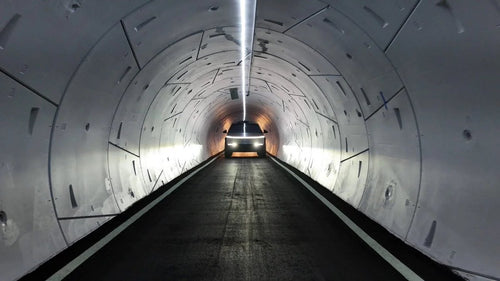
Pilot production began at Gigafactory Texas in February 2026, with the official production start announced in April 2026. Tesla is targeting volume production before the end of 2026, with an eventual annual capacity goal of 2 million units across multiple factories. The vehicle itself is a two-passenger, fully autonomous design — no steering wheel, no pedals — with a target price under $30,000 according to previous statements from Elon Musk.
How much real-world Robotaxi data does Tesla have so far?
Tesla reported 2.4 million cumulative paid Robotaxi miles as of Q2 2026, with roughly 900,000 of those miles logged in that quarter alone. That pace of accumulation matters: it's the dataset Tesla is using to refine unsupervised FSD performance ahead of broader geographic expansion. The federal green light from Moravy means that scaling is now primarily an operational and state-by-state regulatory challenge, not a Washington problem.
🚕 Following the Robotaxi rollout? See every operating city, launch date and announced market in our Tesla Robotaxi Tracker.
Related Gear
Gear up your Tesla with tested, custom-fit BASENOR accessories — shop Tesla accessories →
Sources & reporting notes
The links below identify the material source records used for this report.
- @wholemars on X (2026-07-22T22:19:25.000Z) — Direct source
Source links are preserved as published or accessed. See our editorial standards and corrections policy.
The BASENOR Editorial Desk covers Tesla, SpaceX, and related technology, curating reporting from primary sources — official accounts, regulatory filings, and software release data. Every article passes source-record and fact-checking review before publication. About the newsroom.
This report was curated by the BASENOR Editorial Desk from the sources listed above. Read our editorial standards or email editorial@basenor.com to report an error.