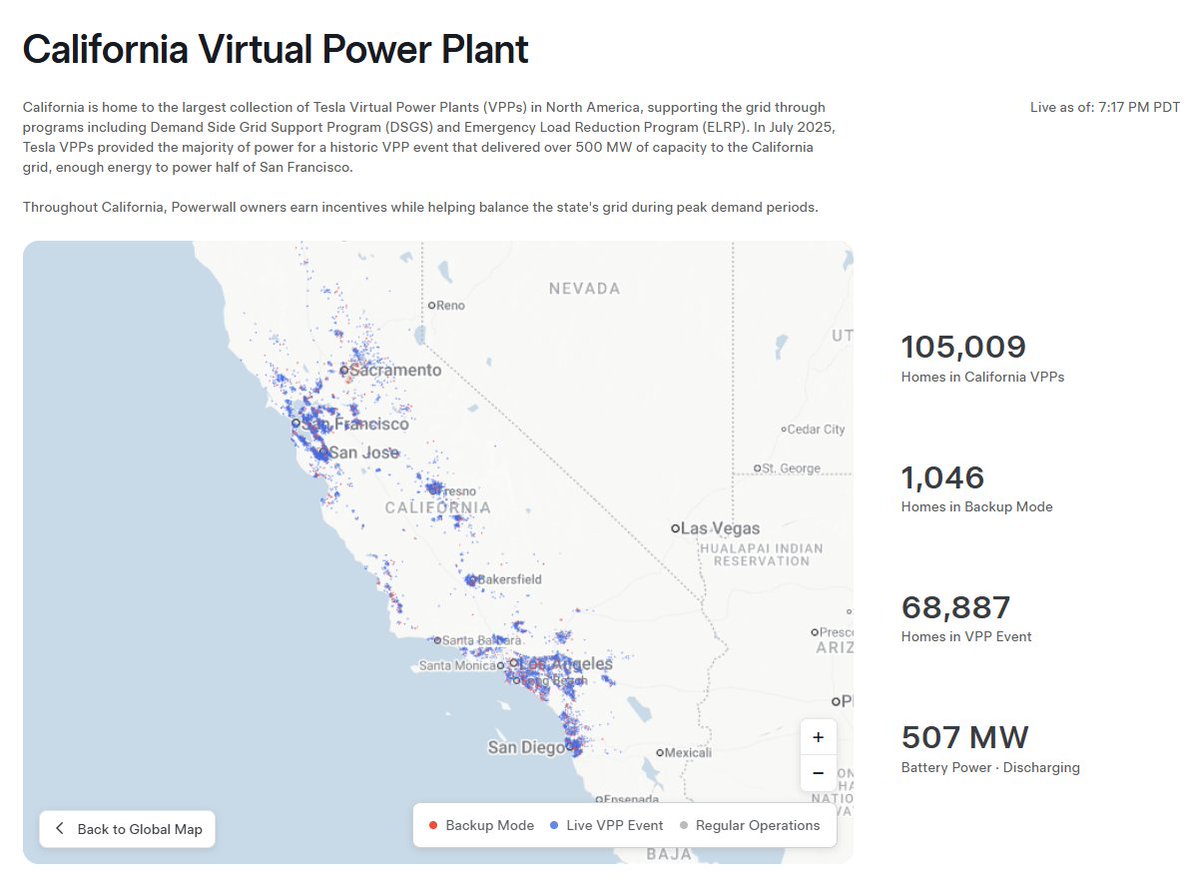
Tesla Energy confirmed late Tuesday that roughly 69,000 Powerwall owners across California simultaneously dispatched more than 500 MW to the state's grid, helping the California ISO meet peak evening demand during an ongoing heatwave. The event, streamed live by Tesla, is one of the largest coordinated residential battery dispatches on record and effectively replaced the output of a mid-sized natural gas peaker plant — using hardware already installed in customers' homes.
Elon Musk amplified the announcement shortly after, calling it a demonstration of Tesla's "virtual powerplant grid stabilization system." The event underscores how quickly distributed home batteries have grown into a serious grid resource in California, one of the most stressed electricity markets in the country during late-summer heat events.

What Happened
According to Tesla Energy's post, about 69,000 California Powerwall households discharged stored energy back to the grid during the evening peak on September 9. The combined output topped 500 MW — a figure Tesla noted is "equivalent to the output of a power plant, but from Powerwalls already in people's homes."
The dispatch was triggered under California's demand-response frameworks that pay residential battery owners to send stored solar energy back to the grid when the ISO signals stress conditions. Owners typically retain a user-defined reserve so their homes remain backed up if the grid actually fails during or after the event.
How We Got Here
Tesla's California VPP has scaled rapidly. According to reporting from Latitude Media and Utility Dive, a July 29, 2025 event saw more than 100,000 residential batteries across multiple aggregators discharge simultaneously, delivering an average of 539 MW over two hours during the evening peak. Tesla was the largest OEM in that test, with Powerwall households alone contributing close to 500 MW.
The programs behind these events — primarily California's Demand Side Grid Support (DSGS) Program and the Emergency Load Reduction Program (ELRP) — were designed after the state's 2020 rolling blackouts to pull flexible demand and distributed storage into the grid operator's toolkit. What started as a pilot with a few thousand Powerwalls has grown into a resource that now rivals mid-sized generation assets in dispatchable capacity.
Key Figures
| Metric | Value |
|---|---|
| Powerwall households dispatching | ~69,000 |
| Peak dispatch during event | 500+ MW |
| Equivalent generation | Mid-sized gas plant |
| Prior benchmark (July 29, 2025) | 539 MW avg over 2 hrs |
| Enabling programs | DSGS, ELRP |
Why This Matters for Powerwall Owners
California is the most mature market for Tesla's VPP, but the model is spreading — Texas, Colorado, Puerto Rico, and several New England utilities now run some form of Powerwall-based grid service. If you own a Powerwall in California and are enrolled in a participating program, tonight's dispatch is exactly what you signed up for: your battery earned compensation for exporting energy at the moment the grid needed it most, while retaining your backup reserve.
For owners not yet enrolled, events like this strengthen the economic case. The more frequently VPP events fire during summer peaks, the shorter the effective payback window on a Powerwall — and the more predictable the annual revenue side of the ownership math becomes. Tesla has been steadily expanding eligibility and simplifying enrollment through the mobile app, and utilities are widening the pool of qualifying households under DSGS.
What to Watch Next
Three signals worth tracking as this VPP season plays out:
- Frequency of dispatch events. California typically sees the heaviest VPP activity in August and September. How many more times the fleet is called before autumn will shape the annual earnings picture for enrolled owners.
- Total enrolled Powerwalls. The 69,000-household figure is a snapshot. Tesla's July 2025 disclosures pointed to well over 100,000 residential batteries participating statewide across all OEMs — the Tesla-specific number should keep climbing as new Powerwall 3 installations come online.
- Program expansion outside California. ERCOT (Texas) and ISO-New England are the most likely near-term expansion markets. Any formal DSGS-style program launch in those regions would meaningfully expand the addressable VPP fleet.
Editor's View
The headline number — 500 MW from home batteries — is easy to dismiss as a marketing moment, but the underlying shift is real. Five years ago, distributed residential storage was a footnote in grid planning conversations. Tonight, roughly 69,000 garages and side yards in California just did the job of a natural gas peaker. That's not a demo. That's infrastructure.
The interesting question isn't whether VPPs work — this event settles that. It's how fast utilities and regulators outside California move to build the same programs, and whether Tesla can keep its OEM lead as competing home batteries scale up. Watch the second half of 2026 closely.
Related Gear
Gear up your Tesla with tested, custom-fit BASENOR accessories — shop Tesla accessories →
Sources & reporting notes
The links below identify the material source records used for this report.
- @teslaenergy on X (2026-09-10T02:26:34.000Z) — Direct source
- @teslaenergy on X (2026-09-10T02:26:35.000Z) — Direct source
- @elonmusk on X (2026-09-10T02:58:00.000Z) — Direct source
Source links are preserved as published or accessed. See our editorial standards and corrections policy.
The BASENOR Editorial Desk covers Tesla, SpaceX, and related technology, curating reporting from primary sources — official accounts, regulatory filings, and software release data. Every article passes source-record and fact-checking review before publication. About the newsroom.
This report was curated by the BASENOR Editorial Desk from the sources listed above. Read our editorial standards or email editorial@basenor.com to report an error.