📌 UPDATE — August 17, 2026
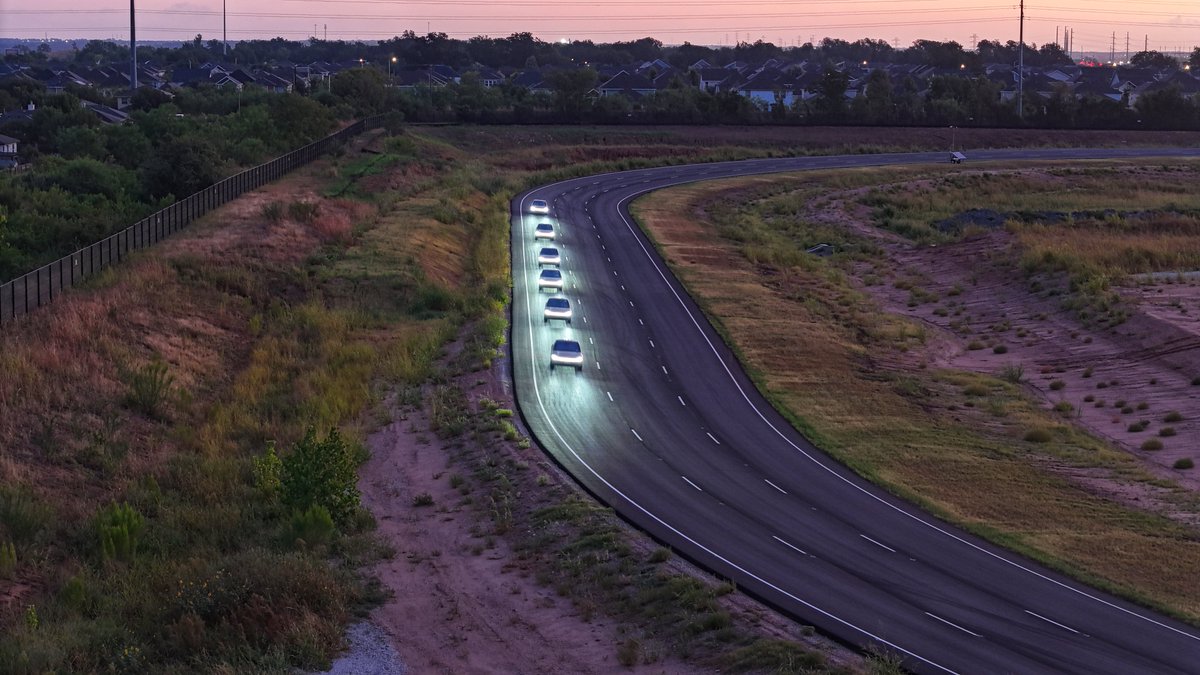
Tesla appears to be ramping toward a public Cybercab launch in Austin as early as this month, according to a report from Grace Ihle at The Information. The timing aligns with a dramatic surge in activity at Giga Texas: Joe Tegtmeyer observed more Cybercabs on the test track and in staging than he has ever seen, describing a "conga line" of vehicles circling the Operations Center. New Supercharger infrastructure is also being installed at the site, strongly suggesting the elevated testing cadence is here to stay as Tesla prepares for commercial-scale fleet operations.
@wholemars · Aug 17, 2026
"Tesla is gearing up for a public launch of Cybercab in August in Austin, Texas, @graceihle with @theinformation reports"

📸 Joe Tegtmeyer — Cybercab conga line at Giga Texas, Aug 17, 2026. New Supercharger stalls visible in staging area.
Tesla's Cybercab program doesn't clock out when the sun goes down. Early on the morning of August 12, prolific Giga Texas observer Joe Tegtmeyer arrived on site in time to catch multiple Cybercabs working through laps on the factory test track in the dark — headlights on, autonomy stack presumably engaged. It's the clearest confirmation yet that Tesla is pushing round-the-clock validation ahead of the Cybercab's commercial launch.

What the Sightings Actually Tell Us
Night testing is operationally significant. Autonomous systems face a distinct challenge set after dark — sensor calibration under artificial lighting, edge-case object detection, and the kind of low-contrast scenarios that stress perception models differently than daylight driving. The fact that Tesla is running Cybercabs on the track before sunrise suggests the validation program has matured well beyond basic daytime shakedowns.
Tegtmeyer also noted a large number of Cybercabs sitting in the outbound lot — vehicles staged and ready for either further testing or early logistics preparation. According to background reporting, Tesla commenced volume production of the Cybercab at Giga Texas in April 2026, so the inventory building up in that lot reflects genuine manufacturing throughput, not just prototype units.

The Starlink Hatch Is Still Absent From Most Units
The more telling detail in Tegtmeyer's August 12 snapshot report: none of the Cybercabs he observed this morning carried the Starlink hatch modification that had appeared on select units in earlier sightings. That's worth paying attention to. It means the Starlink integration — which would give the Cybercab a direct satellite connectivity path independent of cellular infrastructure — is still being evaluated on a subset of vehicles rather than rolled out fleet-wide.
This kind of staggered hardware iteration is standard Tesla practice. A modification gets fitted to a handful of test units, accumulates real-world data, then either gets refined or green-lit for broader production. The absence of the Starlink hatch on the majority of cars in the lot today doesn't mean it's been dropped — it more likely means it hasn't cleared that internal bar yet.
Reading the Pace of Development
Taken together, these two data points — intensive night-track testing plus a hardware modification still in selective trial — paint a program that is simultaneously further along than many expected and still actively iterating. Tesla isn't coasting toward launch; it's compressing the validation timeline by running vehicles around the clock and testing hardware variants in parallel.
Construction activity in multiple areas of the Giga Texas campus, also noted by Tegtmeyer, adds further context. The factory footprint is still expanding, which aligns with production ramp ambitions that would require significantly more floor space than the initial Cybercab line occupies today.
For anyone tracking the Cybercab rollout, the sunrise footage from Austin this morning is a useful calibration point: the hardware is real, the testing is serious, and the details — like which units get a Starlink hatch and which don't — are still being worked out in plain sight.
🚕 Following the Robotaxi rollout? See every operating city, launch date and announced market in our Tesla Robotaxi Tracker.
Related Gear
Gear up your Tesla with tested, custom-fit BASENOR accessories — shop Tesla accessories →
Sources & reporting notes
The links below identify the material source records used for this report.
- @JoeTegtmeyer on X (2026-08-12T14:50:17.000Z) — Direct source
- @JoeTegtmeyer on X (2026-08-12T14:57:34.000Z) — Direct source
Source links are preserved as published or accessed. See our editorial standards and corrections policy.
The BASENOR Editorial Desk covers Tesla, SpaceX, and related technology, curating reporting from primary sources — official accounts, regulatory filings, and software release data. Every article passes source-record and fact-checking review before publication. About the newsroom.
This report was curated by the BASENOR Editorial Desk from the sources listed above. Read our editorial standards or email editorial@basenor.com to report an error.