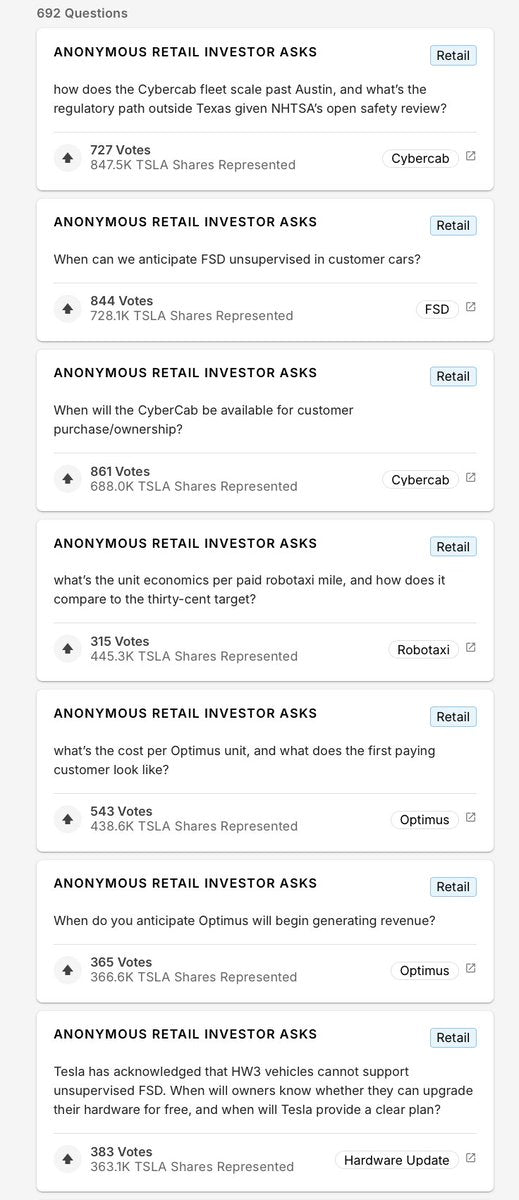
With Tesla's Q3 earnings call arriving this Wednesday, retail investors have made their priorities clear: the top question isn't about margins or deliveries — it's about whether the Cybercab can actually scale beyond Texas, and what NHTSA's open safety review means for that ambition. The gap between Austin's early success and a national robotaxi network runs directly through a regulatory gauntlet that Tesla has never faced before.

Where the Cybercab Stands Right Now
The Austin operation has moved faster than most analysts expected. According to verified reports, Tesla's Cybercab fleet in Austin surpassed 300 units as of mid-October — an eightfold increase in just 30 days. Combined with Model Y robotaxis running in parallel, the total Texas autonomous fleet sits at approximately 739 vehicles. Cybercabs have been observed operating fully unsupervised and picking up paying passengers, and Elon Musk has confirmed the first customer-owned Cybercab will be delivered before year-end.
Mass production at Gigafactory Texas began in April 2026, following a pilot phase that kicked off in February. The long-term production target — 2 million Cybercabs annually — signals that Tesla views this as a volume business, not a premium niche. Dallas has been identified as the next deployment city, though no launch date has been announced publicly.
The operational momentum is real. The regulatory picture is considerably more complicated.
Three Open NHTSA Files — and What They Mean
Tesla is currently navigating three distinct federal inquiries related to the Cybercab, each at a different stage and carrying different risk profiles for expansion.
Self-Certification Audit (AQ26002). On September 4, 2026, NHTSA opened a formal Audit Query specifically examining how Tesla self-certified the Cybercab as compliant with Federal Motor Vehicle Safety Standards. The core issue: the Cybercab has no steering wheel and no pedals, which means it cannot satisfy several FMVSS requirements written for human-operated vehicles. Tesla's position appears to be that those standards don't apply to a vehicle designed from the ground up for autonomous operation — a legal argument that hasn't been tested at this scale.
Special Order Documentation Demand. In late September, NHTSA escalated by issuing a Special Order requiring Tesla to hand over comprehensive technical documentation and engineering processes behind the Cybercab's safety certification. Special Orders carry legal weight; non-compliance isn't an option. The scope and timeline of Tesla's response will likely come up on Wednesday's call.
School Zone Speeding Investigation. On October 9, NHTSA opened a defect petition investigation into claims that 2026 model year Cybercabs and Model Y robotaxis exceed speed limits in active school zones while operating autonomously. The preliminary probe covers approximately 1,000 vehicles. This is the most operationally sensitive of the three: if NHTSA finds a defect, it could trigger a recall or operational restrictions that directly cap fleet growth.
NHTSA Open Actions — Cybercab
The Expansion Problem Outside Texas
Texas operates under a permissive autonomous vehicle framework — no state permit is required to deploy a driverless commercial service, which is precisely why Austin became the launch city. That regulatory luxury does not exist everywhere. California requires a Driverless Deployment Permit from the DMV and separate CPUC authorization for commercial passenger service. Other large markets have no AV framework at all, meaning Tesla would need to work with state legislators before a single Cybercab turns a wheel commercially.
The NHTSA self-certification question compounds this. If the federal agency ultimately determines that the Cybercab cannot legally self-certify under existing FMVSS rules — or imposes interim operational conditions — that ruling would apply nationally, not just in Texas. Any state-level expansion plan is effectively contingent on federal clarity that doesn't yet exist.
That's the crux of what investors want answered on Wednesday: Tesla can point to 300-plus Cybercabs running unsupervised in Austin, but the path from 739 Texas vehicles to a multi-city national fleet requires navigating a regulatory framework that was written for a different era of transportation. How Tesla's leadership frames that challenge — and whether they offer any concrete timeline for NHTSA resolution — will tell investors more about the robotaxi business than any production number.
🚕 Following the Robotaxi rollout? See every operating city, launch date and announced market in our Tesla Robotaxi Tracker.
Related Gear
Gear up your Tesla with tested, custom-fit BASENOR accessories — shop Tesla accessories →
Sources & reporting notes
The links below identify the material source records used for this report.
- @SawyerMerritt on X (2026-10-19T20:25:50.000Z) — Direct source
Source links are preserved as published or accessed. See our editorial standards and corrections policy.
The BASENOR Editorial Desk covers Tesla, SpaceX, and related technology, curating reporting from primary sources — official accounts, regulatory filings, and software release data. Every article passes source-record and fact-checking review before publication. About the newsroom.
This report was curated by the BASENOR Editorial Desk from the sources listed above. Read our editorial standards or email editorial@basenor.com to report an error.