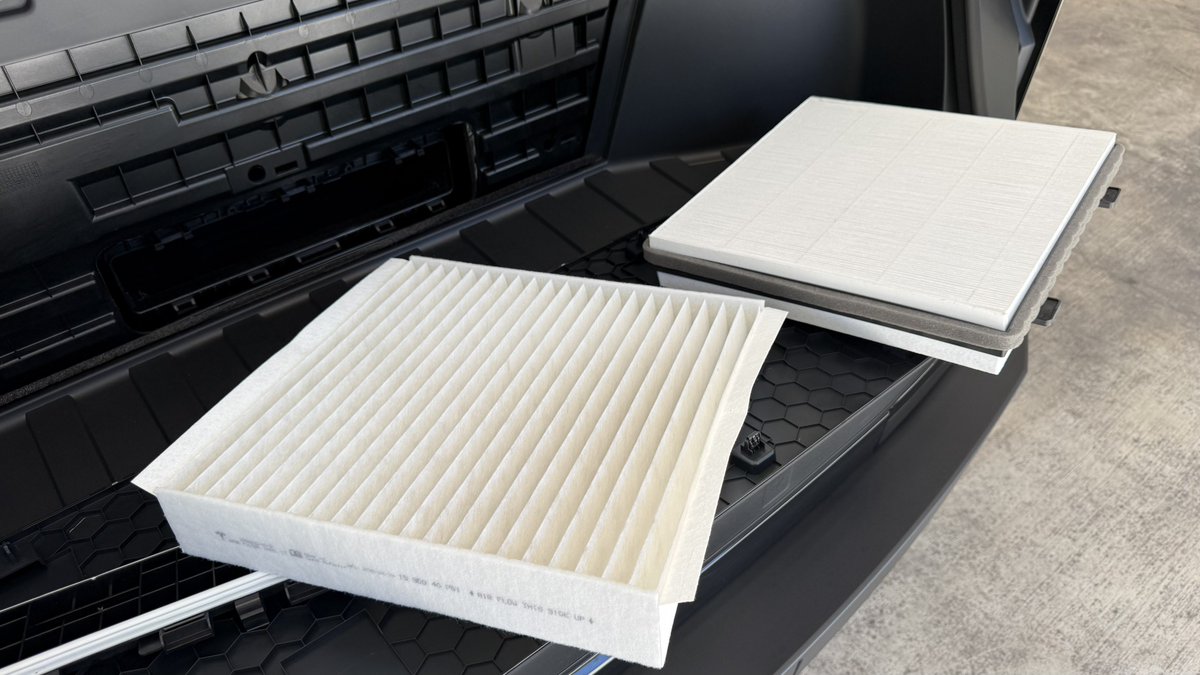
Side-by-side photos shared by teardown specialist Joe Tegtmeyer on Tuesday put the Cybertruck's cabin air filtration split into sharp focus: the Standard AWD model ships with a frameless pleated filter element, while the Premium AWD and Cyberbeast trims get a full medical-grade HEPA unit. It's a meaningful hardware difference that affects air quality, software features, and long-term ownership costs — and it's one Tesla doesn't exactly advertise on the spec sheet.


What the Photos Actually Show
Tegtmeyer's images are straightforward but telling. The Standard AWD filter is a bare pleated element — no rigid frame, no activated carbon layer, no structural housing beyond the filter media itself. It's functionally similar to what you'd find in a mainstream ICE vehicle. The Premium filter, by contrast, is a framed, multi-layer HEPA unit engineered to capture at least 99.97% of airborne particles down to 0.3 micrometers — that includes fine dust, pollen, mold spores, bacteria, and most virus particles. Many HEPA units for the Cybertruck also incorporate an activated carbon layer to scrub odors and harmful gases.
The visual gap between the two components is significant. The Standard filter is noticeably thinner and lighter. The Premium unit has the density and construction you'd associate with hospital-grade air handling equipment — which is essentially what Tesla's "Bioweapon Defense Mode" markets it as.
The Bioweapon Defense Mode Complication
The filtration hardware difference has a software consequence that Standard AWD owners should understand. Bioweapon Defense Mode — which pressurizes the cabin positively to prevent outside air from infiltrating through gaps — is a feature tied to the Premium and Cyberbeast trims. According to community research documented at Cybertruck Owners Club, the physical filter housing is consistent across all Cybertruck trims, which means a HEPA filter can be physically retrofitted into a Standard AWD. The blower motor is also engineered to handle HEPA-level airflow resistance, so hardware compatibility isn't the barrier.
The barrier is software. Bioweapon Defense Mode may not activate on a Standard AWD even after a HEPA filter is installed, absent a Tesla software unlock. That's a meaningful caveat for owners in wildfire-prone regions or high-pollution urban environments who are considering the upgrade path.
Trim-by-Trim Breakdown
| Trim | Filter Type | Bioweapon Defense Mode | Recommended Replacement |
|---|---|---|---|
| Standard AWD | Basic pleated element (no frame) | Not included | Standard cabin filter interval |
| Premium AWD | Medical-grade HEPA (framed, multi-layer) | Included | Every 2 years (Tesla recommendation) |
| Cyberbeast | Medical-grade HEPA (framed, multi-layer) | Included | Every 2 years (Tesla recommendation) |
Why This Matters Beyond the Spec Sheet
The Standard AWD Cybertruck launched as Tesla's entry point into the truck lineup — a lower-cost configuration designed to widen the addressable market. Trimming the cabin air filtration is a logical place to cut cost without affecting driving dynamics or range. But for owners who bought into the Cybertruck partly for its survivability narrative — the truck that can handle anything — discovering that Bioweapon Defense Mode is a trim-level feature rather than a universal one is worth knowing upfront.
The retrofit path exists, at least on the hardware side. Whether Tesla eventually unlocks the software feature for Standard AWD owners who install a HEPA filter — or offers it as a paid upgrade — remains an open question. Given Tesla's track record with feature unlocks on other platforms, it's not an unreasonable thing to watch for.
Related Gear
Gear up your Cybertruck with tested, custom-fit BASENOR accessories — shop Cybertruck accessories →
Sources & reporting notes
The links below identify the material source records used for this report.
- @JoeTegtmeyer on X (2026-08-19T11:04:21.000Z) — Direct source
Source links are preserved as published or accessed. See our editorial standards and corrections policy.
The BASENOR Editorial Desk covers Tesla, SpaceX, and related technology, curating reporting from primary sources — official accounts, regulatory filings, and software release data. Every article passes source-record and fact-checking review before publication. About the newsroom.
This report was curated by the BASENOR Editorial Desk from the sources listed above. Read our editorial standards or email editorial@basenor.com to report an error.