Tesla just spotlighted the engineering breakthroughs it introduced with the Cybertruck — and the list is more significant than most owners realize. Two systems in particular, the 48V low-voltage architecture and true Steer-by-Wire with rear-wheel steering, represent genuine departures from how the auto industry has built cars for decades. Here's what each one actually means.

What is 48V architecture, and why does it matter?
Most vehicles on the road today run their low-voltage systems — windows, door locks, touchscreens, lighting — on a 12V electrical system that dates back to the 1950s. The Cybertruck scraps that entirely in favor of a 48V lithium-ion low-voltage battery. Because voltage and current are inversely related for the same power output, running at 48V means the system draws four times less current than a 12V equivalent. Less current means the wiring can be physically thinner and lighter, and it generates significantly less heat, which improves efficiency across the board. According to Tesla, 48V connectors are colored blue for easy identification, and 48V wires are marked with blue tape. The practical payoff is a cleaner, lighter wiring harness throughout the truck — and Tesla has confirmed this architecture will carry forward into all future models.
What makes the Cybertruck's steering system different from a normal power steering setup?
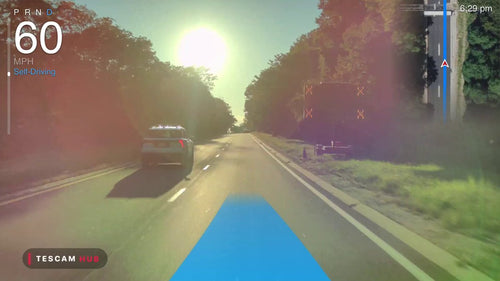
Conventional power-assisted steering — even the electric power steering found in most modern EVs — still maintains a physical mechanical link between the steering wheel and the front wheels. If the electronics fail, the mechanical connection remains. The Cybertruck's Steer-by-Wire system eliminates that link entirely. Steering inputs from the wheel are read by sensors in the steering column and transmitted electronically to actuators on the steering racks. There is no shaft, no intermediate shaft, no rack-and-pinion connected to the wheel you're turning. According to Tesla's engineering documentation, the entire lock-to-lock rotation is just 340 degrees — 170 degrees in each direction — meaning you never need more than roughly half a turn to reach full steering lock in either direction.
How does Tesla make Steer-by-Wire safe without a mechanical backup?
This is the obvious question, and Tesla's answer is aerospace-grade redundancy. The system uses triple-redundant position sensors and dual-redundant power supplies, power converters, controllers, and communication buses. Critical signals travel over a dual-redundant 48V Ethernet loop. In the event of a fault, the Cybertruck is designed to alert the driver, sound a chime, and gradually reduce drive torque to prompt a safe stop — rather than losing steering abruptly. The architecture mirrors the approach used in fly-by-wire aircraft, where redundancy replaces the mechanical backup rather than supplementing it.
What does the variable steering ratio actually feel like?
Because there's no fixed mechanical ratio between wheel and road, the Cybertruck's steering response is software-defined and speed-dependent. At low speeds — parking lots, tight maneuvers — a small steering wheel input produces a large wheel angle, making the truck feel far more agile than its size suggests. At highway speeds, the ratio tightens up for stability. This is the same concept as variable-ratio steering on some luxury sedans, but implemented entirely in software rather than through a variable mechanical rack.
How does rear-wheel steering change the Cybertruck's real-world handling?
The Cybertruck's rear wheels can move up to 10 degrees. At low speeds, the rear wheels turn in the opposite direction to the front wheels — effectively shortening the vehicle's turning radius by reducing the functional wheelbase. According to Tesla's specifications, this produces a turning circle of approximately 43.5 feet (13.25 meters), which is tighter than a Tesla Model S and tighter than the Ford F-150 Lightning at 47.8 feet. For a truck with the Cybertruck's footprint, that's a meaningful real-world advantage in parking structures and urban environments. At higher speeds, the rear wheels turn in the same direction as the front wheels, which reduces body roll during lane changes and improves high-speed stability.
Will these systems come to other Tesla models?
The 48V architecture is already confirmed for all future Tesla vehicles — it's a platform decision, not a Cybertruck exclusive. Steer-by-Wire hasn't been officially announced for other models yet, but the Cybertruck's role as Tesla's engineering testbed makes it the logical first deployment before broader rollout. The combination of 48V wiring and software-defined steering represents a significant reduction in mechanical complexity, which aligns with Tesla's broader manufacturing philosophy of replacing hardware with software wherever safety allows.
Related Gear
Gear up your Cybertruck with tested, custom-fit BASENOR accessories — shop Cybertruck accessories →
Sources & reporting notes
The links below identify the material source records used for this report.
- @Tesla on X (2026-09-10T18:46:04.000Z) — Direct source
Source links are preserved as published or accessed. See our editorial standards and corrections policy.
The BASENOR Editorial Desk covers Tesla, SpaceX, and related technology, curating reporting from primary sources — official accounts, regulatory filings, and software release data. Every article passes source-record and fact-checking review before publication. About the newsroom.
This report was curated by the BASENOR Editorial Desk from the sources listed above. Read our editorial standards or email editorial@basenor.com to report an error.