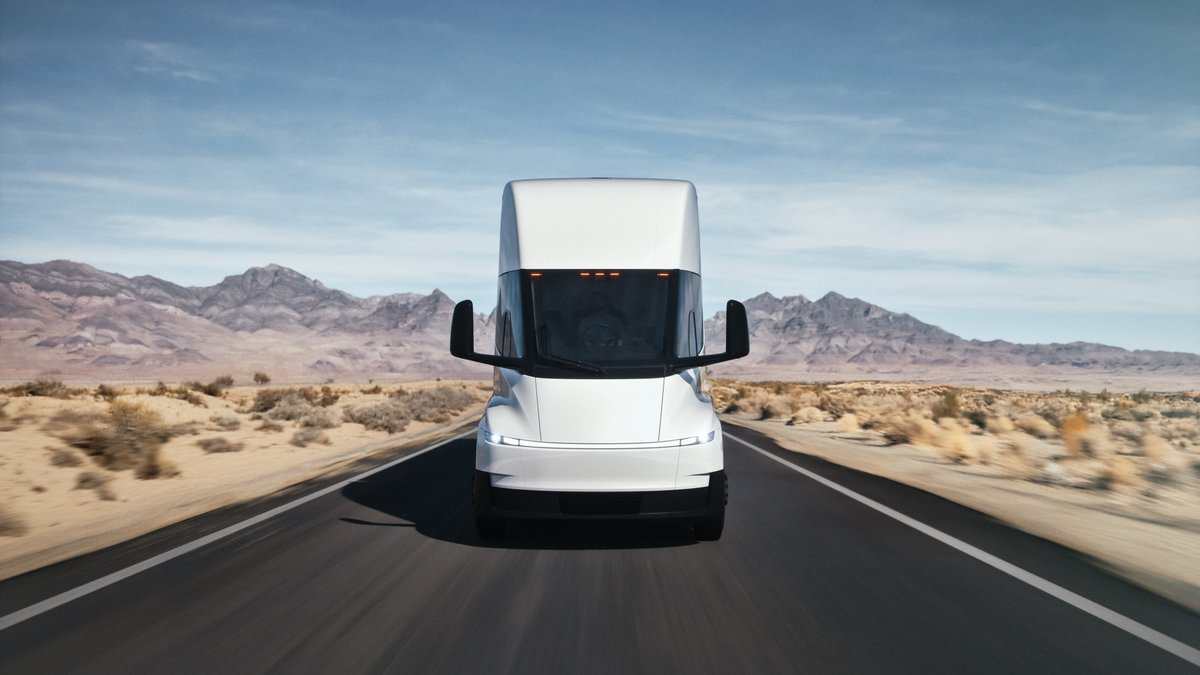
Swedish freight-tech company Einride just placed what appears to be the single largest order for the Tesla Semi ever announced: 500 electric heavy-duty trucks, valued at roughly $125 million based on Einride's own figure. The trucks will run under Einride's Saga AI fleet intelligence platform, hauling for Amazon and other customers along freight corridors in California, Texas, New Jersey, Illinois, and Georgia. For a program that Tesla has publicly said very little about in 2026, it's the biggest external validation the Semi has received to date.

What Einride Announced
According to Einride's release and reporting from Teslarati and Electrek, the 500-truck deployment will roll out in phases over 24 months, starting September 2026. The order will triple Einride's currently deployed electric truck fleet and is being fully financed through third-party arrangements — meaning Einride is not putting $125M+ of its own balance sheet on the line to buy the trucks outright.
Sawyer Merritt's post — which triggered the wider news cycle — pegged the deal at approximately $125 million. Independent estimates from trucking industry outlets put the sticker value somewhat higher: with Tesla's April 2026 pricing of about $260,000 for the standard-range Semi and $290,000 for the long-range version, a 500-truck mix comes out to roughly $130–145 million, according to trucknews.com and theevreport.com. Einride has not officially disclosed the financial terms.
Key Figures
| Metric | Value |
|---|---|
| Trucks ordered | 500 |
| Announced deal value | ~$125 million |
| Independent estimate | $130–145 million |
| Deployment start | September 2026 |
| Rollout window | 24 months, phased |
| Fleet multiplier for Einride | 3x current electric fleet |
| Financing | 100% third-party |
Why the Saga AI Layer Matters
The trucks themselves aren't the whole story. Einride is not a traditional carrier — it positions itself as a freight orchestration platform, and Saga AI is the software layer that plans routes, matches loads, and optimizes energy use across an electric fleet. Wrapping 500 Semis in that platform is what turns this from a bulk vehicle purchase into a competitive offering aimed at large shippers.
Amazon is the anchor customer named in the announcement, which is meaningful for two reasons. First, Amazon already operates a large Rivian electric van fleet for last-mile, but its middle-mile linehaul work has stayed diesel-heavy. Bringing Tesla Semis into corridors between Amazon fulfillment centers is a real dent in that. Second, the named states — California, Texas, New Jersey, Illinois, Georgia — line up with dense Amazon logistics geography and existing or planned Megacharger sites.
The Production Question Tesla Still Hasn't Answered
Here's the tension. Einride is committing to a September 2026 deployment kickoff with a two-year rollout. Tesla, meanwhile, has been unusually opaque about Semi production. Per Tesla's own disclosures, the first Semi off the "high-volume line" at the new Nevada factory was reported on April 29, 2026, though the Q1 shareholder deck still described that phase as pilot production. The Q2 update on July 22, 2026 said the Semi "remains on track for production this year," and Elon Musk stated on the same earnings call that Tesla had started Semi production. Tesla has not published official Semi delivery or production numbers, and it has not reconciled the pilot-vs-volume language.
An order of 500 units, phased over 24 months, works out to an average of roughly 20 trucks per month to Einride alone. That is not a taxing number for a real high-volume line, but it is a large number if the Nevada facility is still ramping. The Einride deal effectively puts a public schedule on Tesla's Semi output — something the automaker has been reluctant to do itself.
What It Means for Tesla Owners and Investors
For consumer Tesla owners, the direct impact is limited — the Semi program does not share manufacturing capacity with Model 3, Model Y, or Cybertruck. But there are two indirect effects worth watching.
First, the Semi's Megacharger network expansion (the 1MW+ chargers required for the truck) is being deployed along the same interstate corridors that Supercharger travelers use. As Semi volumes ramp, Tesla has a stronger business case to accelerate 500kW-and-above buildout in those states, which benefits high-power passenger charging over time. Second, Semi revenue and gross margin are still an unknown line item in Tesla's financials. A confirmed, financed 500-unit customer with a named anchor shipper is the kind of data point analysts have been asking for on every earnings call since 2023.
What to Watch Next
- September 2026 first deliveries: Whether the initial batch actually starts moving freight on schedule, and in which of the five states first.
- Q3 2026 Tesla earnings (late October): Whether Tesla breaks out Semi units delivered — the Einride deal makes it harder to keep those numbers vague.
- Megacharger buildout: Public permits and utility filings for 1MW charging along the I-5, I-10, I-80, and I-95 corridors.
- Follow-on orders: PepsiCo, Saia, Sysco, and Costco have all done Semi pilots. Einride's order likely reprices what a "serious" Semi commitment looks like — expect other fleets to move from pilot to firm order.
Einride's announcement doesn't answer every question about where the Tesla Semi program is going, but it does something Tesla itself hasn't managed in three years: it puts a real customer, a real number, and a real timeline on the truck. The next test is whether Nevada can deliver.
Related Gear
Gear up your Tesla with tested, custom-fit BASENOR accessories — shop Tesla accessories →
Sources & reporting notes
The links below identify the material source records used for this report.
- @SawyerMerritt on X (2026-08-18T14:30:42.000Z) — Direct source
Source links are preserved as published or accessed. See our editorial standards and corrections policy.
The BASENOR Editorial Desk covers Tesla, SpaceX, and related technology, curating reporting from primary sources — official accounts, regulatory filings, and software release data. Every article passes source-record and fact-checking review before publication. About the newsroom.
This report was curated by the BASENOR Editorial Desk from the sources listed above. Read our editorial standards or email editorial@basenor.com to report an error.