The News: Every Tesla rolling off the line ships with the hardware needed to run Full Self-Driving — steering wheel or not. Software, not silicon, is the gating factor for autonomy.
Why It Matters: This hardware-first strategy is what allows Tesla to extend FSD to lower-cost vehicles like the Cybercab, potentially bringing unsupervised autonomy to a mass-market price point for the first time.
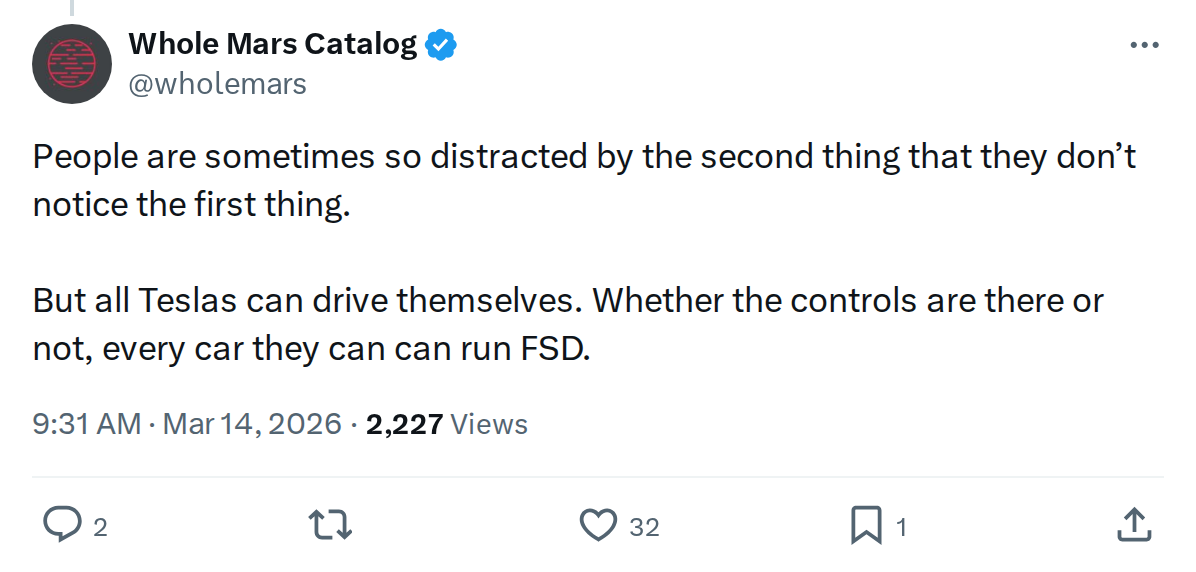
Source: @wholemars on X
The Point Everyone Keeps Missing
There's a detail buried inside Tesla's product strategy that most people scroll right past. While the automotive world debates steering wheels, pedals, and robotaxi permits, Tesla has already answered the hardest question: every car they build can run FSD. The controls are secondary. The capability is already there.
That's the observation Whole Mars Catalog surfaced this week — and it's worth sitting with for a moment.

The implication is significant. Tesla doesn't build two classes of vehicle — one for autonomous operation and one for human driving. They build one platform, and software determines what it can do at any given moment. Whether you're in a Model 3 with a steering wheel or a Cybercab without one, the underlying compute and sensor architecture is designed for the same job.
Hardware as a Foundation, Software as the Unlock
To understand why this matters, it helps to know where Tesla's hardware stands today. Since January 2023, every new Tesla has shipped with Hardware 4 (HW4) — Tesla's current FSD compute platform. FSD v14, built on a neural network roughly 10x larger than its predecessor, launched for HW4 vehicles in October 2025. The gap between what the hardware can theoretically do and what the software currently enables is the story of Tesla's entire autonomy roadmap.
There's an important asterisk here for older owners: vehicles built between 2019 and 2022 on Hardware 3 (HW3) face real limitations. Tesla confirmed in early 2025 that HW3 cannot support future FSD versions, and while FSD v14 Lite is targeted for HW3 vehicles in Q2 2026, the long-term upgrade path for HW3 owners who purchased FSD remains an open question without a clear official resolution. The 'all Teslas can run FSD' framing applies cleanly to current production vehicles — HW4 and beyond.
Looking further ahead, Hardware 5 (AI5) — described as the final hardware iteration Tesla intends to install in vehicles — has been pushed to early 2027 after multiple timeline revisions. The Cybercab is expected to ship with an upsized version of AI5, positioning it as the most capable autonomous platform Tesla has built.
Cybercab: The Model 3 Moment for Autonomy
The second tweet from Whole Mars Catalog makes the democratization argument explicit — and it's a compelling one.

The Model 3 and Model Y didn't just sell well — they repackaged what had been a $100,000 luxury product into something a middle-class family could actually buy. The Cybercab is being positioned to do the same thing for autonomy. Autonomous driving systems that previously required a ~$50,000 vehicle could arrive in a platform priced for buyers who can't come close to that number.
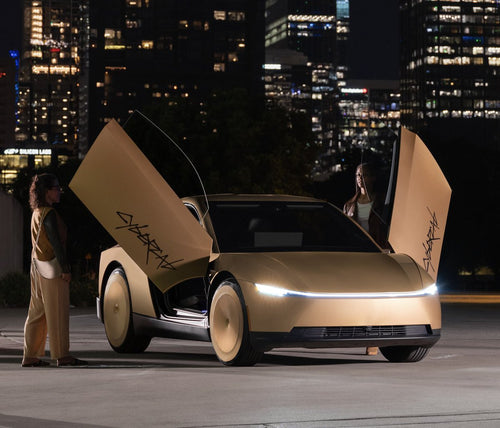
The Cybercab, unveiled in October 2024, is a dedicated robotaxi with no steering wheel and no pedals. It is entirely dependent on FSD software to operate. That's not a limitation — it's the point. By stripping out the human-control redundancies, Tesla can potentially hit a price point that makes autonomous mobility accessible to a far wider market than any prior autonomous vehicle program has reached.
📊 Key Figures
| Metric | Value | Context |
|---|---|---|
| FSD Subscription (Supervised) | $99/month | One-time purchase ended Feb 14, 2026 |
| FSD Unsupervised (speculated) | ~$299/month | $249/month with 6-month pre-pay (speculated) |
| HW4 shipping since | January 2023 | Current production standard across all models |
| FSD v14 Lite for HW3 | Q2 2026 target | Enables international FSD for HW3 vehicles |
| Hardware 5 (AI5) timeline | Early 2027 | Intended as final in-vehicle hardware iteration |
| Unsupervised FSD national rollout | End of 2026 (predicted) | Initially geofenced; Austin fleet already running autonomously |
🔭 The BASENOR Take
Timeline: FSD Unsupervised geofenced launch in Austin is underway internally. Nationwide U.S. rollout predicted by end of 2026. Cybercab deliveries expected to follow AI5 production ramp in 2027.
Impact Level: 🔴 High — affects every current Tesla owner's understanding of what their vehicle can become
Confidence: Hardware universality is confirmed Tesla policy. Cybercab pricing and timeline remain subject to change.
The strategic logic here is sound and underappreciated. Tesla's competitors build autonomous vehicles as separate, bespoke programs — expensive, slow to scale, and difficult to price accessibly. Tesla builds one hardware platform and deploys autonomy via software update. That means the fleet is always ready; the question is only when the software catches up.
For current HW4 owners, this is genuinely good news: your car is already hardware-capable for whatever FSD becomes. The subscription model — now the only way to access FSD after the one-time purchase option closed in February 2026 — is the ongoing unlock mechanism. For prospective buyers, it reframes the purchase decision: you're not just buying a car, you're buying into a platform that gets more capable over time.
The Cybercab angle is where this gets most interesting for the broader market. If Tesla can deliver a purpose-built autonomous vehicle at a price point significantly below $50,000, the addressable market for autonomy expands dramatically. That's not just a product launch — it's a potential inflection point for how urban transportation is priced and accessed. The Model 3 comparison isn't hyperbole; it's a reasonable historical parallel for what Tesla has done before and is explicitly trying to repeat. For more on how FSD is evolving across the fleet, see our FSD coverage.
📋 Tracking Tesla software? See every firmware, FSD and app version in one place in our Tesla Software Update Tracker.
🚕 Following the Robotaxi rollout? See every operating city, launch date and announced market in our Tesla Robotaxi Tracker.
Related Gear
Gear up your Tesla with tested, custom-fit BASENOR accessories — shop Tesla accessories →
Sources & reporting notes
The links below identify the material source records used for this report.
- @wholemars on X (2026-03-14T01:57:31.000Z) — Direct source
- @wholemars on X (2026-03-14T01:31:47.000Z) — Direct source
Source links are preserved as published or accessed. See our editorial standards and corrections policy.
The BASENOR Editorial Desk covers Tesla, SpaceX, and related technology, curating reporting from primary sources — official accounts, regulatory filings, and software release data. Every article passes source-record and fact-checking review before publication. About the newsroom.
This report was curated by the BASENOR Editorial Desk from the sources listed above. Read our editorial standards or email editorial@basenor.com to report an error.