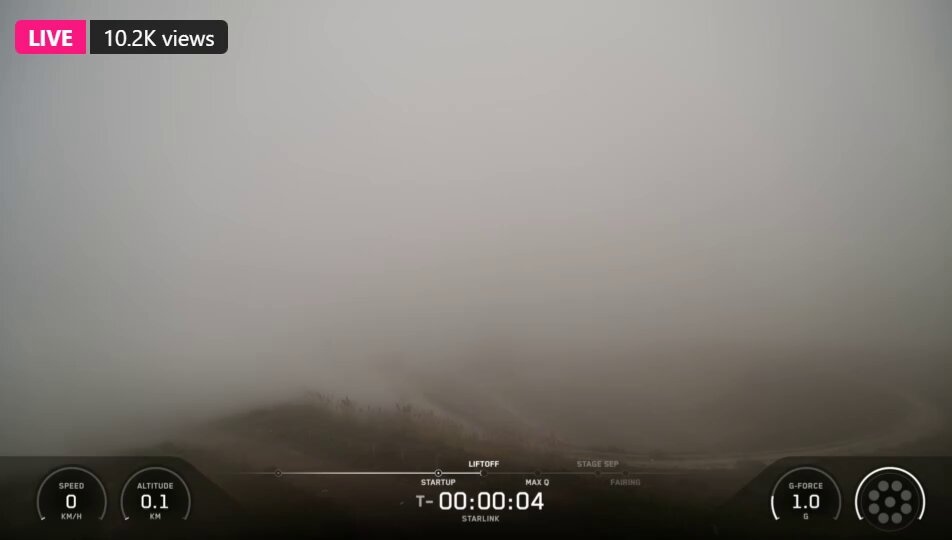
SpaceX launched its Starlink Group 17-53 mission from Vandenberg Space Force Base on August 4, landing booster B1063 for the 34th time aboard the Of Course I Still Love You droneship in the Pacific. NASASpaceflight's coverage captured the moment perfectly: no fanfare, just another Tuesday in low-Earth orbit operations. But the mundane surface of this launch is exactly what makes it worth examining closely.

1. 34 flights on a single booster is genuinely unprecedented in orbital rocketry
Before SpaceX proved out reusability at scale, the working assumption across the industry was that orbital-class boosters were single-use hardware. B1063 has now flown 34 times — each flight involving hypersonic reentry, grid-fin steering through the atmosphere, and a precision propulsive landing on a moving droneship. No other orbital rocket in history has approached this cadence on a single airframe. The booster is not a prototype; it is a production workhorse operating on what amounts to an airline maintenance schedule.
2. Twenty-four Starlink satellites rode this flight to low-Earth orbit
According to pre-launch information from SpaceX and tracking sources, the Starlink Group 17-53 payload comprised 24 satellites destined for low-Earth orbit. Each launch like this incrementally densifies the Starlink constellation, improving coverage and redundancy for subscribers globally. The cadence of these missions — multiple per month from both Vandenberg and Cape Canaveral — means the network is effectively a living infrastructure project, continuously expanding in the background.
3. SLC-4E at Vandenberg handles the high-inclination orbits the Cape cannot
The choice of Space Launch Complex 4 East at Vandenberg Space Force Base is not incidental. Launches from Vandenberg fly over the Pacific on southward trajectories, reaching higher-inclination orbits that provide better polar and mid-latitude coverage. The Cape's geometry favors equatorial and lower-inclination paths. SpaceX running parallel launch cadences from both coasts is a deliberate infrastructure decision — it doubles throughput and ensures Starlink can serve latitudes that an exclusively Florida-based operation would cover less efficiently.
4. The droneship landing is the quiet engineering achievement most people scroll past
Landing on Of Course I Still Love You — a ship moving in open ocean — requires the booster to execute a controlled burn, deploy grid fins, and touch down on a platform roughly the size of a football field after separating from the second stage at altitude and re-entering the atmosphere. The fact that this now reads as a footnote in a launch report is the point. Routine reliability at this level took years of iterative failure and redesign to achieve, and it is the foundational capability that makes the economics of Starlink possible.

5. NSF's Starship projection is the real story buried in the landing post
NASASpaceflight's post-landing comment — "Now apply this to Starship in the 2030s, with both stages returning and reflying" — is worth sitting with. Falcon 9's reusability covers the first stage only; the upper stage is expended on every flight. Starship is designed for full stack reusability, with both the Super Heavy booster and the Ship upper stage intended to return and fly again. If Starship achieves even a fraction of Falcon 9's demonstrated reliability at 34 flights, the cost-per-kilogram economics of reaching orbit change by an order of magnitude. That is the trajectory B1063's landing quietly points toward.
For SpaceX coverage including Starlink and Starship milestones, see our SpaceX coverage.
🚀 Following the Starship program? See every test flight, official outcome and the next launch window in our SpaceX Starship Tracker.
Sources & reporting notes
The links below identify the material source records used for this report.
- @NASASpaceflight on X (2026-08-04T17:05:53.000Z) — Direct source
- @NASASpaceflight on X (2026-08-04T17:13:53.000Z) — Direct source
Source links are preserved as published or accessed. See our editorial standards and corrections policy.
The BASENOR Editorial Desk covers Tesla, SpaceX, and related technology, curating reporting from primary sources — official accounts, regulatory filings, and software release data. Every article passes source-record and fact-checking review before publication. About the newsroom.
This report was curated by the BASENOR Editorial Desk from the sources listed above. Read our editorial standards or email editorial@basenor.com to report an error.