📌 UPDATE — July 29, 2026
Tesla has launched the 8th wave of the FSD 14.3.6 rollout, now bundled within software version 2026.20.6.11. Notably, this wave also brings FSD v14 Lite to Hardware 3 vehicles, expanding access to the v14 generation beyond HW4-equipped cars. If you haven't received the update yet, this latest wave significantly widens the pool of eligible owners.

📌 UPDATE — July 27, 2026
Tesla has launched a 7th wave of the FSD 14.3.6 rollout, now bundled within the 2026.20.6.11 software release. Notably, this wave also brings FSD v14 Lite to Hardware 3 (HW3) vehicles, expanding the v14 experience to owners who haven't yet upgraded to HW4. If you're on HW3 and haven't received the update yet, your car may be in the queue — keep an eye on your Tesla app.

📌 UPDATE — July 26, 2026
Tesla has kicked off the 6th wave of the FSD 14.3.6 rollout, expanding access to more vehicles as part of the 2026.20.6.11 software release. Notably, this wave also brings FSD v14 Lite to owners still running Hardware 3, marking a meaningful expansion of the v14 generation beyond HW4-equipped cars. If you haven't received the update yet, this latest push significantly widens the pool — check your Tesla app for a pending install.

📌 UPDATE — July 23, 2026
FSD 14.3.6 is now in its 4th rollout wave, arriving via OTA version 2026.20.6.11. Notably, this wave also brings FSD v14 Lite to Hardware 3 (HW3) vehicles — meaning owners on older hardware can now access the v14 stack for the first time. If you haven't received the update yet, this latest wave significantly expands the pool of eligible vehicles, so check your Tesla app.

📌 UPDATE — July 23, 2026
Not all early impressions of FSD 14.3.6 are glowing. Tesla owner and YouTuber Dirty Tesla (@DirtyTesLa) reports persistent unnecessary brake tapping on the latest build — a behavior visible in the FSD visualization as the "blue tentacle" repeatedly extending and retracting. Each retraction corresponds to the car briefly applying the brakes without a clear reason, creating an uneven, choppy ride feel that contradicts some of the smoother experiences reported by other testers. This suggests 14.3.6 performance may vary significantly depending on route, environment, or individual vehicle configuration. Owners noticing similar phantom braking are encouraged to submit in-app feedback to help Tesla identify and address the pattern.

📌 UPDATE — July 22, 2026
Beyond the clean, intervention-free drives reported at launch, FSD 14.3.6 is now showing its mettle in adverse weather. @wholemars shared a video of the system navigating heavy fog, calling the performance "pretty impressive." The clip highlights the stack's ability to maintain confident path-planning even when visibility is severely reduced — a scenario that has historically exposed weaknesses in camera-only autonomy systems. This adds meaningful real-world context to the early zero-intervention reports: 14.3.6 isn't just smoother on clear roads, it appears to be holding up in genuinely difficult conditions.

📌 UPDATE — July 22, 2026
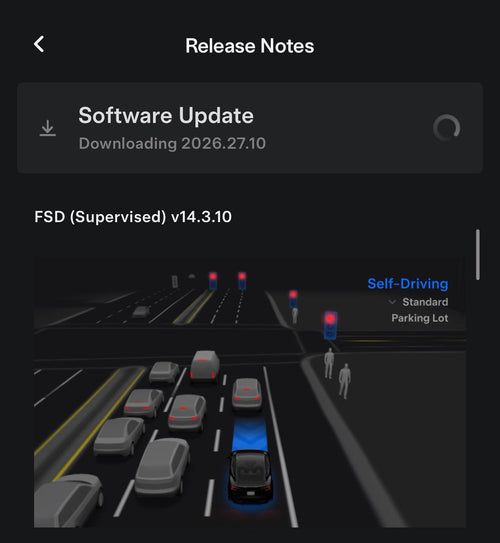
Tesla has kicked off the second wave rollout of FSD (Supervised) v14.3.6, bundled under software update 2026.20.6.11. Critically, this is a unified release — it simultaneously delivers FSD v14.3.6 to HW4/AI4 vehicles and FSD v14 Lite to HW3/AI3 vehicles, meaning the broader Tesla fleet now has access to the v14 stack in one push. Release notes are unchanged from the initial rollout, pointing to a backend bug-fix update rather than new feature additions. If you haven't received the prompt yet, this second wave significantly expands eligibility — check your Tesla app.

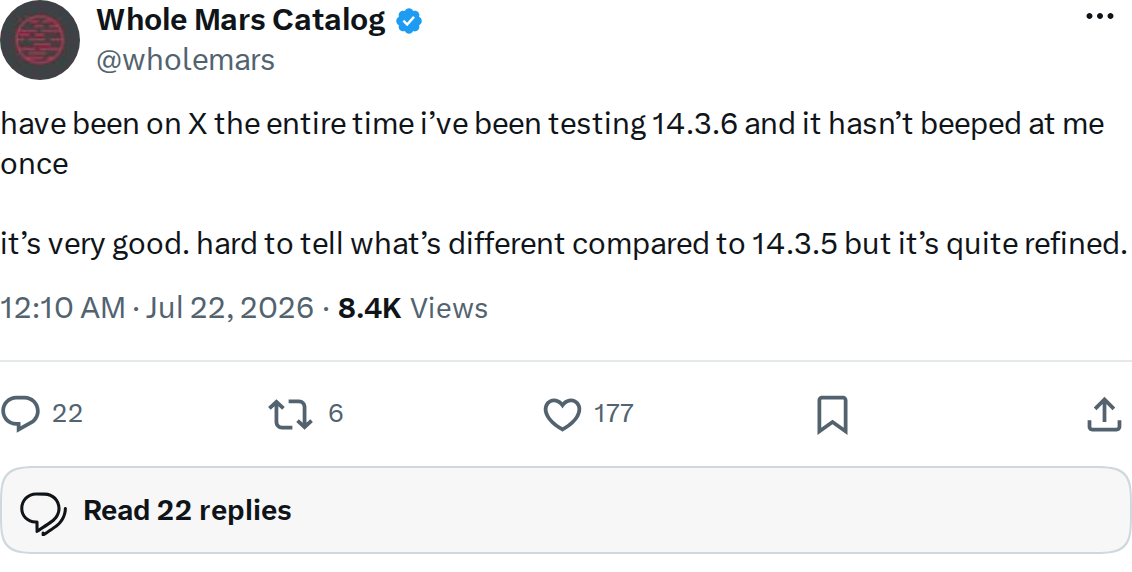
Tesla pushed FSD Beta 14.3.6 on July 21, 2026 — less than a week after 14.3.5 landed — and the first hands-on impressions are in. The headline: it's quiet. As in, no beeps, no takeovers, no drama. That's a meaningful signal for a system that's been iterating rapidly through the 14.3 lineage.

Whole Mars Catalog, one of the more consistent long-form FSD testers on X, reported spending an entire session on the platform without a single intervention alert. His read: 14.3.6 is "very good" and "quite refined," though he noted it's genuinely difficult to articulate what's different from 14.3.5. That last part is worth paying attention to — when improvements become hard to name, it usually means the system has crossed from "fixing obvious problems" into "polishing the edges."
The Context Behind the Point Release
The pace of these releases is itself a story. According to community reports, some users received 14.3.5 the night before and 14.3.6 the following evening — two point updates inside 24 hours. That cadence suggests Tesla's engineering team is in an active tuning cycle, pushing incremental refinements rather than holding changes for a larger drop.
FSD 14.3.5 (released around July 16, 2026, as part of software update 2026.20.6.6) had already introduced a few notable additions: an Intervention-Free Streak tracker and a live camera preview that stays active while driving, according to autopilotreview.com. The community consensus on 14.3.5 was already strong — "really really good" was a phrase that surfaced repeatedly — which makes 14.3.6 more of a confidence-builder than a course-correction.
What the 14.3 Lineage Has Built Toward
To understand why 14.3.6 feels polished, it helps to trace where the series started. When FSD v14.3 began rolling out in early April 2026 (software version 2026.2.9.6), it brought structural changes that were more significant than most point releases: an upgraded Reinforcement Learning training stage, an improved neural network vision encoder, and a rewritten AI compiler and runtime using MLIR, according to teslaoracle.com. The practical result was a reported 20% faster reaction time, alongside fixes for unnecessary lane biasing, minor tailgating, and improved handling at traffic lights and complex intersections.
Each subsequent 14.3.x release has been layering refinement on top of that foundation. By the time 14.3.6 arrived, the architecture was already mature — which is likely why the improvements feel subtle rather than dramatic.
It's also worth noting the hardware split. FSD v14.3.x is primarily targeting vehicles equipped with Hardware 4 (HW4/AI4). Owners on Hardware 3 are receiving FSD v14 Lite, which carries its own meaningful upgrades — reinforcement learning support, offline models, smoother driving behavior, and reduced false slowdowns — but runs on a separate firmware track (2026.20.6.10).
What "Boringly Good" Actually Means
The phrase that keeps appearing in community discussions around the 14.3 series is "boringly good" — and that framing matters more than it might seem. FSD has historically been evaluated on its failures: the phantom braking, the uncomfortable lane changes, the moments that forced a driver to grab the wheel. A version that generates no memorable moments is, paradoxically, the best possible outcome.
Zero interventions during a full testing session isn't just a data point — it's the product working as intended. Whether 14.3.6 sustains that across more varied conditions, longer drives, and a wider range of drivers remains to be seen. But the early signal from one of the more credible community testers is unambiguous: this version is doing its job without asking for help.
Broader rollout data and more diverse driving reports will sharpen the picture over the coming days. For now, the 14.3 series continues to look like the most consistent FSD release cycle Tesla has shipped. For our broader coverage of where autonomous driving is headed, see our FSD coverage.
Related Gear
Gear up your Tesla with tested, custom-fit BASENOR accessories — shop Tesla accessories →
Sources & reporting notes
The links below identify the material source records used for this report.
- @wholemars on X (2026-07-22T00:10:02.000Z) — Direct source
Source links are preserved as published or accessed. See our editorial standards and corrections policy.
The BASENOR Editorial Desk covers Tesla, SpaceX, and related technology, curating reporting from primary sources — official accounts, regulatory filings, and software release data. Every article passes source-record and fact-checking review before publication. About the newsroom.
This report was curated by the BASENOR Editorial Desk from the sources listed above. Read our editorial standards or email editorial@basenor.com to report an error.