European Tesla owners may soon have significantly more room to work with when using Actually Smart Summon. The United Nations Economic Commission for Europe (UNECE) is reportedly planning to raise the feature's permissible operating range from 6 meters to 15 meters — a 2.5x increase that would bring the European experience much closer to what North American owners already enjoy. Here's what's behind the proposal and what it means in practice.

1. The current 6-meter cap is a regulatory constraint, not a Tesla choice
Actually Smart Summon launched in Europe and the Middle East in November 2024, but it arrived with a significant limitation baked in: a 6-meter (roughly 19.5 feet) proximity requirement between the driver and the vehicle. That restriction isn't Tesla's engineering decision — it's a direct result of UNECE Regulation No. 171, the UN framework that governs automated low-speed maneuver systems in European markets. Tesla had to comply with the existing rule to get the feature approved at all. The proposed change originates from UNECE itself, not from Tesla lobbying for a looser standard.
2. The proposed new limit is 15 meters — roughly the length of two parking spaces
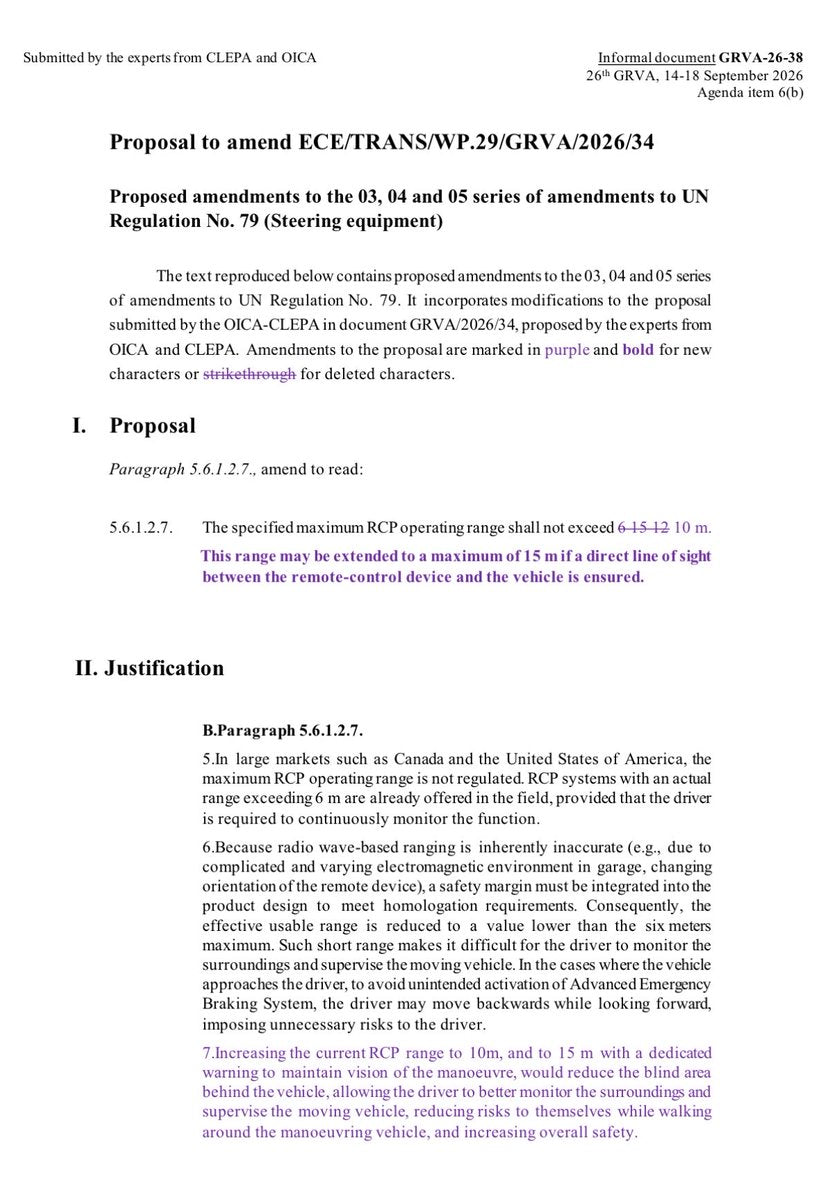
The UNECE proposal would more than double the allowable range, moving the ceiling from 6 meters (~20 feet) to 15 meters (~50 feet). To put that in practical terms: 15 meters is roughly the distance across two standard parking bays plus the lane between them. That's enough to summon your car from across a typical parking aisle, which is precisely the scenario Smart Summon was designed for. At 6 meters, you often have to walk most of the way to the car anyway, which undermines the feature's core value proposition in tighter European parking structures.
3. Three specific safety rationales are driving the proposal
UNECE isn't expanding the range without justification. According to the proposal, regulators identified three concrete reasons the 15-meter limit is defensible from a safety standpoint. First, maintaining visibility of the maneuver throughout the operation — the driver must be able to see the car at all times, and 15 meters still keeps the vehicle within a reasonable sightline in most parking environments. Second, reducing the blind area behind the vehicle — a longer operating range allows the system to position the driver in a spot where rear visibility is less obstructed. Third, improving the driver's ability to monitor the vehicle's path and intervene if needed. The logic is that a slightly longer range, combined with clear sightlines, can actually be safer than forcing the driver to stand very close where their own position may create blind spots.
4. This is still a proposal — no implementation date has been confirmed
It's worth being precise about where this stands: UNECE is planning to extend the range, but this is a regulatory proposal, not a finalized rule change. UNECE working groups move through formal amendment cycles, and any change to Regulation No. 171 would need to be adopted by member states before Tesla could update the feature's behavior via OTA in European vehicles. There is no confirmed timeline for when the new limit would take effect. Owners should expect this to play out over months, not weeks — though once a regulation amendment is adopted, Tesla's OTA infrastructure means the corresponding software update could roll out quickly.
5. When it happens, no hardware change is required — it's a software unlock
The good news for European owners: the 6-meter cap isn't a physical hardware limitation. Tesla's vehicles already have the sensors, cameras, and compute required to operate Smart Summon at longer ranges — the constraint is purely regulatory and therefore enforced in software. Once UNECE formally adopts the new limit and Tesla updates the relevant parameters, the expanded range should arrive via a standard OTA update with no visit to a service center required. North American owners have operated with a longer range since the feature launched, which confirms the underlying system is already capable. European owners are essentially waiting on a policy change, not an engineering one.

The underlying message from UNECE is notable: regulators are actively revisiting the conservative limits set when automated parking features were new, and updating them as real-world data builds confidence. For European Tesla owners, the 15-meter proposal is a meaningful quality-of-life improvement that's been a long time coming — and the regulatory machinery now appears to be moving in the right direction.
Related Gear
Gear up your Tesla with tested, custom-fit BASENOR accessories — shop Tesla accessories →
Sources & reporting notes
The links below identify the material source records used for this report.
- @TeslaNewswire on X (2026-09-19T16:10:00.000Z) — Direct source
Source links are preserved as published or accessed. See our editorial standards and corrections policy.
The BASENOR Editorial Desk covers Tesla, SpaceX, and related technology, curating reporting from primary sources — official accounts, regulatory filings, and software release data. Every article passes source-record and fact-checking review before publication. About the newsroom.
This report was curated by the BASENOR Editorial Desk from the sources listed above. Read our editorial standards or email editorial@basenor.com to report an error.