Parking is quietly killing FSD streaks — and Tesla knows it. Elon Musk has confirmed that an upcoming FSD release will introduce parking memory, enabling vehicles to learn and recall preferred spots at frequently visited locations like home garages, offices, and school drop-offs. It's a targeted fix for what Musk himself has identified as the single biggest reason drivers disengage from FSD today.

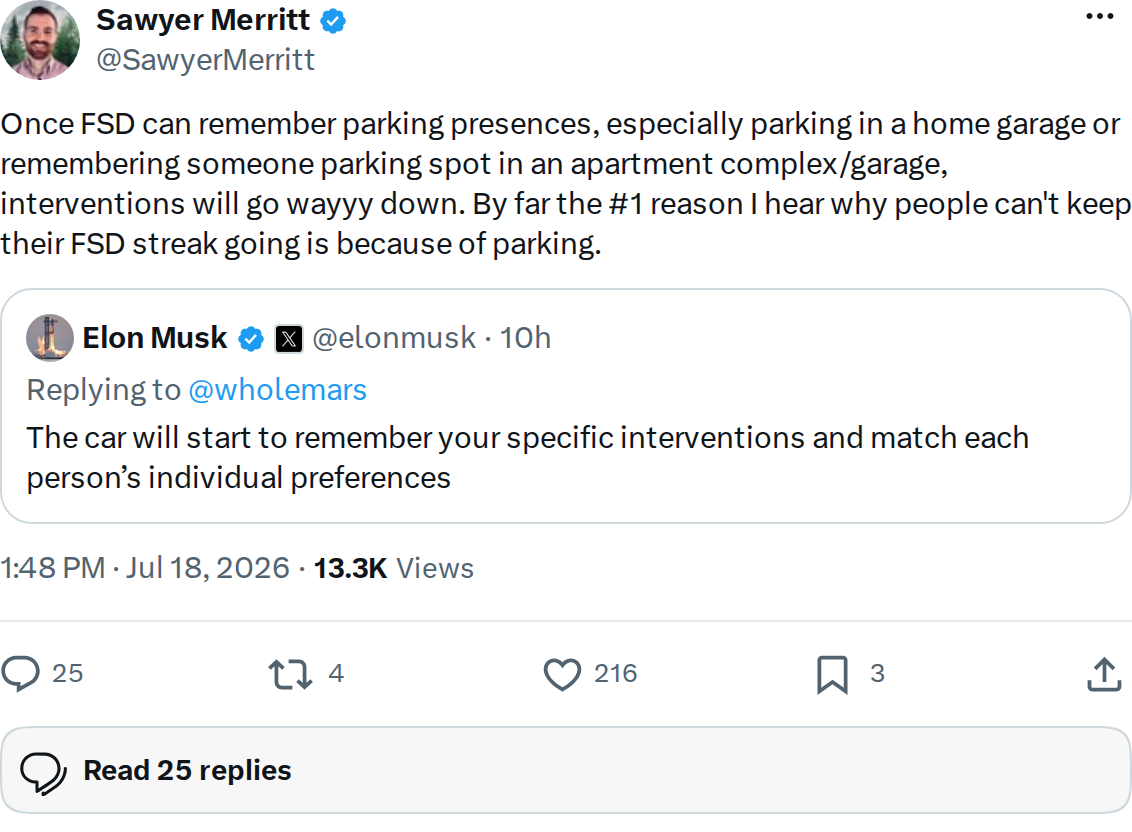
Sawyer Merritt, one of the more closely watched Tesla commentators, put it plainly on X: once FSD can remember parking preferences — especially home garages and apartment complex spots — interventions will drop sharply. "By far the #1 reason I hear why people can't keep their FSD streak going is because of parking," he wrote. That observation lines up directly with what Musk has said publicly about disengagement data.
Why Parking Is the Weak Link in FSD
The core problem isn't that FSD can't park — it can. The issue is that FSD currently defaults to the first available space rather than the one you actually want. Pull into your apartment complex and the car might aim for a random open spot three rows from your usual space. At that point, most drivers take over. Multiply that across thousands of daily trips and you get a significant intervention rate driven entirely by a preference mismatch, not a safety failure.
Musk has been direct about this distinction: according to previous statements, critical safety interventions are now extremely rare. The bulk of disengagements happening today are what engineers call "comfort interventions" — the driver isn't worried about a crash, they just want the car to go somewhere specific. Parking is the dominant example.
How We Got Here — The Parking Improvement Arc
Tesla has been iterating on FSD parking for several releases. FSD v12.3.6 added the ability to select a parking space directly on the touchscreen. FSD v14.1 introduced "Arrival Options," letting drivers pre-program parking preferences per destination. FSD v14.3.4, which rolled out in June 2026, brought "increased decisiveness of parking spot selection" and improved parking location pin prediction — meaning the car got better at guessing where you wanted to end up.
Parking memory is the logical next step: instead of guessing or requiring manual input each time, the car learns from repeated behavior. Park in the same spot at home ten times and the system should start navigating there automatically on the eleventh.
What Musk Has Confirmed
According to Musk's public statements, upcoming FSD releases will allow the vehicle to remember parking preferences so it goes to the right location at your home, office, school drop-off, and similar frequent destinations. No specific version number has been attached to this feature yet, and Tesla has not published a release date. Given that new FSD versions have been shipping every few weeks, the feature could appear in a near-term update — but that timeline remains unconfirmed.
A related capability is also in the pipeline: voice control for FSD parking instructions through xAI's Grok integration. Musk indicated this would allow commands like "drop us off here, we'll walk" or "park far away after dropping at the entrance" — and placed that functionality roughly around September 2026. That's a separate feature from passive parking memory, but together they'd give drivers substantially more control over the last mile of every trip.
The Broader Implication for FSD Adoption
Intervention rate is one of the most closely watched metrics in the autonomous driving space — both internally at Tesla and externally by regulators and analysts. A feature that meaningfully reduces disengagements at the destination end of a trip doesn't just improve the user experience; it shifts the statistical picture of how capable FSD actually is in daily use.
If parking accounts for a disproportionate share of current interventions, then solving it could produce a step-change improvement in reported autonomy metrics without any change to highway or urban driving performance. That's a meaningful data story for Tesla, and it's why Musk flagged it specifically rather than bundling it into a generic changelog entry.
The feature isn't live yet, and the exact implementation — how many visits trigger memory, whether it's per-vehicle or tied to a Tesla account, how drivers correct a learned preference — remains to be seen. But the direction is clear, and for anyone who has ever taken the wheel in their own driveway, it can't arrive soon enough. For more on FSD's ongoing development, see our FSD coverage.
Related Gear
Gear up your Tesla with tested, custom-fit BASENOR accessories — shop Tesla accessories →
Sources & reporting notes
The links below identify the material source records used for this report.
- @SawyerMerritt on X (2026-07-18T13:48:39.000Z) — Direct source
Source links are preserved as published or accessed. See our editorial standards and corrections policy.
The BASENOR Editorial Desk covers Tesla, SpaceX, and related technology, curating reporting from primary sources — official accounts, regulatory filings, and software release data. Every article passes source-record and fact-checking review before publication. About the newsroom.
This report was curated by the BASENOR Editorial Desk from the sources listed above. Read our editorial standards or email editorial@basenor.com to report an error.