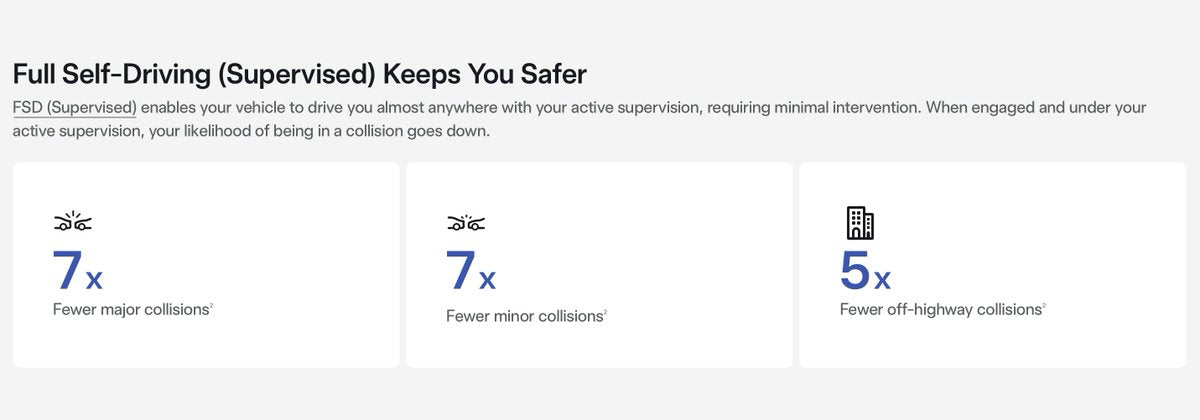
Tesla has been making its most direct safety pitch yet for FSD Supervised, and the numbers behind it are worth understanding. Over the past week, the company published a series of posts highlighting both the statistical safety record and the perceptual advantages of its driver-assistance system — framing it as a sub-coffee-cost upgrade that meaningfully changes your collision risk. Here's what the data actually shows.

1. The 7x Safety Claim Comes With Real Mileage Behind It
Tesla's headline figure — that FSD Supervised keeps drivers 7x safer — isn't just a marketing multiplier. In North America, Tesla reported as of February 2026 that vehicles with FSD Supervised engaged recorded one major collision every 5,300,676 miles, compared to the U.S. average of one every 660,164 miles during the same period. That's roughly an 8x gap. The 7x figure Tesla is now promoting appears to be a conservative rounding of that dataset, which now spans considerably more miles. The fleet crossed 8 billion cumulative FSD miles in February 2026, with projections pointing toward 10 billion by year-end.
2. European Data Adds a Granular Layer
Since April 2026, Tesla has been collecting collision data across five EU countries — the Netherlands, Lithuania, Estonia, Denmark, and Belgium. According to that dataset, FSD Supervised was involved in 5.2 times fewer collisions than manual driving over 65 million kilometers. The highway numbers are particularly striking: zero FSD collisions over 41.9 million kilometers, versus 88 collisions for manual driving over 429.3 million kilometers — an 8.5x margin. On non-highway roads the advantage narrows to 2.8x, which is still significant but reflects the added complexity of urban and suburban environments. Beyond collisions, FSD Supervised also recorded 13.4 times fewer automatic emergency braking events and 7.1 times fewer harsh braking events than manual driving in the same European sample.
3. The Perception Argument Is About Physics, Not Marketing
Tesla's second major message this week was simpler: humans can't look everywhere at once, but FSD Supervised can. That's not hyperbole — it's a straightforward description of how the system works. FSD Supervised processes input from multiple cameras covering a 360-degree field simultaneously, cross-referencing that data with neural network models trained on billions of real-world miles. A human driver has a roughly 200-degree forward field of view and must physically turn to check mirrors and blind spots. The system doesn't get distracted, doesn't fatigue, and doesn't have reaction-time lag between perception and response. The practical result is that threats appearing from the side or rear — a common cause of intersection and lane-change collisions — are processed before a human would typically register them.
4. The $3.33/Day Framing Is About Subscription Positioning
At roughly $100/month for an FSD Supervised subscription, Tesla is deliberately anchoring the cost against a daily coffee purchase. It's a straightforward consumer psychology move, but the underlying math is real. For owners who don't have FSD included in their purchase price, the monthly subscription is the access point — and Tesla is clearly trying to reduce the perceived barrier. The current subscription covers the full FSD Supervised feature set, including Navigate on Autopilot, Auto Lane Change, Autopark, and the city-streets driving capability. The latest confirmed rollout as of late July 2026 is v14.3.6 on Hardware 4 vehicles, with a v14 Lite build running simultaneously on Hardware 3 hardware.
5. The NHTSA Investigation Is the Context Tesla Isn't Mentioning
The timing of this safety push isn't random. In October 2025, NHTSA opened a formal investigation into FSD Supervised covering approximately 2.88 million U.S. vehicles, focused on 58 documented incidents of alleged traffic violations. Tesla was granted an extension to submit related data through March 2026. Tesla's decision to publish its own safety statistics — both the North American mileage data and the new European dataset — is clearly part of a broader effort to shape the public and regulatory narrative around FSD's safety record. That doesn't make the numbers invalid, but owners evaluating the claims should understand they're being presented by a company with an active regulatory file on the same system. Independent verification of Tesla's collision-rate methodology has not yet been published by NHTSA or a third-party body.
The core case Tesla is making is straightforward: the system perceives more, reacts faster, and the collision data across hundreds of millions of miles supports a meaningful safety advantage over unassisted driving. Whether that's enough to justify a subscription is a personal calculation — but the underlying numbers are more substantive than a typical marketing push. For more on FSD's capabilities and recent updates, see our FSD coverage.
Related Gear
Gear up your Tesla with tested, custom-fit BASENOR accessories — shop Tesla accessories →
Sources & reporting notes
The links below identify the material source records used for this report.
- @Tesla on X (2026-08-01T21:03:28.000Z) — Direct source
- @Tesla on X (2026-08-03T23:15:42.000Z) — Direct source
- @Tesla on X (2026-08-03T23:49:12.000Z) — Direct source
Source links are preserved as published or accessed. See our editorial standards and corrections policy.
The BASENOR Editorial Desk covers Tesla, SpaceX, and related technology, curating reporting from primary sources — official accounts, regulatory filings, and software release data. Every article passes source-record and fact-checking review before publication. About the newsroom.
This report was curated by the BASENOR Editorial Desk from the sources listed above. Read our editorial standards or email editorial@basenor.com to report an error.