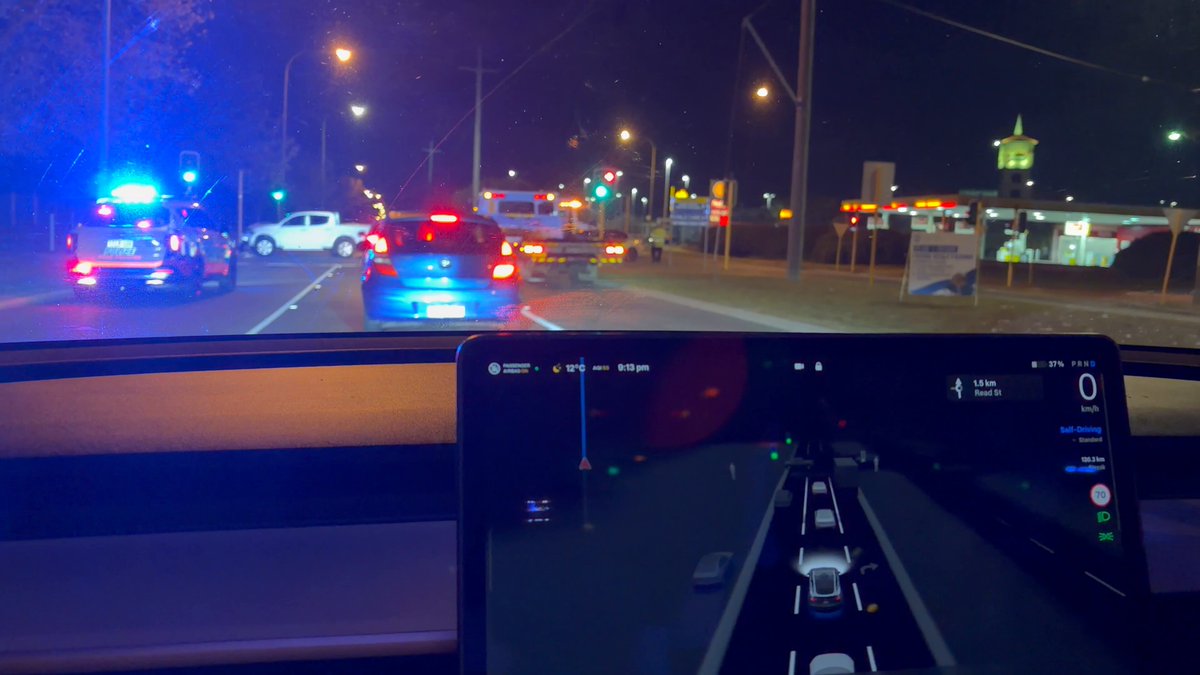
Tesla Australia & New Zealand is spotlighting one of FSD Supervised's most consequential capabilities: its ability to detect and safely respond to emergency situations on the road. The highlight comes as FSD Supervised v14.3.3 begins rolling out to Hardware 4-equipped vehicles in Australia and New Zealand — making these among the first right-hand-drive markets to receive the update.

What v14.3.3 Actually Changes for Emergency Scenarios
The headline improvement in this update is explicit in Tesla's own release notes: "Enhanced response to emergency vehicles, school buses, right-of-way violators, and other rare vehicles." That's not a vague capability claim — it's a documented change in how the neural network prioritises and reacts to high-stakes road events.
Underpinning the improvement is a significant infrastructure rewrite. Tesla rebuilt the AI compiler and runtime for FSD using MLIR (Multi-Level Intermediate Representation), which the company says delivers a 20% faster reaction time and improved model iteration speed. For emergency scenarios specifically, that latency reduction matters: the system needs to identify an approaching ambulance, a stopped school bus, or a vehicle running a red light and adjust trajectory before a human would even consciously register the threat.
The update also includes an upgraded neural network vision encoder, strengthening 3D geometry comprehension and expanding traffic sign recognition — both critical for navigating the unpredictable behaviour that tends to surround emergency scenes.
A Real-World Example That Put the Tech in Context
The timing of Tesla's regional push on this messaging isn't arbitrary. In November 2025, a Tesla Model Y running FSD Supervised v14.1.3 in the US maintained course during a driver's medical emergency — a heart attack. The driver's son was able to remotely reroute the vehicle to the nearest hospital via the Tesla app, with FSD navigating local roads and pulling up to the emergency room entrance. Tesla North America publicised the incident in June 2026 as a concrete demonstration of the system's potential in critical situations.
That story reframes what "emergency handling" means in practice. It's not just about yielding to a passing fire truck — it's about the system holding the car stable and navigable when the human in the seat can no longer do so.
Where the Numbers Stand
Tesla reports that vehicles with FSD Supervised engaged experience 7x fewer major and minor collisions and 5x fewer off-highway collisions compared to unassisted driving. The FSD fleet crossed 10 billion cumulative miles in early May 2026 — a dataset that continues to feed the reinforcement learning improvements visible in each successive version.
The Australian and New Zealand rollout, which began around June 19, is still in early stages. Real-world data from right-hand-drive markets operating under local road rules will add a new dimension to that dataset over the coming months.
One important caveat remains unchanged: FSD Supervised is an advanced driver-assistance system. It requires active driver supervision at all times, and drivers must be ready to take control. The emergency handling improvements are a meaningful step — but the "Supervised" in the name still carries legal and practical weight for every owner using it today.
📋 Tracking Tesla software? See every firmware, FSD and app version in one place in our Tesla Software Update Tracker.
Related Gear
Gear up your Tesla with tested, custom-fit BASENOR accessories — shop Tesla accessories →
Sources & reporting notes
The links below identify the material source records used for this report.
- @TeslaAUNZ on X (2026-06-25T02:39:33.000Z) — Direct source
Source links are preserved as published or accessed. See our editorial standards and corrections policy.
The BASENOR Editorial Desk covers Tesla, SpaceX, and related technology, curating reporting from primary sources — official accounts, regulatory filings, and software release data. Every article passes source-record and fact-checking review before publication. About the newsroom.
This report was curated by the BASENOR Editorial Desk from the sources listed above. Read our editorial standards or email editorial@basenor.com to report an error.