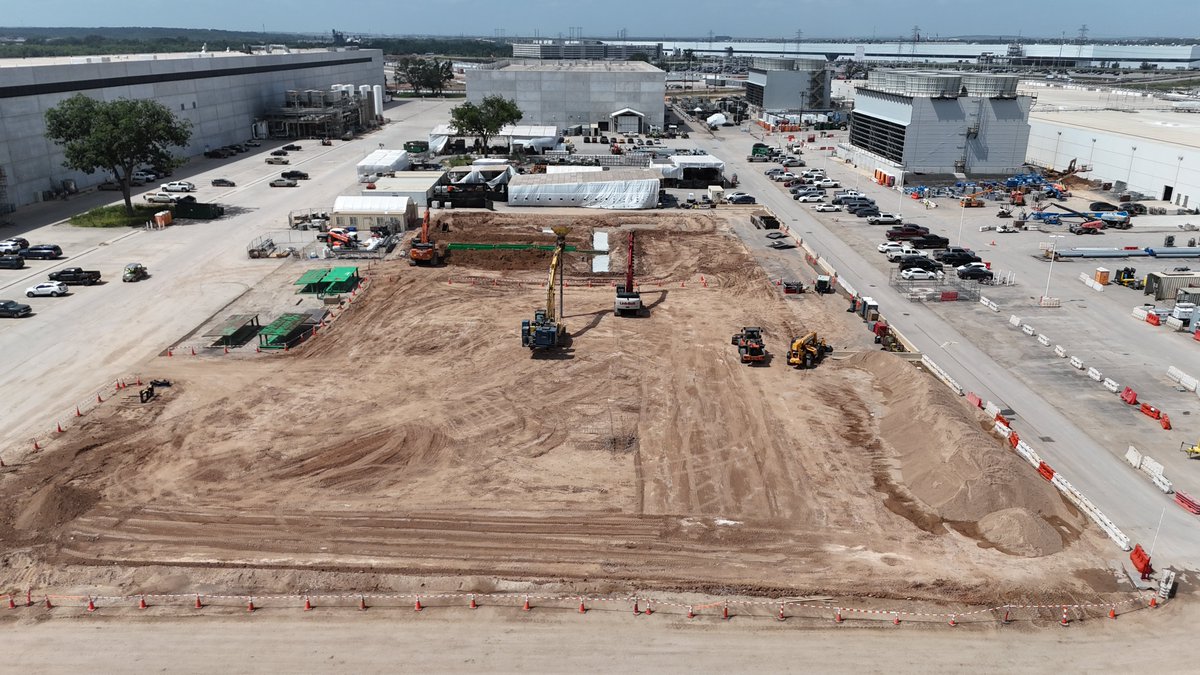
A new construction project has appeared at Giga Texas near the Cortex 2 campus, and aerial observer Joe Tegtmeyer believes it's the condensation reclamation plant Tesla outlined in its 2025 Impact Report. The timing lines up: Tesla published that report in early July 2026, and ground work is already visible. For a factory that consumed 556 million gallons of treated water in 2025, the urgency to close that loop is real.

What the 2025 Impact Report Actually Said
Tesla's 2025 Impact Report, published around July 7–10, 2026, was unusually specific about Giga Texas water strategy. The document states that the factory is "developing large-scale rainwater capture and reclaimed water systems" with the explicit goal of reducing potable water consumption. That language — reclaimed water systems at scale — is precisely what a condensation reclamation plant would deliver.
The report goes further. It also describes a planned waste heat recovery system for the Giga Texas data center that would capture thermal energy and redirect it as process heating water for vehicle coatings and paint shops. The net effect: less demand on chiller plants, which are among the heaviest water consumers in any large manufacturing facility. Both initiatives point to a coordinated infrastructure push, not a one-off project.
Why 556 Million Gallons Is the Number That Matters
Giga Texas's treated water usage rose roughly 60–68% between 2023 and 2025, reaching 556 million gallons last year, according to Austin Water data. That growth rate made Tesla the third-largest customer on Austin's municipal water system — a distinction that carries both operational and political weight in a region that has faced drought conditions and water supply pressures.
The factory already has substantial water treatment infrastructure in place. In January 2021, H2O Innovation Inc. contracted to build two reverse osmosis trains for the site, each rated at 2,200 cubic meters (approximately 5.8 million gallons) per day, designed to strip salts and contaminants from feedwater. But treatment capacity alone doesn't reduce consumption — reclamation does. Capturing condensate from HVAC and industrial cooling systems and cycling it back into the process loop is one of the more efficient ways to flatten that consumption curve without throttling production.
The Construction Context
The new site sits near Cortex 2, which is itself the center of an enormous North Campus buildout. Tegtmeyer's aerial footage shows water tank supports already in place — the kind of structural foundation work that precedes large storage or processing vessels. The broader area is simultaneously hosting construction of the Cortex 2.0 supercomputer facility, the Optimus robot production factory, and the Terafab chip fabrication facility, according to ongoing site reporting.
That cluster matters for water planning. Data centers and chip fabs are among the most water-intensive industrial operations that exist. Cortex 2.0 alone will generate significant waste heat that needs to be managed. If Tesla is building the condensation reclamation plant adjacent to these facilities, the design logic is straightforward: capture the condensate and waste heat from the compute infrastructure, treat it, and feed it back into the manufacturing process next door.
It's worth noting that Tegtmeyer's identification of this specific project as a condensation reclamation plant is an informed read of the site evidence against the Impact Report's stated plans — not an official Tesla confirmation. The structural elements visible in the aerial footage are consistent with that interpretation, but Tesla has not publicly named this particular construction project.
What is clear is that Tesla is moving quickly from stated intent to physical infrastructure. The 2025 Impact Report was published less than two weeks ago, and steel is already in the ground. For a factory growing as fast as Giga Texas, getting ahead of water constraints isn't just good sustainability optics — it's an operational prerequisite for everything else being built on that campus.
Related Gear
Gear up your Tesla with tested, custom-fit BASENOR accessories — shop Tesla accessories →
Sources & reporting notes
The links below identify the material source records used for this report.
- @JoeTegtmeyer on X (2026-07-20T12:03:55.000Z) — Direct source
Source links are preserved as published or accessed. See our editorial standards and corrections policy.
The BASENOR Editorial Desk covers Tesla, SpaceX, and related technology, curating reporting from primary sources — official accounts, regulatory filings, and software release data. Every article passes source-record and fact-checking review before publication. About the newsroom.
This report was curated by the BASENOR Editorial Desk from the sources listed above. Read our editorial standards or email editorial@basenor.com to report an error.