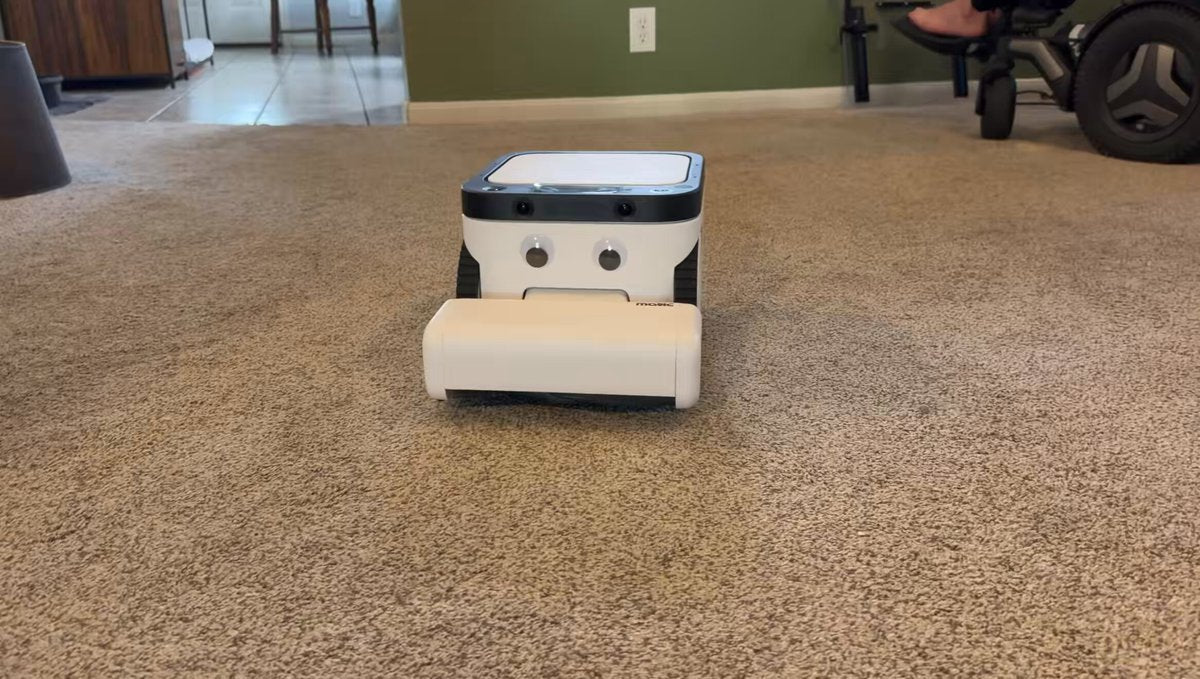
A video shared by Whole Mars Catalog on November 2, 2026, shows a robot moving under what appears to be direct mind control — the clearest public demonstration yet of Neuralink's brain-computer interface (BCI) being applied to robotics. Here's what the footage signals, what we know about the underlying technology, and what it could mean for Tesla's Optimus program.

What exactly is being shown in this video?
The clip shows a robot responding to commands issued without any physical controller — what Neuralink and its participants have described as operating machinery "all via telepathy." The most likely mechanism is a Neuralink N1 implant decoding motor-intent signals from the user's motor cortex and translating them into robot movement commands in real time. Neuralink has previously demonstrated this approach with robotic arm control through its "Convoy Project" clinical study, so extending that to full-body robot movement is a logical next step rather than a leap.
How mature is the underlying technology right now?
More mature than most people realize. According to Neuralink's own reporting, at least 26 individuals had received N1 implants by mid-2026, with participants averaging 50 hours of independent BCI use per week for tasks ranging from gaming to professional work to robotic arm control. The N1 chip itself packs up to 3,072 electrodes into a device roughly the size of a quarter. A next-generation surgical robot introduced in early 2026 cut electrode thread insertion time to 1.5 seconds per thread and achieved compatibility with 99% of anatomical variations worldwide — a meaningful manufacturing and accessibility milestone.
What does this have to do with Tesla's Optimus robot?
The connection is direct and has been publicly stated. In November 2025, Elon Musk outlined a roadmap for integrating Neuralink interfaces with Optimus, describing a future where users could operate the humanoid robot telepathically. Danish Hussain, Neuralink's Head of Surgery, said at the same time that a human-to-Optimus interface would happen "very soon." The vision is specifically aimed at people who cannot speak or move independently — Neuralink participants would give commands to Optimus simply by thinking them. What the November 2 video appears to show is that the underlying BCI-to-robot control loop is no longer theoretical.
Is this the first time a Neuralink patient has controlled a robot?
No. The first documented case came in November 2025, when Alex — a patient with a cervical spinal cord injury and the second Neuralink recipient — became the first person to use the N1 implant to control an assistive robotic arm, in a demonstration conducted at Barrow Neurological Institute. What appears to be progressing now is the scale and fluidity of that control, moving from a single assistive arm toward broader robot body movement. In July 2026, Neuralink also demonstrated telepathic wheelchair control using an implant-decoded cursor paired with a custom camera interface, showing the same decode-and-actuate pipeline applied to mobility devices.
How close is Neuralink to scaling this beyond a handful of trial participants?
The company has been explicit about its production ambitions. On December 31, 2025, Musk announced that Neuralink would begin high-volume production of BCI devices in 2026 and transition to an almost entirely automated surgical procedure — one where electrode threads pass through the dura without requiring its removal, a technique Neuralink confirmed it had performed in its first transdural clinical procedure by June 30, 2026. Manufacturing costs for needle cartridges were cut by 95% by January 2026. A $650 million Series E round in May 2025 valued the company at approximately $9 billion and is funding that production ramp. The infrastructure for scale is being built now; the clinical trial phase is the remaining gating factor.
What's still unknown about this specific demonstration?
Quite a bit. The video shared by @wholemars does not identify the participant, the specific robot platform, the latency of the control signal, or whether this is part of a formal Neuralink study or a more informal internal demonstration. It is also not confirmed whether the robot shown is an Optimus unit or a third-party robotic platform. Those details matter for understanding how close this is to a deployable system versus a proof-of-concept milestone. Neuralink has not issued a formal press release accompanying the footage as of publication time.
🤖 Tracking Tesla's humanoid robot? See every Optimus production milestone and appearance in our Tesla Optimus Tracker.
Sources & reporting notes
The links below identify the material source records used for this report.
- @wholemars on X (2026-11-02T18:23:13.000Z) — Direct source
Source links are preserved as published or accessed. See our editorial standards and corrections policy.
The BASENOR Editorial Desk covers Tesla, SpaceX, and related technology, curating reporting from primary sources — official accounts, regulatory filings, and software release data. Every article passes source-record and fact-checking review before publication. About the newsroom.
This report was curated by the BASENOR Editorial Desk from the sources listed above. Read our editorial standards or email editorial@basenor.com to report an error.