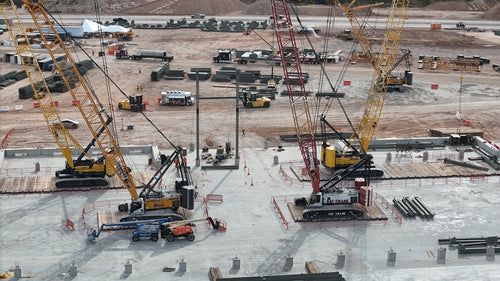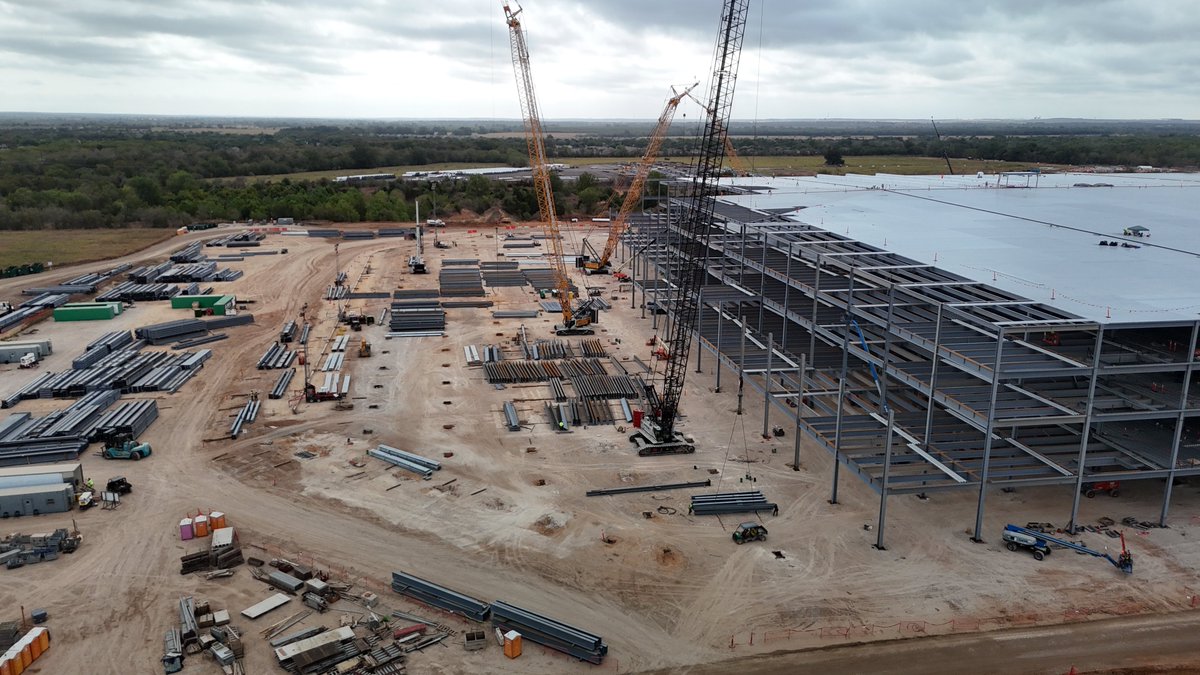
Tesla's dedicated Optimus robot factory at Giga Texas has gone from raw earth to a nearly complete structural steel skeleton in roughly six months — a construction pace that signals the company is serious about hitting its 2027 mass-production target. Drone footage captured on October 1, 2026 by aerial documentarian Joe Tegtmeyer shows the main steel frame closing in on its final column grids, with concrete already being poured on upper floors.

A Timeline Built in Six Months
The construction sequence has been remarkably compressed. Ground broke on the North Campus site on March 23, 2026, with general earthwork running through late March. The first structural steel went up on May 27 — roughly nine weeks after ground was broken. By mid-September, according to prior reporting, the steel assembly was approximately five column grids away from reaching the building's north perimeter beam. The October 1 footage confirms the frame is now in its final stretch.
For context, that's a structural shell advancing from nothing to near-complete in about 18 weeks of steel work. Industrial construction of this scale typically takes considerably longer, which suggests Tesla is running an aggressive parallel-track schedule — likely overlapping foundation, steel erection, and floor-slab pours simultaneously rather than sequentially.

What's Actually Being Built Here
The scale of this facility deserves emphasis. According to background research, the Optimus factory is designed to span approximately 7 million square feet of manufacturing space at full build-out — extending nearly the full length of the main Giga Texas building (over 4,000 feet) but narrower by 50 to 70 meters. It sits within a broader 5.2 million square foot North Campus expansion that also includes the planned Terafab AI chip factory and Cortex 2 AI compute halls.
The long-term production target for the facility is 10 million Optimus units annually at full scale — a number that puts the ambition of this construction project in sharp relief. For comparison, Tesla's entire vehicle production across all factories runs in the low millions per year. Building a factory capable of producing 10 million humanoid robots annually is a categorically different engineering and logistics challenge.
Where Optimus Production Stands Today
While Giga Texas rises, Fremont is already running. Tesla commenced Gen 3 Optimus mass production at its California factory on January 21, 2026. According to background research, approximately 300 units were deployed for internal learning at that point, with estimates rising to 1,000–1,200 units by mid-2026 — all used internally for factory operations and data collection rather than sold to external customers.
Fremont is functioning as the early-production and learning site: the place where Tesla works out tooling, assembly sequencing, and quality processes before transferring that knowledge to the much larger Texas operation. High-volume production at Giga Texas is targeted for Summer 2027, with consumer availability aimed for the end of that year.
The investment behind all of this is substantial. The North Campus expansion — including the Optimus factory — is estimated to require between $5 billion and $10 billion, according to background research, making it one of the largest single manufacturing investments in Tesla's history.
What the October 1 Footage Actually Tells Us
Drone footage is a lagging indicator — it shows what's already happened, not what's planned. But in this case, the visual evidence is genuinely informative. A steel frame that is nearly complete by October 1 puts the structural shell on track to close out well before year-end, which aligns with a reported target of completing the shell by the end of 2026. Once the envelope is closed, interior fit-out — MEP systems, clean rooms, assembly line infrastructure — can proceed through winter without weather delays.
The pace also matters strategically. Every month of construction schedule compression is a month closer to the Summer 2027 production ramp. If the shell closes in November or December, Tesla would have roughly six to eight months to complete interior buildout before the targeted production start — tight, but not implausible given how the company has historically approached factory timelines at Giga Berlin and Giga Texas itself.
The next milestone to watch: when the final perimeter beam is set and the roof deck begins. That transition — from open steel frame to an enclosed building — is typically when interior work accelerates sharply.
🤖 Tracking Tesla's humanoid robot? See every Optimus production milestone and appearance in our Tesla Optimus Tracker.
Related Gear
Gear up your Tesla with tested, custom-fit BASENOR accessories — shop Tesla accessories →
Sources & reporting notes
The links below identify the material source records used for this report.
- @JoeTegtmeyer on X (2026-10-01T14:45:18.000Z) — Direct source
Source links are preserved as published or accessed. See our editorial standards and corrections policy.
The BASENOR Editorial Desk covers Tesla, SpaceX, and related technology, curating reporting from primary sources — official accounts, regulatory filings, and software release data. Every article passes source-record and fact-checking review before publication. About the newsroom.
This report was curated by the BASENOR Editorial Desk from the sources listed above. Read our editorial standards or email editorial@basenor.com to report an error.