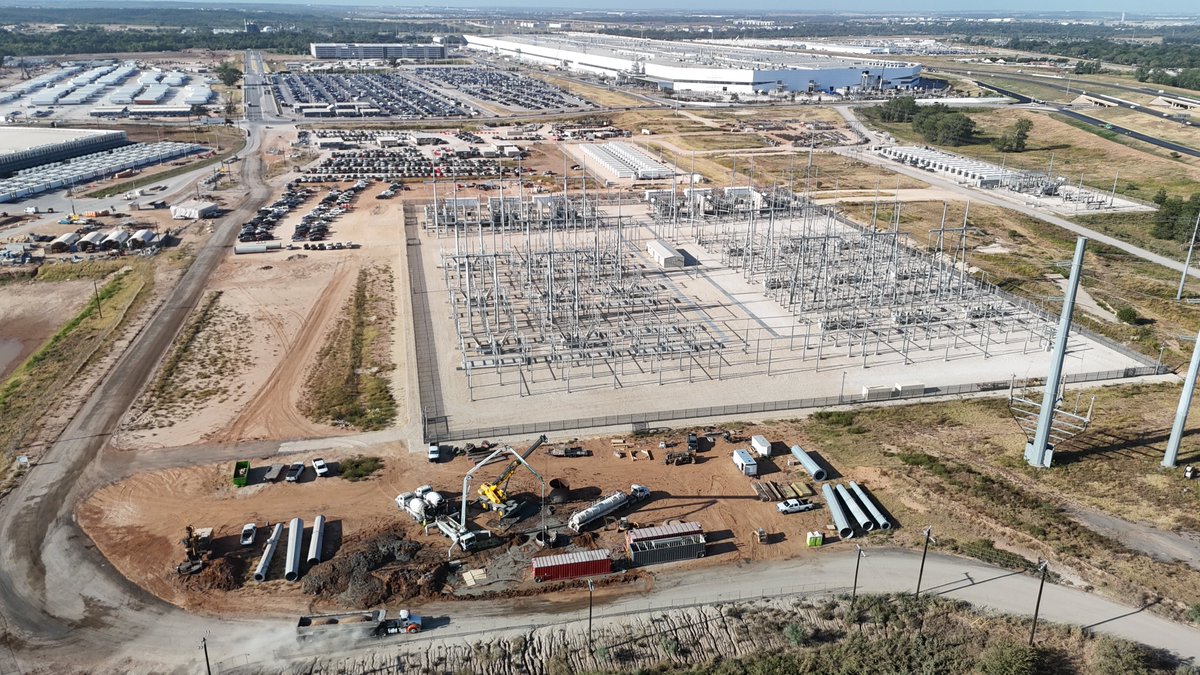
Nine months of construction work at Giga Texas is finally reaching a visible milestone. New power pole foundations are going into the ground at the facility's electrical switchyard — the physical backbone that will feed both the factory floor and Tesla's rapidly growing Cortex AI supercomputing clusters. Aerial observer Joe Tegtmeyer captured the progress this week, and the scale of what's being built deserves a closer look.

1. This project has been running for nine months
The switchyard expansion didn't start last week. According to Tegtmeyer, work has been underway for roughly nine months — meaning Tesla began planning and breaking ground on this electrical infrastructure well before Cortex 2 went live. The new power pole foundations now being completed represent the final structural phase before the expanded capacity can actually be commissioned. That's a long lead time, and it signals Tesla was anticipating this power demand far in advance.
2. Cortex 2 is already drawing serious power — and it's only half built
The first 250 MW phase of Cortex 2 went live in April 2026, actively processing AI training workloads. But the full Cortex 2.0 cluster is designed to reach 500 MW total capacity. That means the system currently running is only half of what's planned. The switchyard expansion is the prerequisite for the second half coming online — without more grid-connected capacity at the site, the remaining 250 MW simply can't be energized.

3. Tesla's AI compute capacity has already more than doubled in 2026
Tesla confirmed it more than doubled its onsite AI compute capacity in Texas — measured in megawatts — during the first half of 2026 alone. The company is targeting nearly 400 MW of AI compute capacity by late 2026, which would represent a 220% increase from end-of-2025 levels. At full build-out, Cortex 2 is expected to house approximately 100,000 Nvidia H100 and H200 GPUs. The switchyard expansion is what makes the final push to 400 MW physically possible.
4. Energy storage is scaling alongside the compute cluster
Raw grid capacity isn't the only piece of the puzzle. Tesla has been deploying Megapacks at Giga Texas to buffer the site's power draw. Roughly 130 Megapacks were initially installed to support Cortex 2, with approximately 150 units delivered by February 2026. Permit filings from May 2026 indicate a target of around 250 total Megapacks — which at roughly 3.9 MWh per unit would provide approximately 975 MWh of on-site energy storage at full deployment. That buffer matters for grid stability when you're running a 500 MW data center around the clock.

5. The cooling system is designed to slash electricity costs by 89%
Running 100,000 high-end GPUs generates an enormous amount of heat. The cooling infrastructure built for Cortex 2 is reported to achieve 89% savings on electricity costs compared to older cooling technologies. That efficiency gain matters enormously at this scale — shaving even a fraction of cooling overhead off a 500 MW facility translates to tens of millions of dollars annually. It also means the net power demand on the switchyard is lower than raw compute numbers would suggest, though the absolute draw is still immense.

The completion of the power pole foundations is the kind of unglamorous milestone that rarely makes headlines — but it's the prerequisite for everything else. Without the switchyard expansion reaching this stage, Cortex 2's second 250 MW phase stays dark. Watch for commissioning activity at the site over the coming months as the new infrastructure gets energized and Tesla pushes toward its late-2026 AI capacity target.
Related Gear
Gear up your Tesla with tested, custom-fit BASENOR accessories — shop Tesla accessories →
Sources & reporting notes
The links below identify the material source records used for this report.
- @JoeTegtmeyer on X (2026-08-24T15:23:05.000Z) — Direct source
Source links are preserved as published or accessed. See our editorial standards and corrections policy.
The BASENOR Editorial Desk covers Tesla, SpaceX, and related technology, curating reporting from primary sources — official accounts, regulatory filings, and software release data. Every article passes source-record and fact-checking review before publication. About the newsroom.
This report was curated by the BASENOR Editorial Desk from the sources listed above. Read our editorial standards or email editorial@basenor.com to report an error.