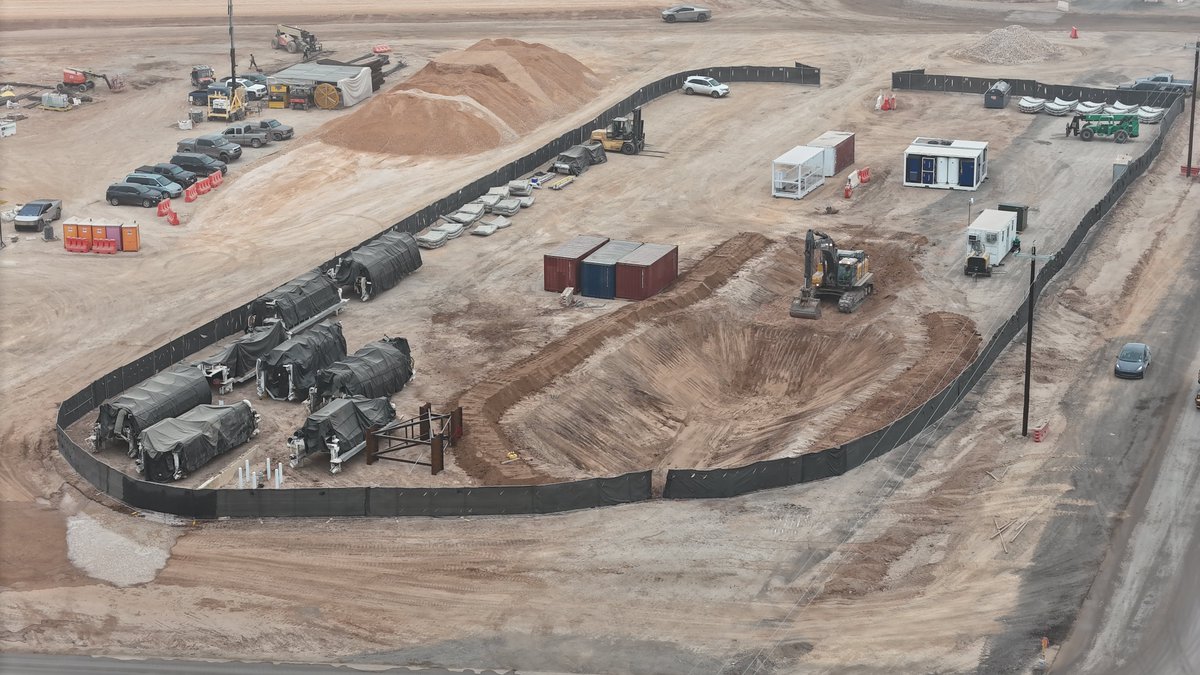
The Boring Company's Prufrock Tunnel Boring Machine is one step closer to breaking ground at Giga Texas. On October 28, drone observer Joe Tegtmeyer spotted the TBM's trailing skid — the rear support assembly that keeps the machine operational during excavation — arriving at the east side of the Gigafactory, adjacent to the Advanced Technology Chip Fabrication Facility. Here's what's happening and why it matters.

1. The trailing skid is the TBM's life-support system
A Prufrock TBM doesn't operate as a single unit. The cutting head bores forward while a long trailing assembly — variously called the trailing skid, gantry, trailing gear, or backup system — follows behind, housing the power systems, ventilation equipment, material conveyance, and crew support infrastructure. Without it, the cutter head is inert. Its arrival on site signals that full machine assembly is imminent, not weeks away.

2. The tunnel is headed toward the Advanced Technology Chip Fab
This isn't a general-purpose transit loop. The new bore is positioned on the east side of Giga Texas specifically to serve the joint SpaceX and Tesla Advanced Technology Chip Fabrication Facility currently under construction. According to prior drone observations, tunnel liners were already on site by October 14, and a fenced construction zone had been established south of the battery cathode plant. The chip fab itself has been moving fast — steel erection on the center section of the foundation was observed as early as September 30, with additional concrete pours and structural steel visible by mid-October.
3. Prufrock is built for exactly this kind of job
The Boring Company's Prufrock machines are engineered for continuous mining — they install tunnel liner segments simultaneously with excavation rather than stopping to shore up the bore. Critically, Prufrock uses a technique called "porpoising" to launch and emerge from the surface without requiring large, disruptive excavation pits. For a dense industrial campus like Giga Texas, that capability is essential. The company's medium-term performance target for Prufrock is a tunneling speed exceeding 7 miles per day — roughly one-tenth of human walking pace — though current operational rates are still ramping toward that benchmark.

4. The Boring Company is running multiple Prufrock deployments simultaneously
Giga Texas is one of several active Prufrock sites right now. As of October 2026, the company's Prufrock-5 machine arrived at Morgan's Inclusion Campus in San Antonio for a 0.8-mile underground route. In Nashville, two Prufrock TBMs (designated MB1 and MB2) were simultaneously tunneling for the Music City Loop, with a third machine scheduled to launch in late October. That level of concurrent deployment reflects a company that has moved past prototype validation and into scaled operations — a shift backed by the $3 billion Series D raise in September 2026, which valued The Boring Company at $23 billion.
5. The permit is filed and construction is already moving
The Boring Company filed a revised permit for this specific Giga Texas tunnel, and construction activity has been visible for weeks before the trailing skid delivery. The planned route is expected to run under the Colorado River to the east of the facility. With tunnel liners staged, the construction zone fenced and active, and now the TBM's trailing assembly on site, the project has cleared the logistics hurdles that typically precede actual boring. The next visible milestone to watch for: the cutter head itself arriving and the launch pit being prepared.

The chip fab tunnel is shaping up as one of the more consequential pieces of infrastructure at Giga Texas — connecting what may become a critical semiconductor supply node directly into the factory campus. Once boring begins, Prufrock's continuous-mining design means progress should be measurable week over week.
Related Gear
Gear up your Tesla with tested, custom-fit BASENOR accessories — shop Tesla accessories →
Sources & reporting notes
The links below identify the material source records used for this report.
- @JoeTegtmeyer on X (2026-10-28T16:57:44.000Z) — Direct source
Source links are preserved as published or accessed. See our editorial standards and corrections policy.
The BASENOR Editorial Desk covers Tesla, SpaceX, and related technology, curating reporting from primary sources — official accounts, regulatory filings, and software release data. Every article passes source-record and fact-checking review before publication. About the newsroom.
This report was curated by the BASENOR Editorial Desk from the sources listed above. Read our editorial standards or email editorial@basenor.com to report an error.