
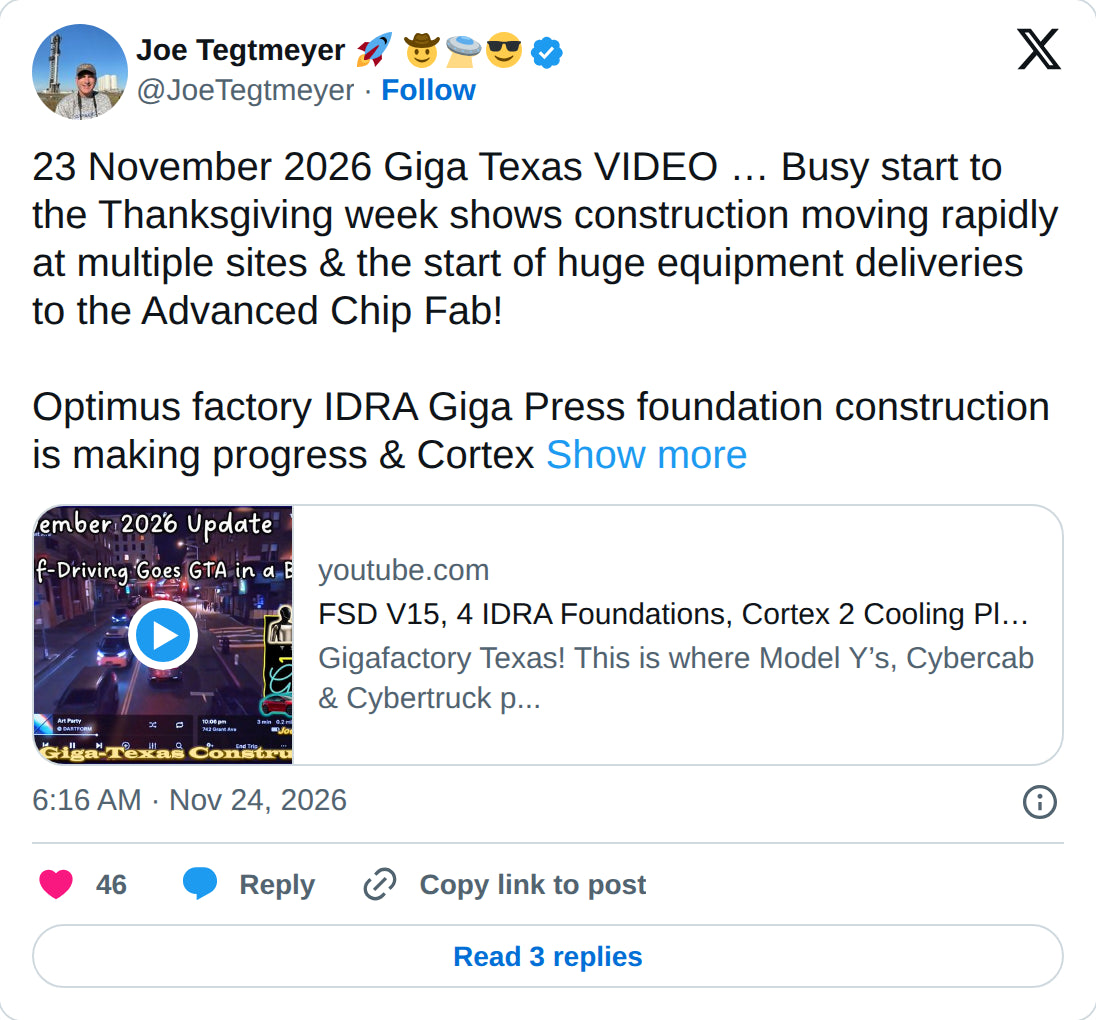
Aerial footage from November 23 shows Giga Texas in the middle of one of its most infrastructure-dense construction phases yet. Among the activity: The Boring Company's tunnel boring equipment is being staged and configured, while the external wall installation for a new Vertical Reciprocating Conveyor system is moving quickly. Two separate projects, two distinct purposes — here's what's actually happening with each.

What is The Boring Company actually building at Giga Texas?
The primary project is the Colorado River Connector Tunnel — a dedicated underground passage linking Giga Texas to the Advanced Technology Chip Fabrication Facility (ATCF) being built to the northeast. The ATCF is a joint SpaceX-Tesla R&D campus, and the tunnel is designed to give it a weather-independent, high-security underground connection for logistics and personnel. It will run as a single-lane, bi-directional tunnel beneath the Colorado River. This is a separate project from any existing Boring Company infrastructure already serving internal factory movement at Giga Texas. For more background on how this project came together, see our earlier breakdown of the Colorado River Tunnel.
Where does the TBM setup currently stand?
As of late November, crews are in the equipment staging and launch-pit preparation phase. Earlier in November, work focused on installing forms, rebar, and a thrust ring support frame — the structural foundation the TBM pushes against when it begins boring. Fresh tunnel liner segments have also been confirmed on-site, which signals that active boring is expected to begin within weeks rather than months. The Boring Company's Prufrock TBM is the machine expected to handle this project. The ATCF has a hard deadline driving the timeline: SpaceX is targeting its first test chip from the facility in May or June 2027, which means the tunnel needs to be operational well before that.
What is the VRC system, and why does Giga Texas need one?
A Vertical Reciprocating Conveyor is essentially a heavy-duty industrial lift — think of it as a freight elevator engineered for very large, very heavy loads moving between floor levels at high frequency. At Giga Texas, the VRC system is being installed on the east side of the factory near new receiving docks, and it's expected to automate the movement of castings between levels. As production scales — particularly with Cybercab ramp-up and the ongoing Cybertruck and Model Y lines — moving large cast components manually or with forklifts becomes a bottleneck. The VRC addresses that directly. For a broader look at how Giga Texas is restructuring its production layout, the full production mode breakdown from November 20 has useful context.
How far along is the VRC installation?
Progress has been fast. By late October, both raising platforms of the system were in place and a roof structure over the top equipment bay was being installed. By early November, the system appeared substantially complete mechanically, though the entranceways connecting it into the factory floor were not yet finalized and some components were still awaiting installation. The external wall installation — what Joe Tegtmeyer flagged in his November 23 footage — represents the enclosure phase, which typically follows once the core mechanical structure is in place. The speed of this phase tracks with the broader push to get east-side receiving capacity online.
Are these two projects connected to each other?
Not directly. The tunnel is external infrastructure serving the chip fab campus across the river. The VRC is internal factory logistics serving production lines inside Giga Texas itself. What they share is timing: both are part of the same broad expansion wave that also includes the Optimus factory Giga Press foundations, the Cortex 2 cooling plant coming online, and major equipment deliveries to the chip fab. Giga Texas is effectively being rebuilt around a significantly larger and more automated production footprint — the Optimus, chip fab, and Cortex 2 expansion piece from November 18 covers the wider picture.
The next visible milestone to watch for is the TBM beginning its actual bore — once the thrust ring and launch pit prep wraps up, that transition will be hard to miss from aerial footage. On the VRC side, the remaining question is when the factory entranceways get cut through and the system goes live for production use.
🤖 Tracking Tesla's humanoid robot? See every Optimus production milestone and appearance in our Tesla Optimus Tracker.
Related Gear
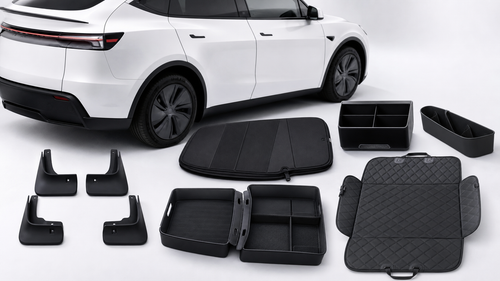
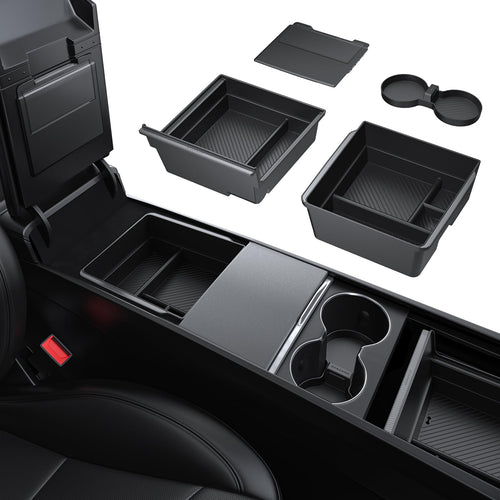
Gear up your Tesla with tested, custom-fit BASENOR accessories — shop Tesla accessories →
Sources & reporting notes
The links below identify the material source records used for this report.
- @JoeTegtmeyer on X (2026-11-23T22:16:51.000Z) — Direct source
Source links are preserved as published or accessed. See our editorial standards and corrections policy.
The BASENOR Editorial Desk covers Tesla, SpaceX, and related technology, curating reporting from primary sources — official accounts, regulatory filings, and software release data. Every article passes source-record and fact-checking review before publication. About the newsroom.
This report was curated by the BASENOR Editorial Desk from the sources listed above. Read our editorial standards or email editorial@basenor.com to report an error.