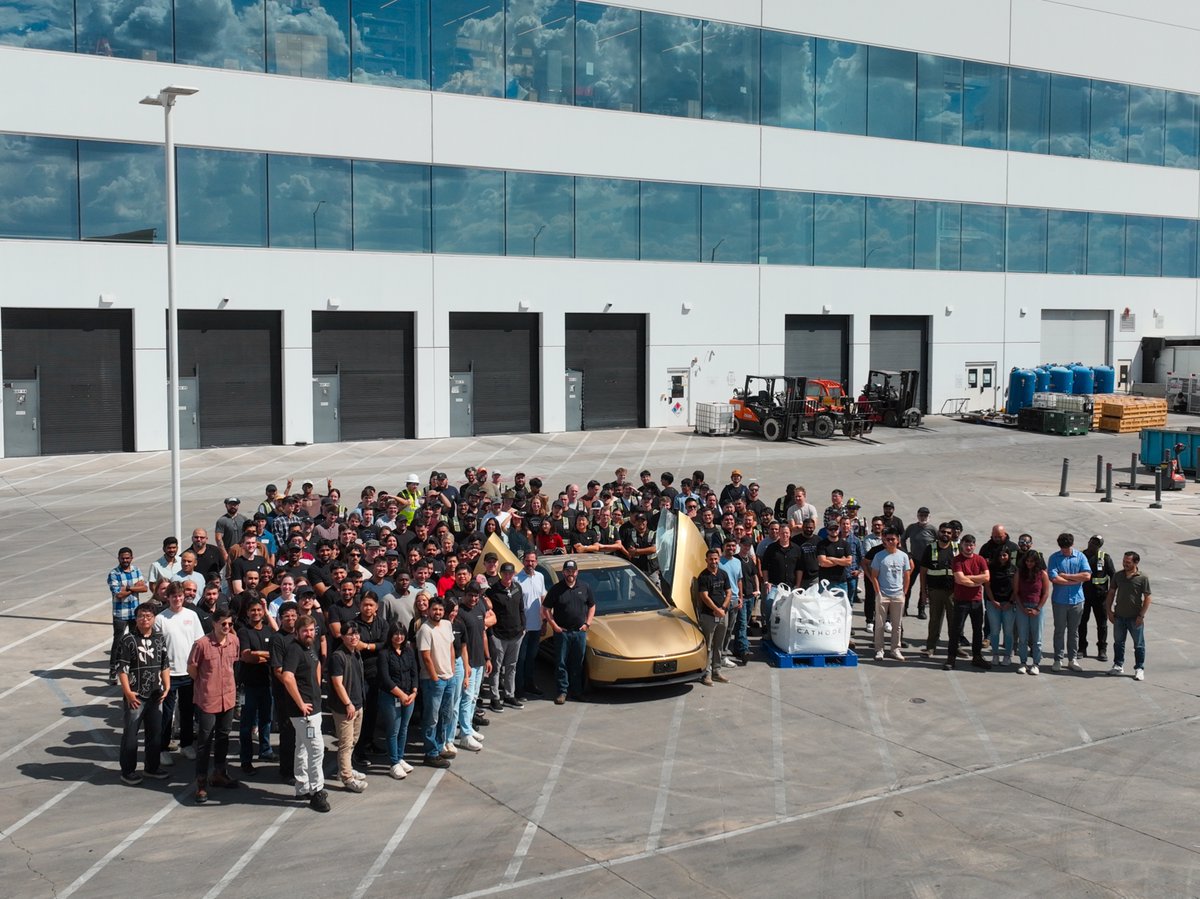
Tesla has crossed a significant threshold in its battery supply chain strategy. Elon Musk confirmed this week that nickel cathode — one of the most critical materials in a lithium-ion battery — is now being manufactured locally at Gigafactory Texas, not shipped in from overseas suppliers. It's a milestone years in the making, and the implications run deeper than a single tweet suggests.

1. It's the Only Large-Scale Lithium Cathode Operation in the Americas
According to Elon Musk, the Gigafactory Texas cathode facility is the only large-scale lithium battery cathode production operation anywhere in North or South America. That's not a minor distinction — cathode material has historically been dominated by Asian manufacturing, particularly in China and South Korea. Tesla's facility doesn't just reduce its own dependency; it represents a structural shift in where EV battery materials are made for the entire Western Hemisphere.
2. The Facility Reached Scale in August 2026
Tesla confirmed the cathode production facility was operating at scale as of August 21, 2026. The ramp began earlier — announcements in January 2026 indicated that both anode and cathode production using a dry electrode process were underway — but August marked the point where output became commercially meaningful. The current capacity is approximately 10 GWh, and the facility is still in an early ramp-up phase, meaning output is expected to grow.
3. The Process Comes From Tesla's Maxwell Technologies Acquisition
The manufacturing method here isn't conventional. Tesla uses a dry-electrode process — technology it acquired when it bought Maxwell Technologies back in 2019. Traditional cathode manufacturing relies on toxic solvents to bind electrode materials. The dry process eliminates those entirely, instead mixing nickel, manganese, and cobalt precursor with lithium hydroxide, then compressing, kiln-treating, and removing magnetic impurities. Beyond the environmental upside, the process is also more capital-efficient at scale, which is part of why Tesla invested in it for over $100 million to commercialize.
4. Local Production Cuts Material Transport by 80%
One of the clearest supply chain benefits: Tesla says local cathode production reduces material transport by approximately 80% compared to importing finished cathode from overseas. That number matters for both cost and resilience. Global lithium and battery material prices have been volatile, and long international logistics chains create exposure to shipping disruptions, tariffs, and currency fluctuations. Producing cathode on-site — or at minimum within Texas — dramatically shortens that chain.
5. It Connects Directly to Tesla's Texas Lithium Refinery
The cathode facility doesn't stand alone. Tesla's lithium refinery near Robstown, Texas — which became operational by January 2026 and fully ramped by July 2026 — feeds directly into the 4680 cell production at Gigafactory Texas. That refinery is targeting 30 GWh of annual capacity. The integration means Tesla now controls the flow from raw lithium refining through cathode manufacturing through cell production, all within the state of Texas. On September 22, 2026, the first Cybertruck equipped with 4680 cells using lithium refined entirely at Tesla's Gulf Coast facility rolled off the production line — a concrete proof point that the full chain is now operational.
6. The Investment Behind It Has Been Building Since 2023
This didn't happen overnight. Tesla filed for a $716 million expansion at Gigafactory Texas in January 2023, which included cathode manufacturing as part of roughly 1.5 million square feet of new projects. A separate capital project exceeding $100 million was specifically tied to commercializing the new cathode manufacturing process. The multi-year investment timeline explains why the facility is only now hitting scale — cathode chemistry at this level of vertical integration is genuinely difficult engineering, not just construction.
Taken together, these six points describe something more consequential than a factory milestone. Tesla has assembled a vertically integrated battery supply chain — lithium refining, cathode production, cell manufacturing — entirely within Texas. How quickly the 10 GWh cathode capacity scales toward the refinery's 30 GWh target will determine how much of Tesla's 4680 output can eventually be called truly domestic.
Related Gear
Gear up your Cybertruck with tested, custom-fit BASENOR accessories — shop Cybertruck accessories →
Sources & reporting notes
The links below identify the material source records used for this report.
- @elonmusk on X (2026-09-24T01:00:30.000Z) — Direct source
Source links are preserved as published or accessed. See our editorial standards and corrections policy.
The BASENOR Editorial Desk covers Tesla, SpaceX, and related technology, curating reporting from primary sources — official accounts, regulatory filings, and software release data. Every article passes source-record and fact-checking review before publication. About the newsroom.
This report was curated by the BASENOR Editorial Desk from the sources listed above. Read our editorial standards or email editorial@basenor.com to report an error.