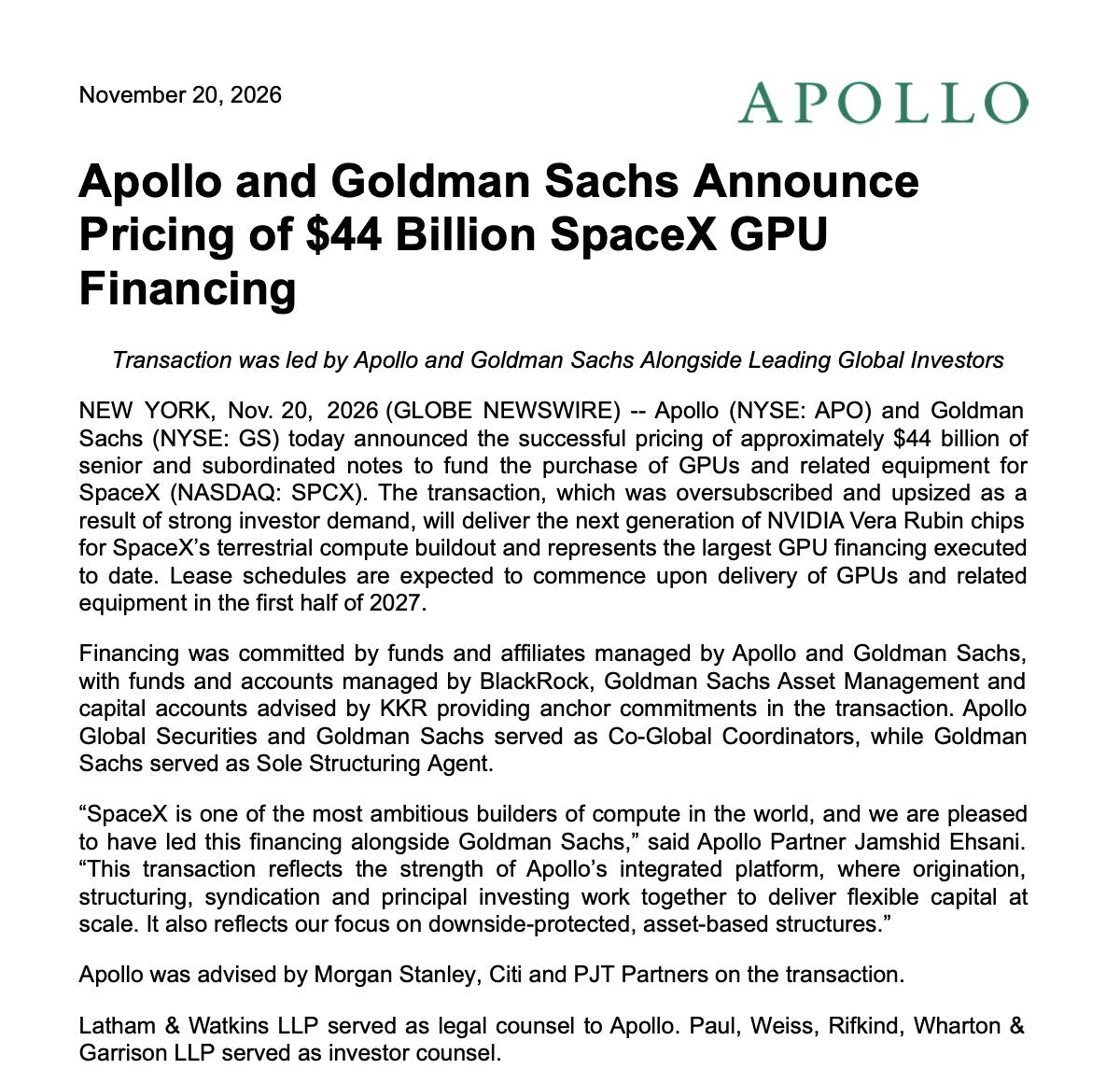
SpaceX has priced roughly $44 billion in senior and subordinated notes to fund its purchase of Nvidia's next-generation Vera Rubin AI chips and related data center equipment, a package the arrangers are calling the largest GPU-backed financing in history. Apollo Global Management and Goldman Sachs led the deal, which was oversubscribed and upsized from an initial $40 billion target, according to an announcement from Apollo on November 20, 2026.
The transaction reframes SpaceX from a rocket and satellite company into one of the most aggressive buyers of AI compute on the planet — and it signals that Elon Musk's terrestrial AI ambitions now rival the capital intensity of his space business.

The Deal in Numbers
| Metric | Detail |
|---|---|
| Total financing | ~$44 billion (upsized from $40B) |
| Lead arrangers | Apollo, Goldman Sachs (Co-Global Coordinators) |
| Anchor investors | BlackRock, Goldman Sachs Asset Management, KKR-advised accounts |
| Largest tranche | ~$25 billion investment-grade bond, yield near 8.3% (3.45 pts over Treasuries) |
| Structure | Lease via SPV (Saturn Funding Trust) |
| Collateral | Nvidia Vera Rubin GPUs and related equipment |
| Delivery | Lease schedules begin on GPU delivery, H1 2027 |
According to Apollo's deal release, the largest tranche — roughly $25 billion of investment-grade bonds — priced at about 3.45 points over Treasuries, implying a yield near 8.3%. The financing is structured through a special purpose vehicle called Saturn Funding Trust, which leases the hardware back to SpaceX. That structure keeps the debt off SpaceX's corporate balance sheet and is designed to protect the company's investment-grade credit rating, per the Apollo announcement.
Why Vera Rubin, and Why Now
Vera Rubin is Nvidia's next-generation data center platform, purpose-built for agentic AI and massive mixture-of-experts models. Full production was confirmed by Nvidia in May/June 2026, with general availability reaching customers by October 2026, according to Nvidia's public roadmap communications. Rubin succeeds the Blackwell generation and is positioned as the backbone of the next wave of frontier model training and inference.
For SpaceX, the timing is deliberate. The company's AI business — which includes Grok and cloud compute services tied to the broader xAI stack — generated $7.6 billion of SpaceX's $14.6 billion in Q3 2026 revenue, surpassing Starlink and launch combined, according to figures reported by multiple outlets covering the deal including TechCrunch and Apollo's own disclosures. Musk has publicly described a payback period of under one year on AI infrastructure investments, which, if accurate, makes a $44 billion GPU commitment financially rational even at an ~8.3% cost of debt.
The "Keep the Chips on Earth" Clause
One of the more unusual details: lenders pushed to include provisions ensuring the GPUs — which serve as collateral — remain on Earth, housed in U.S. data centers majority-owned, controlled, and operated by SpaceX. The clause is a direct acknowledgment that this is SpaceX, a company that routinely launches hardware into orbit, and that creditors wanted explicit assurance their collateral wouldn't end up on a Starship bound for Mars or deployed as part of an orbital compute experiment. It's a reminder that terrestrial AI buildout and SpaceX's space ambitions are being carefully firewalled — at least on paper.
What It Signals for the AI Infrastructure Race
A $44 billion single-transaction GPU financing is a new category of capital formation. Hyperscalers like Microsoft, Google, and Meta have funded their AI buildouts primarily through operating cash flow and corporate debt. SpaceX — a private company — just demonstrated that asset-backed structures using GPUs as collateral can clear at investment-grade pricing, opening a template other AI compute buyers may follow.
The oversubscription and upsizing from $40B to $44B also says something about investor appetite: there is sustained demand for exposure to AI infrastructure debt, particularly when it's tied to a borrower with diversified revenue streams (launch, Starlink, AI services) and a credible operating thesis on utilization.
What to Watch Next
- H1 2027 chip deliveries: Lease schedules only commence when the Vera Rubin units arrive. Any slippage in Nvidia's shipment cadence would delay SpaceX's capacity ramp.
- Data center siting: SpaceX hasn't publicly detailed which U.S. sites will house the Rubin fleet. Expect announcements about new or expanded compute campuses in 2027.
- Grok and xAI integration: How this compute is allocated between Grok inference, xAI model training, and third-party cloud services will shape SpaceX's AI P&L.
- Follow-on financings: If Saturn Funding Trust performs, expect copycat GPU-backed structures from other AI buyers — and potentially additional SpaceX tranches.
Mini-FAQ
Is this debt on SpaceX's balance sheet?
No. The financing is routed through Saturn Funding Trust, a special purpose vehicle that owns the GPUs and leases them to SpaceX. This off-balance-sheet treatment is specifically intended to protect SpaceX's investment-grade credit rating, according to Apollo's deal disclosures.
What are Nvidia Vera Rubin chips?
Vera Rubin is Nvidia's next-generation AI data center platform, successor to the Blackwell generation. It's designed for agentic AI workloads and large mixture-of-experts model training and inference. Nvidia confirmed full production in mid-2026 with general availability by October 2026.
How does this relate to xAI and Grok?
SpaceX's AI business, which includes Grok and cloud compute services, generated more than half of SpaceX's Q3 2026 revenue. The Vera Rubin fleet will expand the compute capacity backing those services and, by extension, Musk's broader AI stack.
Why did lenders require the chips to stay on Earth?
Because SpaceX is a space launch company and the GPUs serve as collateral. Creditors want contractual certainty that the hardware securing their notes won't be deployed off-planet, which would complicate repossession and valuation in any default scenario.
At $44 billion, this isn't just a financing — it's a statement about how AI infrastructure gets funded going forward, and about where SpaceX sees its next decade of revenue coming from.
Related Gear
Gear up your Tesla with tested, custom-fit BASENOR accessories — shop Tesla accessories →
Sources & reporting notes
The links below identify the material source records used for this report.
- @SawyerMerritt on X (2026-11-20T19:04:07.000Z) — Direct source
- @SawyerMerritt on X (2026-11-20T19:04:08.000Z) — Direct source
Source links are preserved as published or accessed. See our editorial standards and corrections policy.
The BASENOR Editorial Desk covers Tesla, SpaceX, and related technology, curating reporting from primary sources — official accounts, regulatory filings, and software release data. Every article passes source-record and fact-checking review before publication. About the newsroom.
This report was curated by the BASENOR Editorial Desk from the sources listed above. Read our editorial standards or email editorial@basenor.com to report an error.