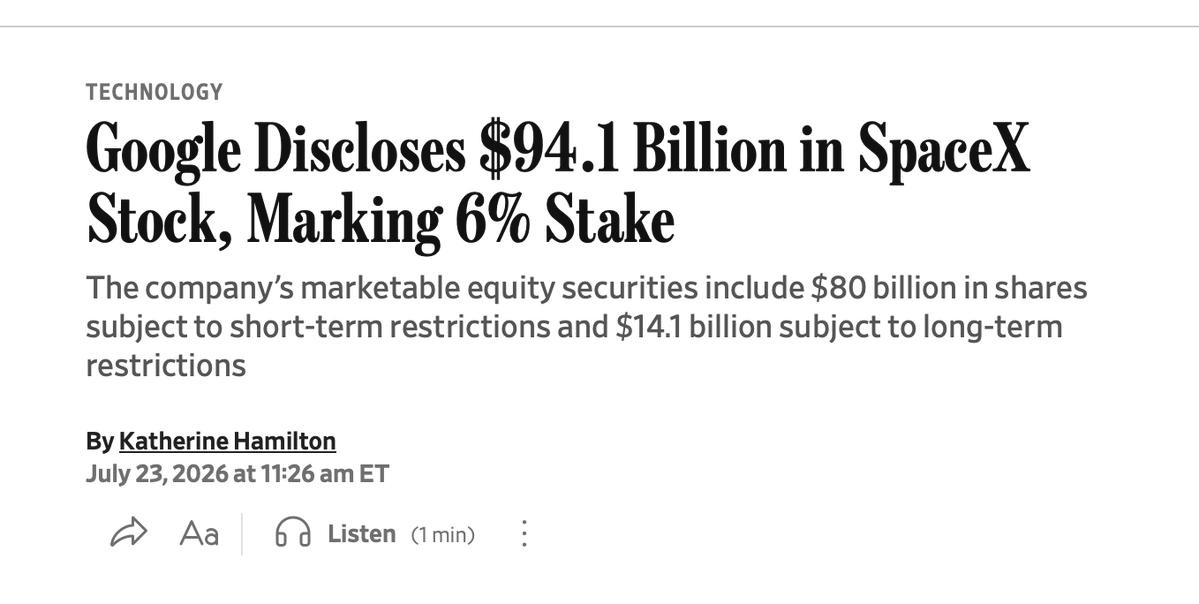
Alphabet Inc. disclosed a $94.1 billion equity stake in SpaceX in its second-quarter filing on July 23, 2026 — a figure that turns what began as a modest 2015 bet into one of the most valuable private-company positions ever held by a public corporation. For anyone tracking the SpaceX ecosystem, the numbers buried in that filing tell a more interesting story than the headline alone.

1. The Stake Is $94.1 Billion — About 6% of a $1.52 Trillion Company
SpaceX went public in June 2026 and now carries a market cap of roughly $1.52 trillion, with shares recently trading around $112.13. Alphabet's disclosed holding of $94.1 billion represents approximately 6% of that valuation. To put the scale in context: that single position is larger than the entire market cap of most Fortune 500 companies. According to Alphabet's Q2 filing, the SpaceX stake was a primary driver of nearly $100 billion in investment gains for the quarter.
2. $80 Billion of It Is Locked Up Short-Term
Not all $94.1 billion is freely tradeable. According to Alphabet's filing, $80 billion of the SpaceX stock is subject to short-term selling restrictions. That's a standard condition for early investors following a public offering — lockup periods prevent large holders from flooding the market immediately after an IPO. The practical implication: Alphabet cannot quickly liquidate the bulk of this position even if it wanted to.
3. Another $14.1 Billion Is Restricted Through Q3 2027
Beyond the short-term lockup, an additional $14.1 billion of the stake carries long-term restrictions that extend through the third quarter of 2027. That means the full position won't be freely liquid for well over a year. The tiered restriction structure suggests the holding was acquired across multiple tranches or subject to negotiated post-IPO terms — either way, Alphabet is effectively a committed long-term holder whether it intends to be or not.
4. Google Paid Around $1 Billion for This in 2015
The origin of this position dates back to January 2015, when Google invested alongside Fidelity in a combined $1 billion round for just under 10% of SpaceX. At the time, SpaceX was valued at approximately $12 billion. That initial investment has grown to a disclosed value of $94.1 billion — a return of roughly 94x on the original outlay, before accounting for any dilution from subsequent funding rounds. It stands as one of the most lucrative venture bets in Silicon Valley history.
5. Google Is Also Paying SpaceX $920 Million Per Month for AI Compute
The equity relationship is only part of the picture. Separately, in June 2026, Alphabet agreed to a multi-year contract to pay SpaceX approximately $920 million per month for AI computing capacity. The deal runs from October 2026 through June 2029 — totaling roughly $30 billion over the contract term, according to reporting on the filing. That means Alphabet is simultaneously one of SpaceX's largest shareholders and one of its largest customers, a degree of financial entanglement that goes well beyond a passive investment.
Taken together, these figures describe a relationship that is now structural rather than speculative. Alphabet holds a locked-up, multi-billion-dollar equity position in SpaceX while committing tens of billions more in computing contracts — a dual dependency that gives both companies significant leverage over the other. How that dynamic plays out as SpaceX matures as a public company will be worth watching closely. For more on the SpaceX business story, see our SpaceX coverage.
Sources & reporting notes
The links below identify the material source records used for this report.
- @wholemars on X (2026-07-26T17:58:27.000Z) — Direct source
Source links are preserved as published or accessed. See our editorial standards and corrections policy.
The BASENOR Editorial Desk covers Tesla, SpaceX, and related technology, curating reporting from primary sources — official accounts, regulatory filings, and software release data. Every article passes source-record and fact-checking review before publication. About the newsroom.
This report was curated by the BASENOR Editorial Desk from the sources listed above. Read our editorial standards or email editorial@basenor.com to report an error.