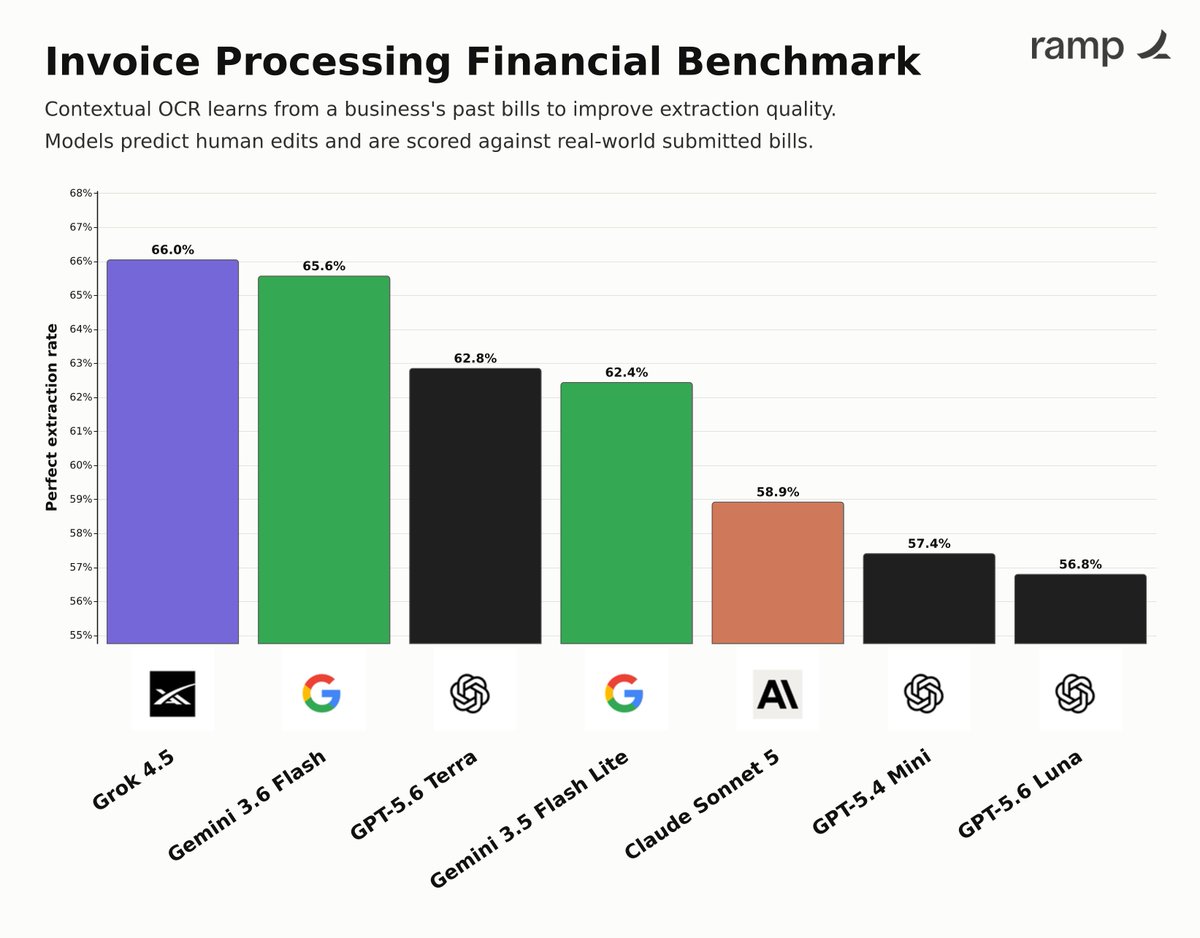
xAI's Grok 4.5 has claimed the top spot among frontier AI models on invoice processing — a task that sounds mundane but is genuinely hard to get right at scale. The announcement came directly from the official @grok account on July 24, 2026, and it's worth unpacking what that actually means for businesses and developers who handle document-heavy workflows.

What exactly is invoice processing, and why is it a meaningful benchmark?
Invoice processing involves extracting structured data from unstructured or semi-structured documents — line items, vendor names, totals, tax fields, payment terms — and doing so accurately across wildly inconsistent formats. It's a real-world stress test for document understanding: the model has to handle variable layouts, handwritten notes, scanned PDFs, currency formatting across locales, and multi-page documents without losing context. Getting it wrong has direct financial consequences, which is why it's a far more meaningful benchmark than abstract reasoning puzzles. Topping this category signals that Grok 4.5 can handle the kind of messy, high-stakes document work that enterprises actually care about.
What makes Grok 4.5 capable of this kind of document work?
According to xAI, Grok 4.5 was specifically built for agentic tasks and knowledge work, with explicit chain-of-thought reasoning that helps it work through multi-step extraction problems systematically rather than pattern-matching its way to a guess. It also features a 500,000-token context window, which means it can hold an entire multi-page document — or a batch of invoices — in a single pass without losing earlier context. The model runs as a mixture-of-experts architecture, which lets it route document-specific tasks to the most relevant internal pathways rather than treating every query identically.
How does Grok 4.5 compare to other leading models on cost and speed?
According to xAI, Grok 4.5 is priced at $2 per million input tokens and $6 per million output tokens — positioning it below comparable models from other leading AI labs. Elon Musk has described it as roughly comparable to Anthropic's Opus 4.7 in capability but faster and approximately 2x more token-efficient. At 80 tokens per second, it operates at fast-model speeds, which matters when you're processing hundreds of invoices in a pipeline rather than a single document interactively.
When did Grok 4.5 launch, and where can you access it?
xAI initially released Grok 4.5 around July 8, 2026, with a broader rollout to grok.com, X, and the official iOS and Android apps completing around July 22–23, 2026 — just days before this invoice processing claim was published. It's also available via API for developers building document automation pipelines, and xAI has released native Microsoft 365 add-ins for Word, Excel, PowerPoint, and Outlook, which makes invoice-adjacent workflows like summarizing PDFs or building multi-sheet Excel reconciliations directly accessible without leaving familiar tools.
Does this have any relevance to Tesla or xAI's broader ambitions?
Directly, no — invoice processing isn't a Tesla vehicle feature. But it matters in the bigger picture. xAI is positioning Grok not just as a chatbot but as an enterprise-grade reasoning engine capable of replacing entire back-office workflows. The faster Grok establishes credibility in high-stakes document tasks, the stronger the foundation for deploying similar reasoning capabilities in more complex domains — including the kind of real-world decision-making that autonomous systems like FSD and Optimus will eventually need. A model that can reliably extract structured meaning from chaotic documents is one step closer to a model that can reliably act on the world.
The invoice processing benchmark is a narrow data point, but it's the kind of narrow win that compounds. xAI has been moving quickly since Grok 4.5's launch, and this claim — made by the official @grok account rather than a third-party benchmark site — suggests the team is confident enough in the result to put it front and center. The next test will be whether independent evaluators can reproduce the finding at scale.
Sources & reporting notes
The links below identify the material source records used for this report.
- @grok on X (2026-07-24T19:20:01.000Z) — Direct source
Source links are preserved as published or accessed. See our editorial standards and corrections policy.
The BASENOR Editorial Desk covers Tesla, SpaceX, and related technology, curating reporting from primary sources — official accounts, regulatory filings, and software release data. Every article passes source-record and fact-checking review before publication. About the newsroom.
This report was curated by the BASENOR Editorial Desk from the sources listed above. Read our editorial standards or email editorial@basenor.com to report an error.