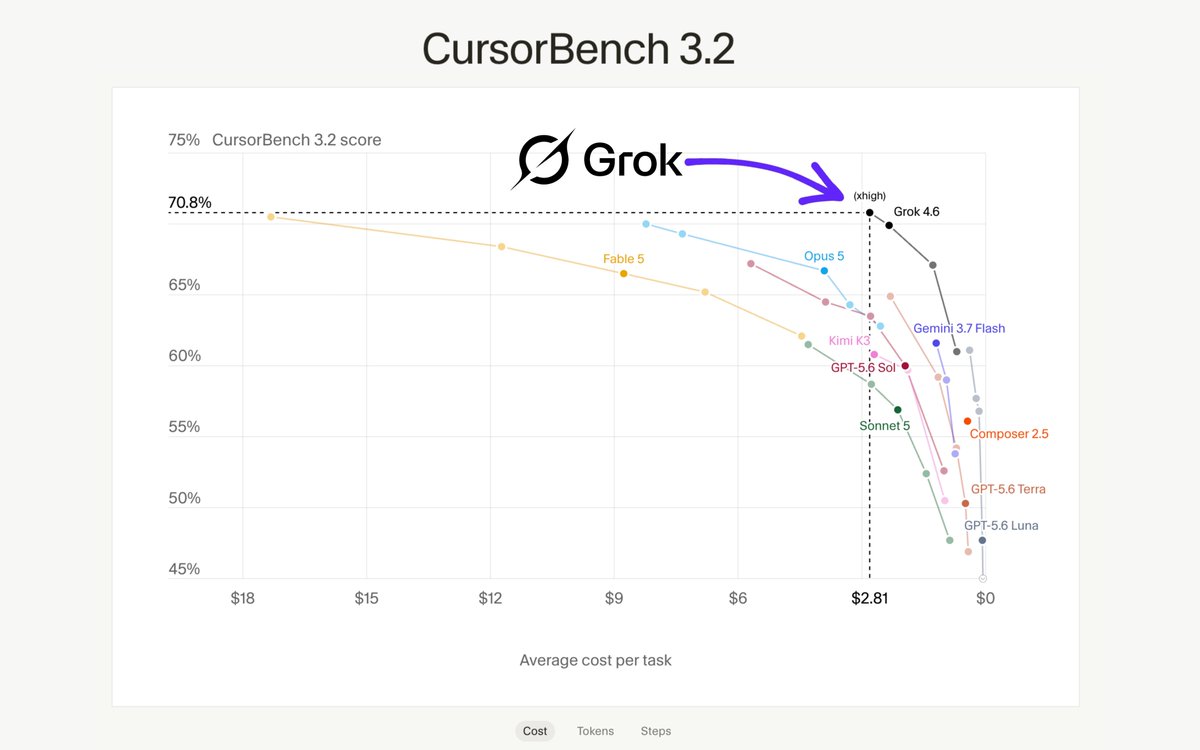
Elon Musk announced Thursday that xAI's Grok 4.6, when run in a newly highlighted 'extra high thinking mode,' has taken the top spot on CursorBench 3.2 — a coding-focused benchmark that measures how well large language models perform real developer tasks inside the Cursor IDE. According to verified benchmark data, Grok 4.6 posted a 70.8% score, edging out Fable 5 Max at 70.5%. What's arguably more notable than the raw score is the cost profile behind it.

Why the benchmark result matters
CursorBench has quickly become one of the more closely watched evaluations in AI-assisted coding because, unlike synthetic problem sets, it grades models on the kind of multi-file, agentic edits developers actually run through Cursor. A top score there translates fairly directly into a real-world claim: that the model is the best available option, right now, for AI-assisted software engineering inside a mainstream IDE.
Grok 4.6 was officially released on August 12, 2026 as an incremental step up from Grok 4.5. In its standard configuration, its earlier CursorBench numbers were competitive but not chart-topping. The 'extra high thinking mode' is essentially a higher-compute reasoning setting — more inference-time deliberation before the model commits to an answer — and it's what pushed the score into first place.
The cost story is the real headline
Benchmark leaderboards flip regularly. What tends to be stickier is unit economics. According to CursorBench 3.2 data, Grok 4.6 in extra high thinking mode came in at roughly $2.81 per task. The models it beat — or tied — were dramatically more expensive on the same workload.
| Model | CursorBench 3.2 Score | Cost per Task |
|---|---|---|
| Grok 4.6 (extra high thinking) | 70.8% | $2.81 |
| Fable 5 Max | 70.5% | $17.32 |
| Opus 5 Max | — | $8.23 |
| GPT-5.6 Sol Max | — | $5.69 |
That's a roughly 6x cost gap between Grok 4.6's top-scoring run and Fable 5 Max's second-place run. In a category where developers and enterprises pay per token, that kind of spread is what actually moves procurement decisions — arguably more than a 0.3-point leaderboard win.
How Grok 4.6 is being distributed
xAI has been noticeably aggressive about distribution since Grok 4.6 launched. According to xAI's own documentation, the model is available through the xAI API, Grok Build, Cursor, OpenRouter, Vercel, and Cloudflare, and it was added to Amazon Bedrock on August 19, 2026 — two days before Musk's CursorBench announcement.
Standard API pricing for Grok 4.6 sits at $2 per million input tokens and $6 per million output tokens for short-context requests (under 200K prompt tokens). Long-context requests at or above 200K tokens double to $4 input and $12 output. The model carries a 500,000-token context window, which is what makes agentic coding workflows — where the model needs to hold an entire repository in its head — practical in the first place.
What this means for the AI-for-coding race
Cursor has emerged as one of the most important battlegrounds for frontier models, because it puts them directly in front of paying professional developers doing production work. Winning CursorBench isn't just a bragging-rights exercise — it's a lead-generation channel. If Grok 4.6 in extra high thinking mode holds its position for even a few weeks, expect xAI to lean into developer-tooling positioning much harder than it has to date.
There are a few caveats worth keeping in mind. CursorBench versions move quickly, and rival labs almost always respond within days with a new checkpoint. The 'extra high thinking' configuration also uses more inference compute per task, which is what the $2.81 already reflects — but latency, not just cost, is a real trade-off in an IDE where developers expect near-instant completions. Musk's post didn't specify how much slower the extra-high mode runs versus standard Grok 4.6.
The Tesla and xAI connection
For Tesla owners, the relevance is indirect but real. xAI's model progress feeds directly into the Grok assistant that ships inside Tesla vehicles, and any gains in reasoning quality — particularly in the higher-compute reasoning modes — are the pool that in-car Grok features are eventually drawn from. A model that's cheaper and smarter at agentic tasks is also, over time, a better foundation for the kind of context-aware, multi-step voice assistant Tesla has been building toward.
What to watch next
- Response from Anthropic and OpenAI. A 0.3-point lead is easily reclaimed. Watch for new Opus and GPT checkpoints on CursorBench within the next 2–4 weeks.
- Latency disclosures. xAI has not published task completion times for extra high thinking mode. That number will determine whether developers actually switch defaults.
- Cursor default model changes. If Cursor promotes Grok 4.6 to a recommended or default option, that's a much stronger signal than any single benchmark score.
- In-car Grok updates. Any bump to the in-vehicle assistant that references the 4.6 base model would confirm the trickle-down to Tesla owners.
For now, xAI has a genuine — if narrow — lead at the top of one of the most scrutinized benchmarks in AI coding, and it's holding that lead at a fraction of competitors' cost. Whether that lead survives the next benchmark refresh is the question that actually matters.
Related Gear
Gear up your Tesla with tested, custom-fit BASENOR accessories — shop Tesla accessories →
Sources & reporting notes
The links below identify the material source records used for this report.
- @elonmusk on X (2026-08-21T16:36:35.000Z) — Direct source
Source links are preserved as published or accessed. See our editorial standards and corrections policy.
The BASENOR Editorial Desk covers Tesla, SpaceX, and related technology, curating reporting from primary sources — official accounts, regulatory filings, and software release data. Every article passes source-record and fact-checking review before publication. About the newsroom.
This report was curated by the BASENOR Editorial Desk from the sources listed above. Read our editorial standards or email editorial@basenor.com to report an error.