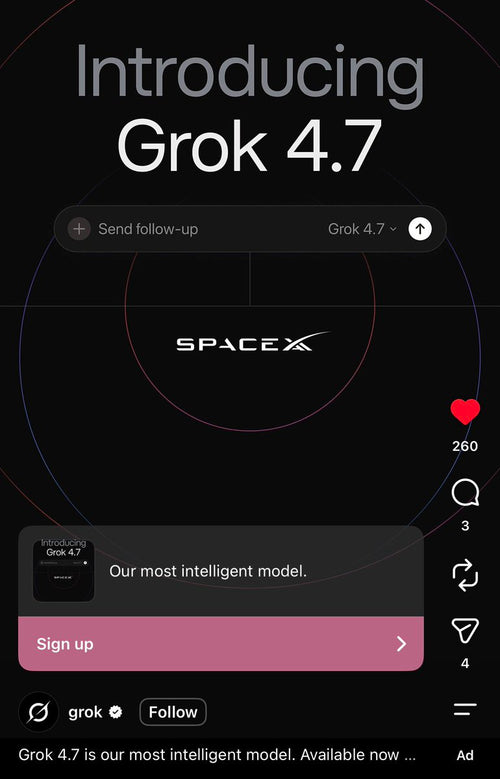
xAI's Grok 4.7 is now available on Amazon Bedrock as of September 28, 2026, giving developers and enterprises direct access to the model through AWS's fully managed infrastructure. The release expands Grok's reach beyond xAI's own API, and comes with a meaningful architectural upgrade over its predecessor. Here's what you need to know.

What actually changed between Grok 4.6 and Grok 4.7?
Quite a lot under the hood. According to xAI, Grok 4.7 runs on a new base model with 2.1 trillion parameters — a 40% increase over Grok 4.6's 1.5 trillion. It was trained with a longer reinforcement learning run on a harder task mix, and went through a supplemental training phase that incorporated SpaceX engineering records, telemetry data, and internal documents. In practical terms, xAI says this translates to better mixed-document handling, more reliable repo-scale coding with planning and error recovery, stronger browser-use agents for form fills and portal navigation, and improved self-verification capabilities.
What is the context window, and what input types does it support?
Grok 4.7 offers a 500,000-token context window — large enough to handle entire codebases or lengthy document sets in a single pass. It accepts both text and image inputs, with text-only output. One notable control is configurable reasoning effort: you can set it to low, medium, high (the default), or xhigh depending on how much compute you want the model to spend on a given task.
What does it cost on Amazon Bedrock?
Pricing matches Grok 4.6 at the standard tier. For prompts under 200,000 tokens, input runs $2.00 per million tokens, cached input is $0.50 per million tokens, and output is $6.00 per million tokens. For prompts at or above 200,000 tokens, those figures double: $4.00 input, $1.00 cached input, and $12.00 output per million tokens. There is also a Grok 4.7 Fast variant available through Cursor and Grok Build — it offers twice the token throughput at twice the price — but it is not available through the public xAI API or Amazon Bedrock.
Where else can you access Grok 4.7?
Beyond Amazon Bedrock, Grok 4.7 is available through the xAI API directly, Cursor, Grok Build, and third-party model routers. The model itself launched on September 21, 2026 — the Bedrock integration, announced September 28, is the latest distribution channel to come online. For teams already running workloads on AWS, Bedrock access means no new vendor relationship, no separate API key management, and billing that rolls into existing AWS spend.
Is there anything specific to the SpaceX training data that developers should know?
xAI incorporated SpaceX engineering records and telemetry data into a supplemental training phase for Grok 4.7. The stated goal was to sharpen the model's performance on complex technical reasoning and agentic tasks — the kinds of multi-step workflows where a model needs to plan, execute, catch its own errors, and recover. Whether that training data produces measurable gains on non-aerospace engineering tasks is something the developer community will stress-test in the weeks ahead. The model's native Grok Bot harness understanding is also cited as an improvement, which matters for teams building autonomous agents on top of the xAI ecosystem.
For AWS-native teams, the Bedrock availability removes the last friction point for evaluating Grok 4.7 against other frontier models in production. The 500k context window and configurable reasoning effort give it a distinct profile worth benchmarking — especially for long-document and agentic use cases where those parameters directly affect cost and latency.
Sources & reporting notes
The links below identify the material source records used for this report.
- @SpaceXAI on X (2026-09-28T23:10:53.000Z) — Direct source
Source links are preserved as published or accessed. See our editorial standards and corrections policy.
The BASENOR Editorial Desk covers Tesla, SpaceX, and related technology, curating reporting from primary sources — official accounts, regulatory filings, and software release data. Every article passes source-record and fact-checking review before publication. About the newsroom.
This report was curated by the BASENOR Editorial Desk from the sources listed above. Read our editorial standards or email editorial@basenor.com to report an error.