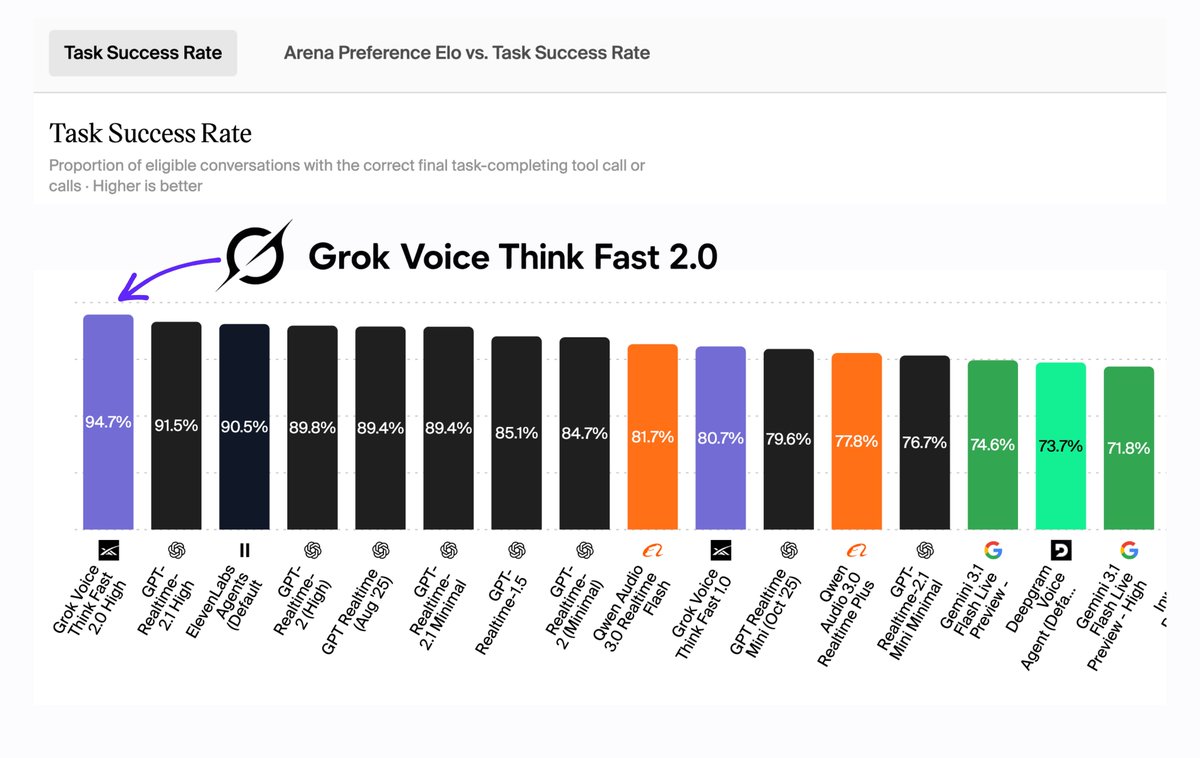
xAI's Grok Voice Think Fast 2.0 has claimed the top spot on a key voice AI benchmark, with Elon Musk flagging the milestone on X. The model — released on July 29, 2026 — posted the highest agentic performance score on the τ-voice Bench, edging out competing models from OpenAI and Google. Here's what the numbers actually mean.

What benchmark did Grok Voice actually top?
The first-place ranking refers to the τ-voice Bench for agentic performance, where Grok Voice Think Fast 2.0 scored 56.5%. This benchmark specifically measures a model's ability to handle multi-step, tool-using workflows over voice — think booking a reservation, querying live data, or chaining actions across apps — rather than simple question-and-answer exchanges. That's a meaningfully different test than raw speech quality or transcription speed.
How does it compare to OpenAI and Google?
On that same τ-voice Bench agentic score, OpenAI's GPT-Realtime-2.1 came in at 45.7% and Google's Gemini 3.1 Flash Live at 37.7%, according to the benchmark data. That's a gap of roughly 11 and 19 percentage points respectively — not a marginal win. For overall speech-to-speech quality, however, Grok Voice Think Fast 2.0 ranks second at 82.9% on Artificial Analysis's Speech-to-Speech Quality Index, sitting just behind Alibaba's Qwen Audio 3.0 Realtime Plus at 84.1%.
What improved over the previous version?
The jump from Think Fast 1.0 is substantial across several dimensions. Overall speech-to-speech quality moved from 75.7% to 82.9%. Latency — measured as time to first audio — dropped from 1.25 seconds to 0.70 seconds, making it the only top-five model to break the one-second barrier. Transcription accuracy improved 1.4 times over the prior Grok version, and in noisy or phone-compressed audio conditions across 24 languages, the model reportedly outperforms dedicated transcription tools by a factor of roughly ten.
Why does latency under one second matter?
In voice AI, the gap between 1.25 and 0.70 seconds is the difference between a conversation that feels natural and one that feels like a phone call with lag. Human speech processing expects near-instant feedback — delays above roughly 800 milliseconds register as unnatural pauses. Getting under one second while maintaining high agentic capability is the harder engineering problem, and it's what separates a useful voice assistant from a demo.
Does this ranking have any direct relevance to Tesla owners?
Not immediately in-vehicle, but the trajectory matters. Grok is already integrated into the Tesla app and has been expanding its footprint across xAI's product surface. As xAI improves Grok's voice capabilities — particularly its ability to handle multi-step tool-using tasks — the case for deeper in-car integration grows stronger. A voice assistant that can reliably execute agentic workflows is a much more useful co-pilot than one that only answers factual questions. Whether and when that capability lands in Tesla's UI is still an open question, but the underlying model is clearly moving fast.
Sources & reporting notes
The links below identify the material source records used for this report.
- @elonmusk on X (2026-08-22T00:43:16.000Z) — Direct source
Source links are preserved as published or accessed. See our editorial standards and corrections policy.
The BASENOR Editorial Desk covers Tesla, SpaceX, and related technology, curating reporting from primary sources — official accounts, regulatory filings, and software release data. Every article passes source-record and fact-checking review before publication. About the newsroom.
This report was curated by the BASENOR Editorial Desk from the sources listed above. Read our editorial standards or email editorial@basenor.com to report an error.