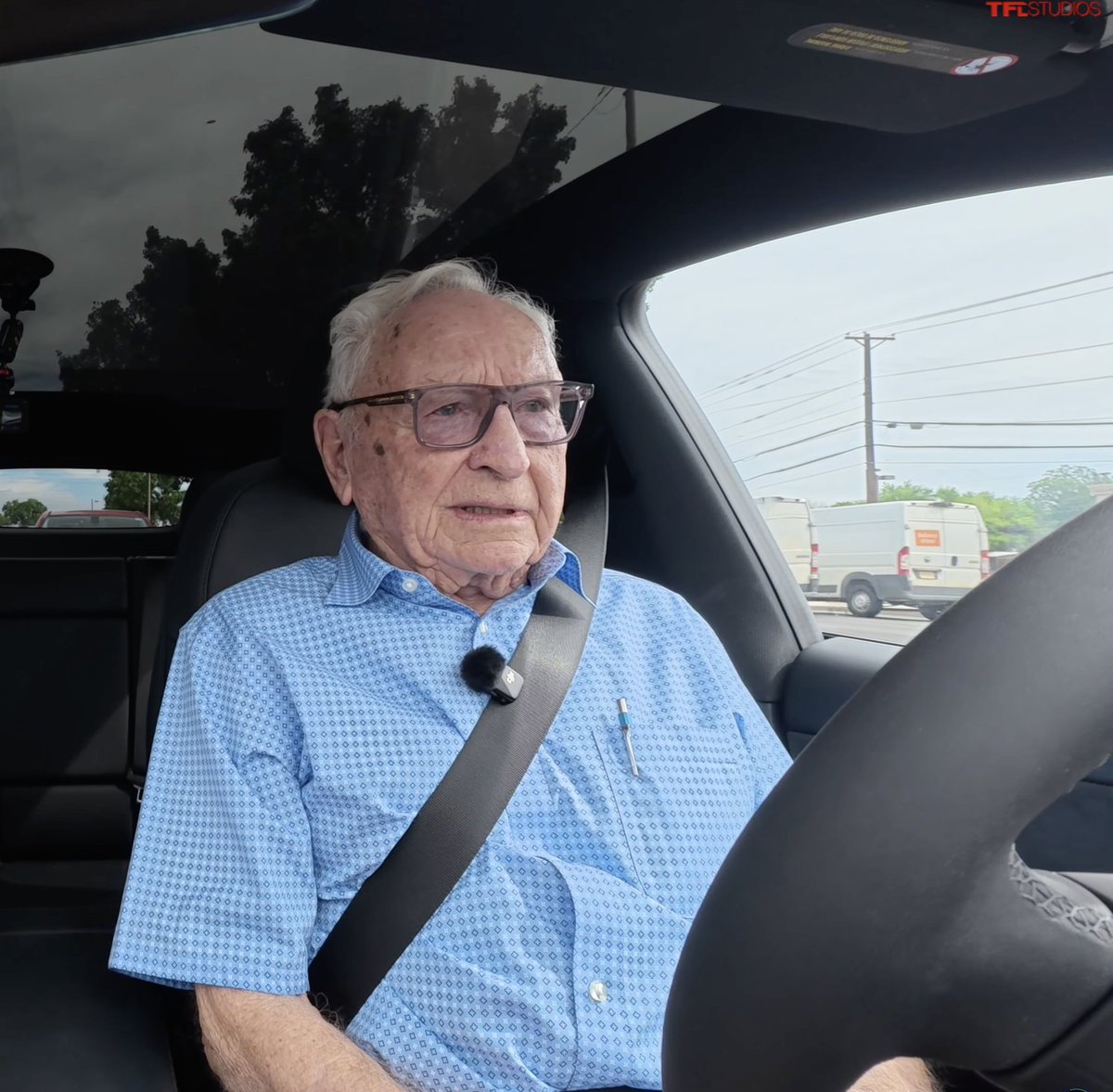
Larry's first car was a 1931 Ford Model A. His latest is a Tesla Model Y — and he lets FSD (Supervised) do most of the driving while Grok handles navigation. At 98 years old, Larry may be the most compelling real-world proof yet that Tesla's driver-assistance stack has moved well beyond the early-adopter crowd. Sawyer Merritt shared his story on September 9, 2026, including a detail that's hard to forget: FSD stopped the car for a chipmunk crossing the road.


What exactly is Larry using — FSD or just Autopilot?
FSD (Supervised), which is the full self-driving package that handles city streets, turns, stop signs, traffic lights, and highway driving. It's not the same as basic Autopilot, which only works on divided highways. FSD (Supervised) still requires a licensed driver to remain attentive and ready to intervene, but it handles the vast majority of the actual driving inputs. Larry is using it for everyday trips, not just highway cruising.
How does Grok fit into navigation — isn't that what the built-in maps are for?
The built-in maps still handle the route itself, but Grok lets you set destinations and adjust routes using plain conversational language instead of typing or tapping. You can say something like "take me to the nearest pharmacy" or "avoid the highway" and Grok interprets and acts on it. According to BASENOR's previous coverage, this Grok navigation integration first launched in North America in July 2025 and has since expanded globally. For someone like Larry, the voice-first interface removes a significant friction point — no touchscreen hunting required.
Did FSD really stop for a chipmunk?
That's what Larry reported, and it tracks with how FSD's object detection works. The system's neural network is trained to identify and respond to objects in the vehicle's path — not just cars, cyclists, and pedestrians, but smaller obstacles too. FSD v14, the current generation, significantly expanded the model's parameters compared to v13 and deepened its environmental awareness. Whether FSD classified the chipmunk as an obstacle or simply detected unexpected movement in the road, the outcome was the same: the car slowed and stopped. Larry's framing — "it has no problems" — suggests this wasn't alarming to him. It was reassuring.
Is FSD actually safe enough for a 98-year-old to rely on?
FSD (Supervised) is not a fully autonomous system — it still legally requires an attentive driver. But the practical reality Larry describes is that the system handles the driving while he monitors. Tesla's most recent FSD update, v14.3.9 (part of the 2026.27.6 software package rolling out now), adds an "Automatic Collision Evasion" feature that can activate FSD to avoid imminent collisions or when driver distraction is detected. That's a meaningful safety layer for any driver, but especially for older ones where reaction time may be a factor. Earlier this year, a similar story emerged about a 93-year-old woman who regained driving independence through the same FSD-plus-Grok combination in a Model Y.
What's coming next for Grok and FSD together?
The integration is still deepening. Elon Musk indicated that natural-language FSD voice commands — where Grok can directly influence FSD's driving decisions in real time — could arrive around September 2026. Tesla's VP of AI has confirmed that FSD (Supervised) will soon accept direct verbal instructions like "turn right here" or "back into the parking spot." The 2026 Summer Update (software package 2026.26) already expanded Grok voice controls to phone calls, music, climate, and the glovebox. Navigation was the first use case; active driving control looks like the next one. For drivers like Larry, that trajectory matters more than any spec sheet.
Larry's story isn't a marketing anecdote — it's a data point about where the technology actually stands. A 98-year-old who started with a hand-cranked 1931 Ford is now using an AI-assisted electric vehicle for daily errands, and his primary feedback is that it stopped for a chipmunk. The gap between FSD's early reputation and its current real-world behavior has rarely been illustrated more simply. The question worth watching now is whether the upcoming voice-controlled FSD commands make that experience even more accessible — or introduce new complexity that older drivers would rather not deal with.
Related Gear
Gear up your Model Y with tested, custom-fit BASENOR accessories — shop Model Y accessories →
Sources & reporting notes
The links below identify the material source records used for this report.
- @SawyerMerritt on X (2026-09-09T14:53:32.000Z) — Direct source
Source links are preserved as published or accessed. See our editorial standards and corrections policy.
The BASENOR Editorial Desk covers Tesla, SpaceX, and related technology, curating reporting from primary sources — official accounts, regulatory filings, and software release data. Every article passes source-record and fact-checking review before publication. About the newsroom.
This report was curated by the BASENOR Editorial Desk from the sources listed above. Read our editorial standards or email editorial@basenor.com to report an error.