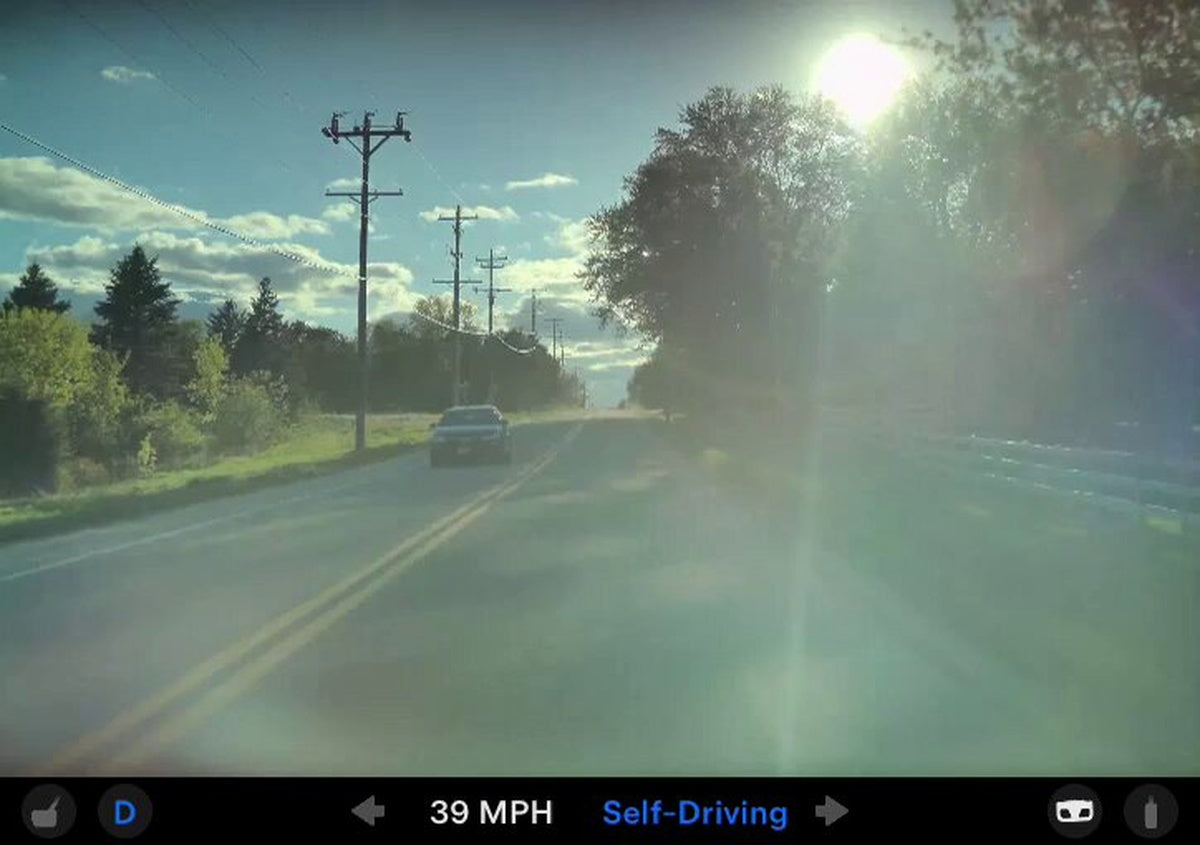
Tesla's official account posted a video this week showing FSD Supervised cutting through extreme sun glare — lighting conditions that would leave a human driver squinting and guessing. It's a striking demonstration, but the technology behind it has been years in the making, and the regulatory picture around it is more complicated than the clip suggests.

What Photon-Count Vision Actually Does
Standard cameras — including the ones in your eyes — use an image signal processor (ISP) to compress and tone-map what they capture. That compression is what causes glare: when a scene has extreme contrast between bright and dark areas, the ISP sacrifices detail at the extremes to produce a usable image. You lose the washed-out highlights. You lose the crushed shadows.
Tesla's approach, which Elon Musk first described publicly in November 2021, bypasses the ISP entirely. Instead of processing a finished image, the neural network trains directly on raw photon counts — the unfiltered light data coming off the sensor before any compression happens. The result is a dramatically wider dynamic range. According to Tesla, the system can resolve detail in near-blackout conditions and in direct glare simultaneously, something no ISP-processed image can do.
During Tesla's Q1 2025 earnings call, Musk described the capability as allowing FSD cameras to prevent image washout and "see in what appears to be the blackest of night." The May 9 side-by-side comparison shared on X — showing a standard RGB image next to the FSD AI's photon-count reconstruction of the same scene — made the gap visible to anyone watching.
Where It Stands in Current FSD Builds
The photon-count approach has been baked into FSD's neural network architecture for several versions now. FSD (Supervised) v14.3.2, released in early May 2026, includes an upgraded vision encoder specifically targeting performance in "rare and low-visibility scenarios" — glare, fog, and similar edge cases that have historically been weak points for camera-only systems.
Hardware matters here. HW4 cameras, found in newer Model 3, Model Y, Model S, Model X, and Cybertruck vehicles, capture higher-resolution data with better native low-light sensitivity, giving the neural network richer raw input to work with. HW3 vehicles can run the same FSD builds and benefit from the same training approach, though the underlying sensor data is less detailed.
The NHTSA Investigation Running in Parallel
The demonstration is impressive. The regulatory context is worth keeping in mind alongside it.
On March 18, 2026, NHTSA escalated its investigation into FSD Supervised to a full Engineering Analysis (EA26002), covering an estimated 3.2 million Tesla vehicles across most model years from 2016 to 2026. The agency's specific concern is not whether FSD can see through glare — it's whether FSD reliably knows when its cameras are impaired and warns the driver accordingly.
The investigation follows nine documented incidents, including one fatality and two injuries, where Tesla vehicles operating under FSD were involved in crashes during reduced-visibility conditions. In several cases, the system reportedly failed to detect or adequately respond to camera impairment caused by sun glare, fog, dust, or airborne particles.
These are distinct problems. Enhanced photon-count vision improves what the cameras can perceive under challenging conditions. Degradation detection is about what happens when perception fails anyway — whether the system recognizes that failure and hands control back to the driver before something goes wrong. NHTSA is focused on the latter. Tesla's video addresses the former.
What This Means for FSD Owners
If you're running a current FSD Supervised build on HW3 or HW4, you're already benefiting from the photon-count vision architecture. The v14.3.2 update specifically sharpened its performance in low-visibility edge cases, so owners who have noticed improved behavior in dawn, dusk, or direct-sun conditions recently are likely seeing this work in practice.
The NHTSA investigation is ongoing and doesn't require any action from owners at this stage — it's an engineering analysis, not a recall. But it's a reminder that perception capability and system safety aren't the same thing. How Tesla responds to NHTSA's degradation-detection questions will matter as much as any vision demo for the long-term trajectory of FSD's regulatory standing.
📋 Tracking Tesla software? See every firmware, FSD and app version in one place in our Tesla Software Update Tracker.
Related Gear
Gear up your Tesla with tested, custom-fit BASENOR accessories — shop Tesla accessories →
Sources & reporting notes
The links below identify the material source records used for this report.
- @Tesla on X (2026-05-14T04:34:10.000Z) — Direct source
Source links are preserved as published or accessed. See our editorial standards and corrections policy.
The BASENOR Editorial Desk covers Tesla, SpaceX, and related technology, curating reporting from primary sources — official accounts, regulatory filings, and software release data. Every article passes source-record and fact-checking review before publication. About the newsroom.
This report was curated by the BASENOR Editorial Desk from the sources listed above. Read our editorial standards or email editorial@basenor.com to report an error.