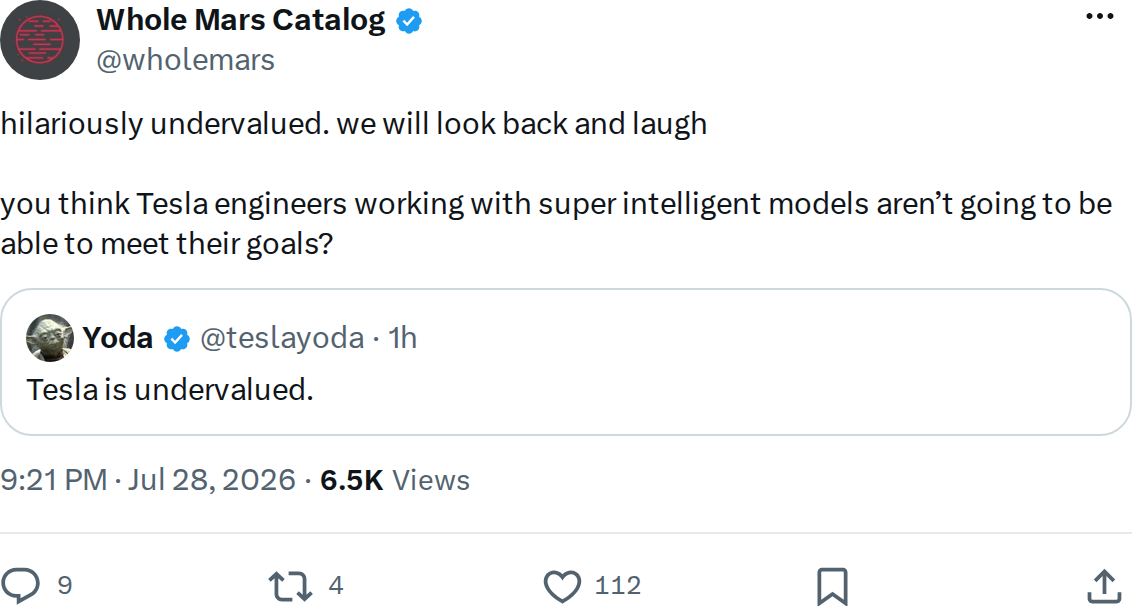
A prominent Tesla community account fired off a pointed question on Monday: if Tesla engineers are now working alongside super-intelligent AI models, why would anyone bet against them hitting their goals? The post, from Whole Mars Catalog, captured a sentiment that's been building quietly in Tesla circles — that the market still hasn't priced in what the company's AI infrastructure actually represents.

The Valuation Tension
Tesla's market capitalization sat between roughly $985 billion and $1.21 trillion in the week ending July 26, according to market data — a range that already makes it one of the most valuable companies on the planet. And yet the bull case, as articulated by accounts like Whole Mars Catalog, is that even at those levels the stock is "hilariously" cheap relative to what the AI layer could eventually produce.
The tension is real and it shows up in Tesla's own Q2 2026 results, released July 22. Revenue hit $28.24 billion — up 26% year-over-year, a genuinely strong top-line number. But GAAP net income fell 5% to $1.11 billion, free cash flow was negative $1.09 billion, and operating income collapsed 57% as operating expenses surged 47% to $4.35 billion. Capital expenditures alone jumped 142% to $5.79 billion. By traditional metrics, that's a company spending aggressively into an uncertain future. By the AI bull framing, it's a company building infrastructure that will compound for decades.
| Q2 2026 Metric | Result | YoY Change |
|---|---|---|
| Total Revenue | $28.24B | +26% |
| GAAP Net Income | $1.11B | −5% |
| Free Cash Flow | −$1.09B | — |
| Capital Expenditures | $5.79B | +142% |
| Operating Income | — | −57% |
| FSD Subscriptions | 1.48M | — |
What the AI Stack Actually Looks Like
The "super intelligent models" reference in Whole Mars Catalog's post isn't just rhetorical. Tesla's AI infrastructure has been quietly expanding on multiple fronts simultaneously.
Development of Dojo 3 — Tesla's in-house supercomputer — officially resumed in January 2026 after a pause through most of 2025 while the company stabilized its AI5 chip. The architecture is designed to be unified across vehicles, Optimus robots, and training data centers. According to previous reporting, Elon Musk has claimed that AI5-class silicon costs significantly less than NVIDIA's data center GPUs, with a single AI5 SoC approaching Hopper (H100)-class performance and dual-chip configurations reaching Blackwell-class levels at lower power draw. Tesla is actively recruiting for the Dojo team, which suggests the program is fully resourced rather than exploratory.
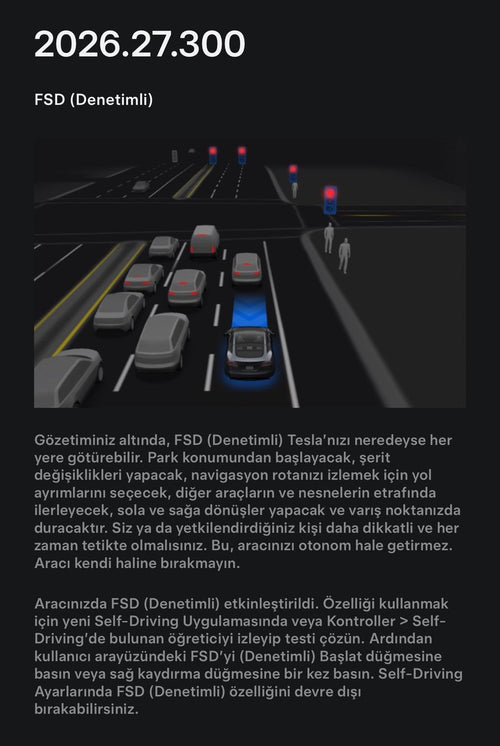
On the software side, FSD (Supervised) version 14.x has been rolling out through early 2026. Tesla deployed FSD 14.3.6 in the days before this post, though some users reported regressions compared to 14.3.5 — a reminder that the path to higher autonomy is iterative rather than linear. FSD subscriptions reached 1.48 million as of Q2, a recurring revenue line that didn't exist at meaningful scale just a few years ago.
Tesla's official position, as stated on its own platform, is that the company's approach relies on "advanced AI for vision and planning, supported by efficient use of inference hardware" to achieve a "general solution for Full Self-Driving, bi-pedal robotics and beyond." That framing — one AI architecture serving cars, robots, and training infrastructure — is precisely what the valuation bulls are pointing at.
The Honest Counterweight
None of this means the bull case is guaranteed. The Q2 numbers show a company absorbing enormous near-term costs to fund long-term bets. Negative free cash flow and a 57% drop in operating income are not abstractions — they represent real capital being consumed today against future returns that remain unproven at scale. FSD still carries the "Supervised" qualifier. Dojo 3 is still in development. Optimus is still pre-mass-production.
The Whole Mars Catalog post is a community sentiment signal, not a financial analysis. But it captures something worth tracking: the gap between how Tesla's near-term financials read and how its long-term AI infrastructure story reads is unusually wide right now. Whether that gap represents undervaluation or optimism depends almost entirely on whether the AI execution actually lands — and on what timeline.
With $5.79 billion in quarterly capex and 1.48 million FSD subscribers already on the books, Tesla is clearly betting it will. The next few quarters of FSD adoption data and Dojo 3 milestones will tell us whether that bet is paying off.
Related Gear
Gear up your Tesla with tested, custom-fit BASENOR accessories — shop Tesla accessories →
Sources & reporting notes
The links below identify the material source records used for this report.
- @wholemars on X (2026-07-28T21:21:47.000Z) — Direct source
Source links are preserved as published or accessed. See our editorial standards and corrections policy.
The BASENOR Editorial Desk covers Tesla, SpaceX, and related technology, curating reporting from primary sources — official accounts, regulatory filings, and software release data. Every article passes source-record and fact-checking review before publication. About the newsroom.
This report was curated by the BASENOR Editorial Desk from the sources listed above. Read our editorial standards or email editorial@basenor.com to report an error.