In a reply on X late Tuesday, Elon Musk dropped a name most people hadn't heard before: Minihard. The system is planned to match Macroharder's raw GPU count — 220,000 Nvidia GB300s with 800 gigabit networking — but in a significantly denser physical footprint. It's a single sentence that opens up a lot of questions about where xAI's compute infrastructure is actually headed.

1. The name is new — the hardware spec is familiar
Musk described Minihard as sharing the same core hardware profile as Macroharder: 220,000 Nvidia GB300 GPUs paired with 800 gigabit NICs. The GB300 is Nvidia's current flagship AI training accelerator, and according to TrendForce, its shipment share is projected to reach nearly 80% of Nvidia's data center GPU mix in 2026. Deploying 220,000 of them in a single cluster puts Minihard in the same tier as the largest AI installations on the planet.
2. "Denser" is the operative word
Musk specifically noted Minihard will use an "improved, much denser configuration" compared to Macroharder. In data center terms, density typically means more compute packed into the same physical rack space — fewer square feet, same or better throughput. For a company that has been acquiring entire buildings near its Memphis Colossus complex, a denser design could mean meaningfully lower real estate, cooling, and power distribution overhead per GPU. It also suggests xAI's engineering team has iterated on the physical layout since Macroharder was designed.
3. 800Gb NICs are a serious networking commitment
The 800 gigabit network interface cards specified for both Minihard and Macroharder aren't standard data center kit — they're the high end of what's currently available for AI cluster interconnects. At this bandwidth per GPU, the goal is to minimize the bottleneck between GPUs during large model training runs, where inter-GPU communication can become the limiting factor well before raw compute is saturated. Matching that spec across both systems suggests xAI is building for workloads that demand tight, low-latency coordination across the full 220,000-GPU pool.
4. Context: where Minihard fits in the broader Colossus build-out
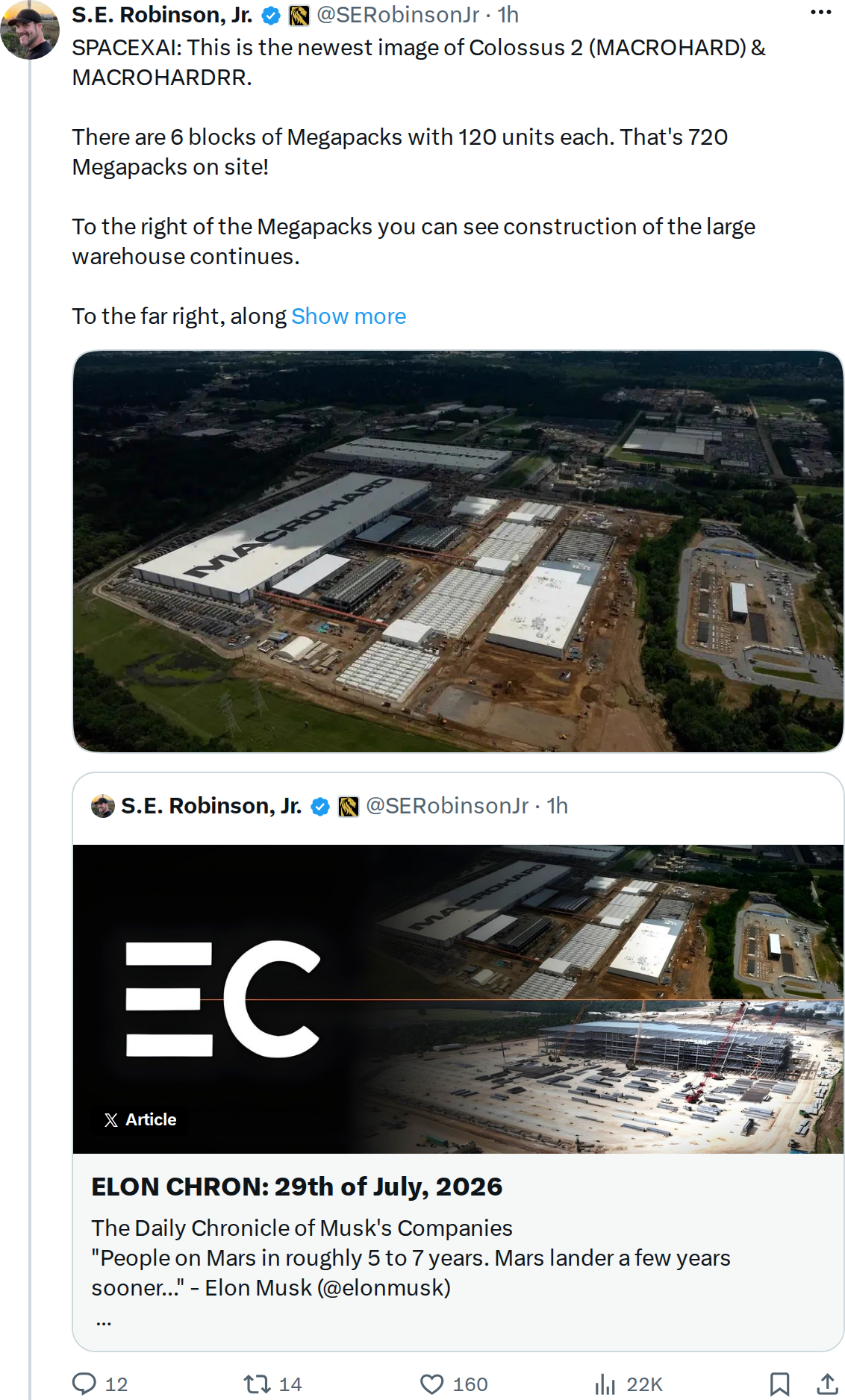
To understand the scale, some background helps. According to verified reports, xAI's Colossus complex in Memphis had expanded to over 555,000 Nvidia GPUs and nearly 2 gigawatts of total capacity by January 2026 — already the world's largest single-site AI training installation. Macroharder (also referred to publicly as "MACROHARDRR") was revealed by Musk in late December 2025 as a third building acquisition near Colossus 2, planned for roughly 500 MW of capacity. Minihard appears to be an additional, distinct cluster — not a rename of an existing one — though Musk's reply doesn't specify which building or site it occupies.
5. The Macrohard software layer sits on top of all this
Separate from the hardware cluster names, "Macrohard" (sometimes called "Digital Optimus") is the joint Tesla-xAI software initiative that pairs Grok AI with a Tesla-built agent capable of controlling a computer's screen, keyboard, and mouse — effectively an autonomous software operator. According to previous reporting, Macrohard runs on Tesla's custom AI4 chips alongside Nvidia hardware, with a beta expected in late 2026. The hardware clusters like Minihard and Macroharder are the compute substrate that trains and runs those models. More GPU density means faster iteration on the software side.
Musk's offhand reply gives us a name and a spec, but the fuller picture — site location, timeline, power draw, and how Minihard slots into xAI's training roadmap — remains unconfirmed. Given the pace at which the Memphis complex has scaled, it likely won't stay unconfirmed for long.
Related Gear
Gear up your Tesla with tested, custom-fit BASENOR accessories — shop Tesla accessories →
Sources & reporting notes
The links below identify the material source records used for this report.
- @elonmusk on X (2026-07-29T23:44:34.000Z) — Direct source
Source links are preserved as published or accessed. See our editorial standards and corrections policy.
The BASENOR Editorial Desk covers Tesla, SpaceX, and related technology, curating reporting from primary sources — official accounts, regulatory filings, and software release data. Every article passes source-record and fact-checking review before publication. About the newsroom.
This report was curated by the BASENOR Editorial Desk from the sources listed above. Read our editorial standards or email editorial@basenor.com to report an error.