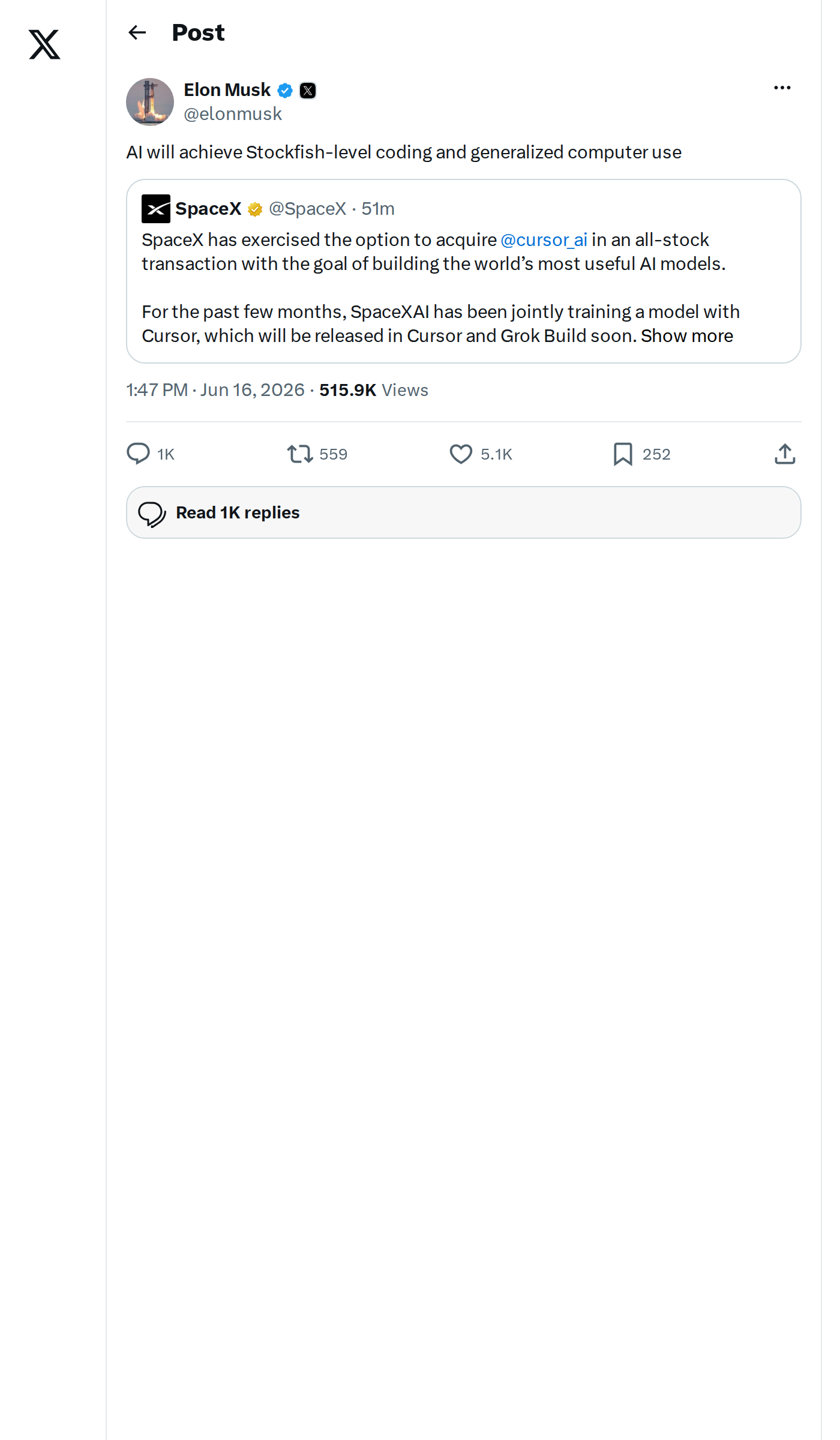
Elon Musk dropped a pointed prediction on Monday: AI will reach what he calls 'Stockfish-level coding and generalized computer use.' The reference to Stockfish — the open-source chess engine that plays at a level no human can match — signals something specific. Musk isn't talking about AI that assists developers. He's describing AI that simply outclasses them.

The Stockfish analogy is worth unpacking. Stockfish doesn't play chess the way grandmasters do — it doesn't approximate human strategy, it transcends it entirely. Applied to coding, Musk's framing implies AI that doesn't just autocomplete functions or suggest refactors, but one that takes a natural-language description of a software goal and produces optimized binary code directly, bypassing compilers and the entire traditional development stack. According to reporting on Musk's recent statements, he believes AI systems are already approaching the point where they generate more efficient binaries than conventional compilers produce.
The timeline Musk has attached to this is aggressive. According to multiple verified sources tracking his public statements, he has suggested traditional coding as a profession could become obsolete by the end of 2026 — meaning this isn't a decade-out prediction, it's a this-year claim. His own xAI venture, which builds the Grok family of models, is reportedly central to that trajectory, with Grok Code cited as a key benchmark for progress as of early 2026.
For Tesla owners, the implications run deeper than abstract tech forecasting. Tesla's entire software stack — from FSD inference to over-the-air update pipelines — is built and maintained by software engineers. If AI-generated code reaches the efficiency and reliability threshold Musk is describing, the pace at which Tesla can ship features, fix bugs, and iterate on autonomous driving systems could accelerate dramatically. The bottleneck shifts from human developer capacity to compute and model quality. That's a meaningful change for anyone waiting on the next FSD improvement or a long-requested UI fix.
Whether the end-of-2026 window holds is an open question. Musk's timelines have historically run optimistic. But the directional bet — that AI coding capability is on a steep upward curve — is one that few serious observers in the field dispute anymore.
Sources & reporting notes
The links below identify the material source records used for this report.
- @elonmusk on X (2026-06-16T13:47:10.000Z) — Direct source
Source links are preserved as published or accessed. See our editorial standards and corrections policy.
The BASENOR Editorial Desk covers Tesla, SpaceX, and related technology, curating reporting from primary sources — official accounts, regulatory filings, and software release data. Every article passes source-record and fact-checking review before publication. About the newsroom.
This report was curated by the BASENOR Editorial Desk from the sources listed above. Read our editorial standards or email editorial@basenor.com to report an error.