📌 UPDATE — June 16, 2026
The SpaceX–Cursor story just got bigger: reports indicate the combined entity is now preparing to launch Origin, a new code repository platform positioned as a direct competitor to GitHub. If accurate, this would signal SpaceX's ambitions extend well beyond AI-assisted coding tools and into the core developer infrastructure market. The move makes strategic sense given Cursor's deep integration with codebases, but no official announcement has been made by SpaceX or Cursor yet. 🔍

📣 @wholemars via X — June 16, 2026
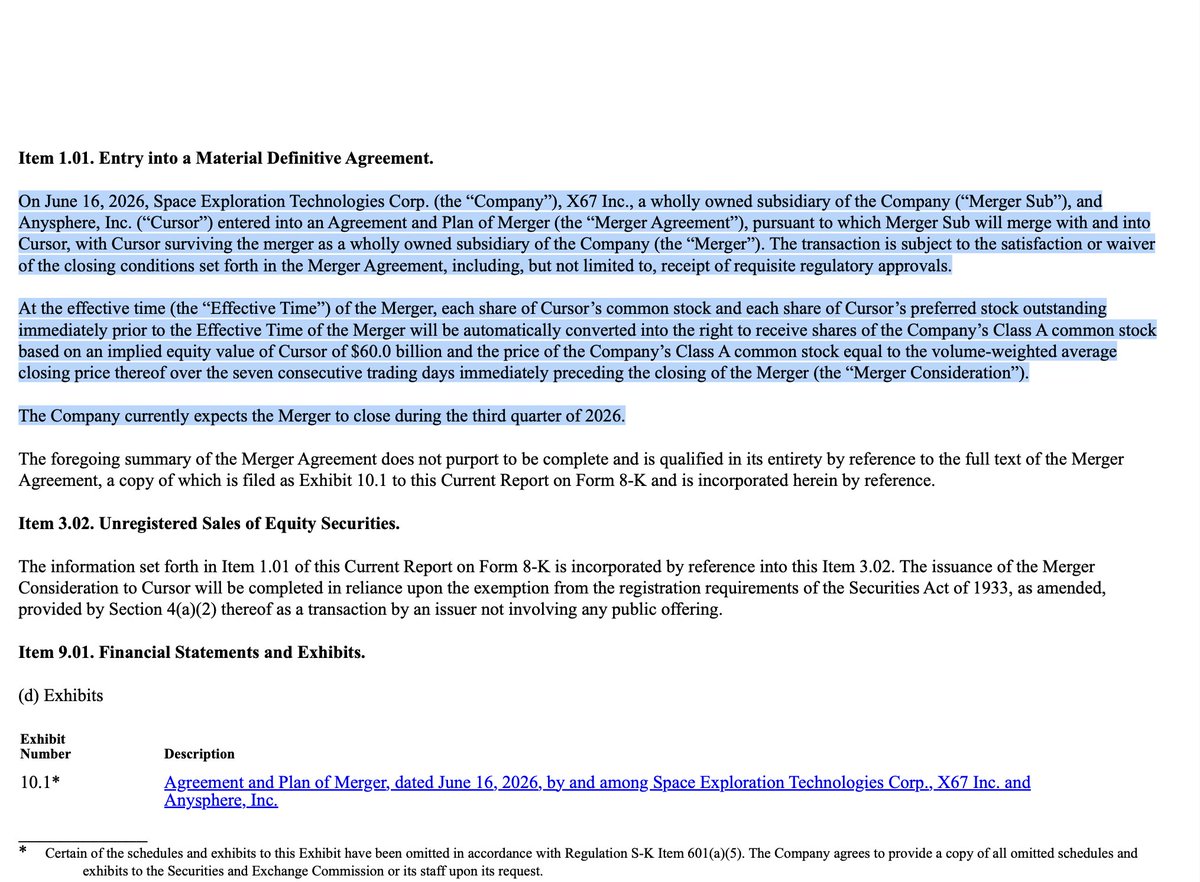
SpaceX has officially confirmed it is acquiring Anysphere, Inc. — the parent company of Cursor AI — in an all-stock transaction valued at $60 billion. The deal, disclosed via an 8-K regulatory filing, is expected to close in Q3 2026 pending regulatory approval. The stated goal: build the world's most useful AI models.

How the Deal Is Structured
The transaction is all-stock: at closing, each Cursor share will be automatically converted into SpaceX Class A common stock, based on an implied equity value of $60 billion and a price equal to the volume-weighted average closing price of SpaceX's Class A shares. No cash changes hands — Cursor shareholders become SpaceX shareholders.

This wasn't a cold approach. According to background reporting, SpaceX had secured an option back in April 2026 to either acquire Cursor outright for $60 billion or pay $10 billion for a partnership arrangement. SpaceX has now exercised the acquisition option — the more aggressive path.
The AI Collaboration Already Running
The announcement isn't just about a future deal — work is already underway. SpaceX confirmed that its AI arm, SpaceXAI (formerly xAI, which merged with SpaceX in February 2026), has been jointly training a model with Cursor for the past several months, leveraging xAI's Colossus supercomputing infrastructure. That model is expected to ship inside both Cursor and Grok Build in the near term.
Cursor is not a small bet. By June 2026, the platform was generating approximately $2.6 billion in annualized business-to-business revenue — a figure that reflects just how deeply AI coding tools have embedded themselves into enterprise software workflows. The company had already reached a $29.3 billion private valuation earlier in the year before this deal.
The Scale of the Number
Ars Technica reporter Eric Berger put the $60 billion figure in stark perspective:

That framing is striking: a company built on rockets and spacecraft is now committing more capital — in a single acquisition — than it has spent on all its launch vehicles combined. It signals that SpaceX's center of gravity is shifting. Rockets remain the business, but AI is becoming the strategic priority.
What This Means Going Forward
The acquisition comes days after SpaceX's Nasdaq debut, giving the company both the public market profile and the stock currency to execute a deal of this magnitude. For Grok users and Tesla owners already embedded in the xAI ecosystem, the immediate signal is that Grok Build — the coding-focused product — is about to get a significant capability upgrade from a tool that millions of professional developers already trust daily.
The deal still needs to clear regulators, and the Q3 2026 close timeline gives some runway for scrutiny. But with a jointly trained model already in the pipeline and a product release described as coming "soon," the practical effects of this merger may arrive well before the paperwork does.
Related Gear
Gear up your Tesla with tested, custom-fit BASENOR accessories — shop Tesla accessories →
Sources & reporting notes
The links below identify the material source records used for this report.
- @SawyerMerritt on X (2026-06-16T13:05:03.000Z) — Direct source
- @SpaceX on X (2026-06-16T13:21:56.000Z) — Direct source
- @SawyerMerritt on X (2026-06-16T13:15:18.000Z) — Direct source
- @SciGuySpace on X (2026-06-16T13:46:12.000Z) — Direct source
- @SawyerMerritt on X (2026-06-16T13:05:04.000Z) — Direct source
- @wholemars on X (2026-06-16T17:44:05.000Z) — Direct source
Source links are preserved as published or accessed. See our editorial standards and corrections policy.
The BASENOR Editorial Desk covers Tesla, SpaceX, and related technology, curating reporting from primary sources — official accounts, regulatory filings, and software release data. Every article passes source-record and fact-checking review before publication. About the newsroom.
This report was curated by the BASENOR Editorial Desk from the sources listed above. Read our editorial standards or email editorial@basenor.com to report an error.