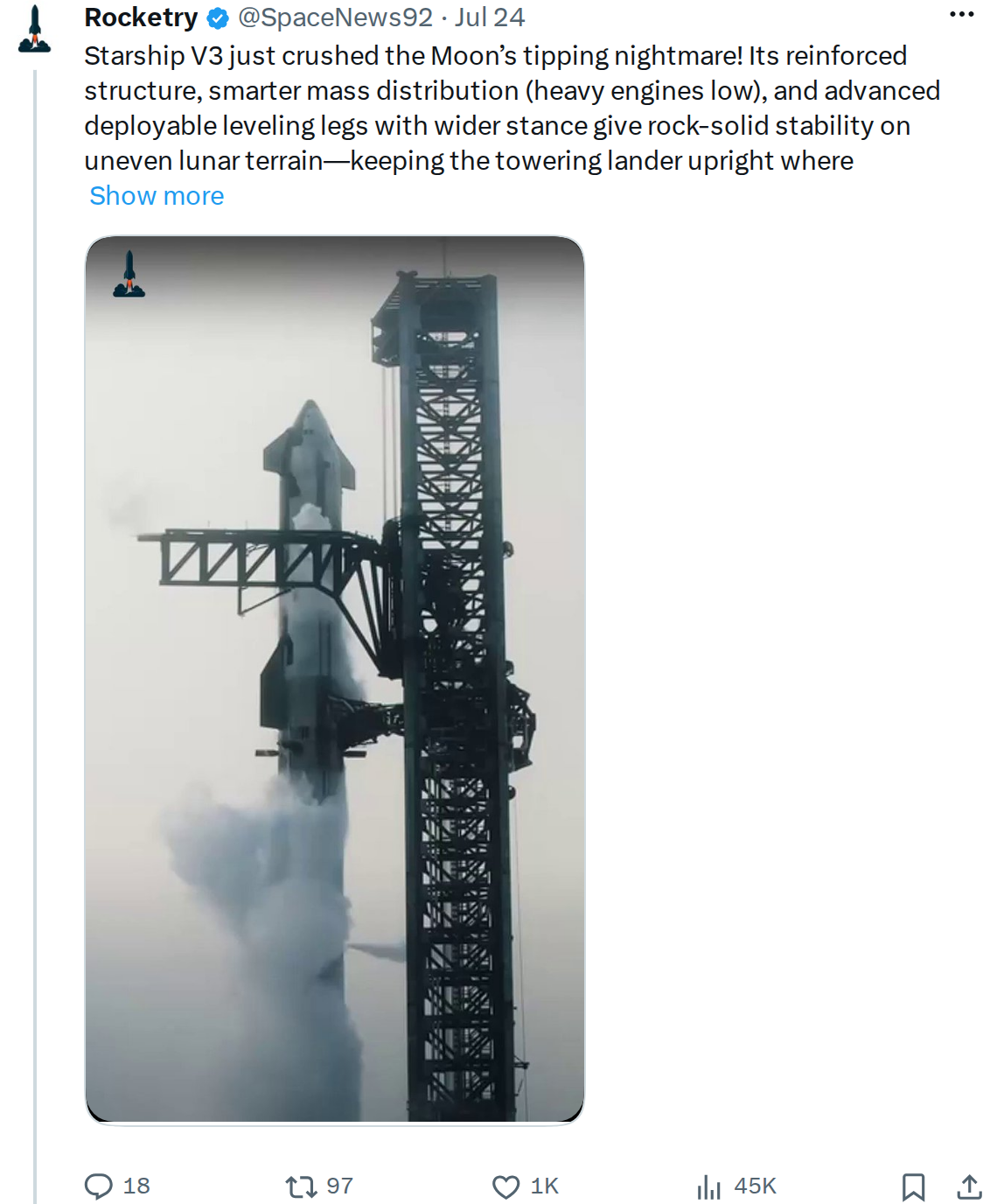
In a brief but pointed reply on X, Elon Musk offered a counterintuitive take on lunar exploration: landing on the Moon is actually easier than landing on Earth. The reason is straightforward — no atmosphere, no wind, no turbulence. For SpaceX, which is building toward both an uncrewed Starship lunar demonstration and NASA's Artemis III crewed landing, that environmental reality carries real strategic weight.

Why Wind Changes Everything
On Earth, landing a large rocket vertically is an exercise in fighting the atmosphere. Wind shear, gusts, and pressure gradients constantly push against the vehicle during final descent, requiring active thrust vectoring and real-time flight computer corrections to maintain stability. The taller and heavier the vehicle, the more surface area the wind has to work with — and Starship, at roughly 50 meters tall in its upper stage configuration, presents a significant profile.
The Moon has none of that. With no atmosphere to speak of, a vehicle descending to the lunar surface encounters no aerodynamic forces at all. Guidance corrections during the final approach are driven purely by gravity and thruster inputs, not by unpredictable environmental variables. Once on the ground, there is no wind load trying to topple the vehicle either — a flat landing pad on the lunar regolith is, in Musk's framing, a genuinely stable resting place.
This isn't a trivial point for mission planning. Stability on the surface matters for loading and unloading cargo, for crew egress, and for the eventual refueling operations that SpaceX envisions as part of a sustainable lunar presence. According to background research, Starship is designed to carry up to 100 tons directly to the lunar surface — rovers, habitat modules, and other infrastructure. Getting that cargo safely off the ship requires the vehicle to remain upright and stable for extended periods, something the windless lunar environment makes considerably more predictable.
Where SpaceX Stands on Lunar Timelines
Musk's comment lands at a moment when SpaceX's lunar program is moving through a critical development phase. According to verified reporting, the company is targeting an uncrewed Starship demonstration landing on the Moon by late 2026 — a prerequisite for human-rating the vehicle for NASA's Artemis III mission. That crewed landing is currently scheduled no earlier than September 2026, though the timeline has faced delays tied to orbital refueling development, in-space propulsion systems, and landing gear designed for the Moon's low-gravity, dusty environment.
Earlier this year, Musk signaled a broader strategic ambition beyond Artemis: building a self-sustaining city on the Moon within a decade, framing it as "time to go back to the Moon at scale." The absence of wind is, in that context, one of the more favorable engineering constraints SpaceX will work with — a rare case where the destination is genuinely less hostile than the launch site.
The Challenges That Remain
Musk's point is accurate but selective. While wind is absent, the Moon presents its own set of landing complications that have nothing to do with atmosphere. The lunar regolith — fine, abrasive dust — is disturbed violently by engine plumes during descent, potentially obscuring sensors and damaging hardware. Low gravity (roughly one-sixth of Earth's) changes the dynamics of vehicle settling and structural loading. Thermal extremes cycle between roughly +130°C in sunlight and -170°C in shadow, stressing materials and seals. And the communication delay from Earth means autonomous systems have to handle far more of the landing sequence without human intervention.
None of that undermines the wind point — it just frames it accurately. For SpaceX's engineers, removing atmospheric turbulence from the landing equation is a genuine simplification. The remaining challenges are significant, but they are known quantities that can be engineered around. Wind, by contrast, is chaotic and site-dependent in ways that are harder to predict and compensate for.
With a demonstration landing potentially months away, Musk's observation reads less like idle commentary and more like a quiet signal of confidence. The physics favor the mission. Whether the hardware timeline does is the question SpaceX is still answering. For more on SpaceX's progress toward the Moon and beyond, see our SpaceX coverage.
🚀 Following the Starship program? See every test flight, official outcome and the next launch window in our SpaceX Starship Tracker.
Sources & reporting notes
The links below identify the material source records used for this report.
- @elonmusk on X (2026-07-26T00:19:41.000Z) — Direct source
Source links are preserved as published or accessed. See our editorial standards and corrections policy.
The BASENOR Editorial Desk covers Tesla, SpaceX, and related technology, curating reporting from primary sources — official accounts, regulatory filings, and software release data. Every article passes source-record and fact-checking review before publication. About the newsroom.
This report was curated by the BASENOR Editorial Desk from the sources listed above. Read our editorial standards or email editorial@basenor.com to report an error.