Five words. Nearly 440,000 views. On August 16, Elon Musk posted that "Intelligence/Joule will keep improving" — and left the rest to interpretation. The phrase sits at the intersection of two of Musk's most consistent obsessions: raw AI capability and the energy cost of running it. Here's what the signal actually tells us, and what context surrounds it.

1. Intelligence per joule is the metric Musk has long treated as the real benchmark
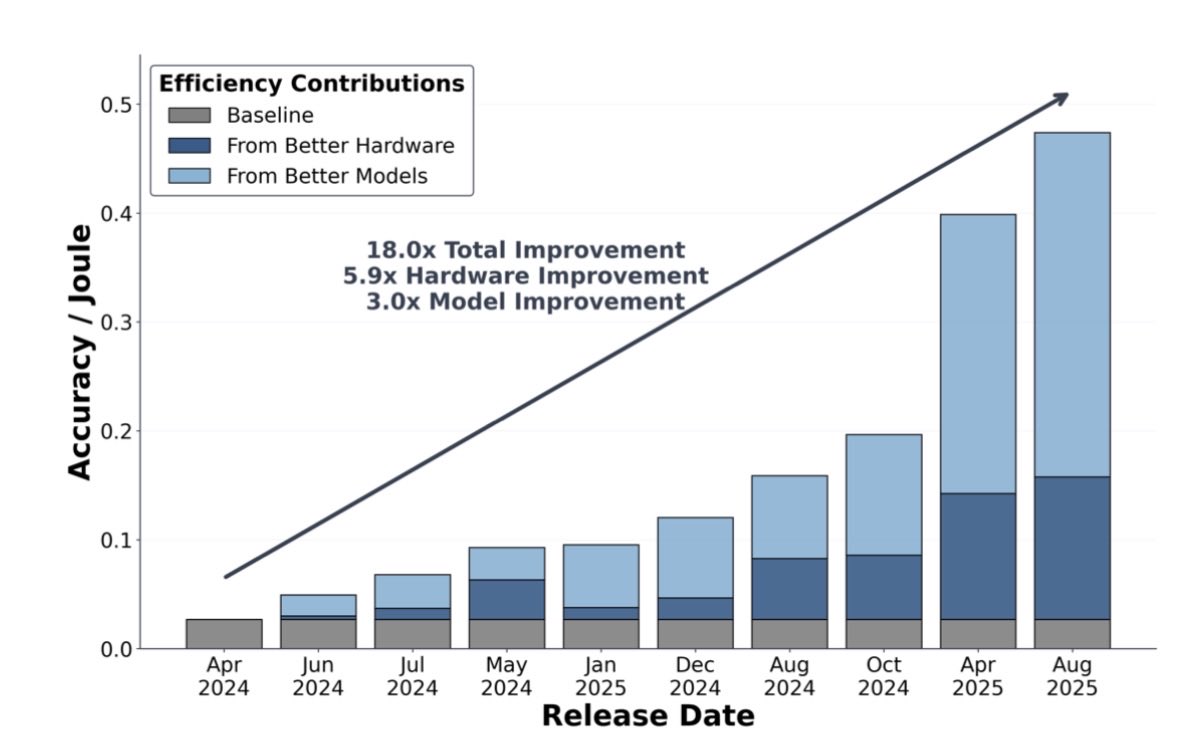
"Intelligence/Joule" isn't a product name — it's an efficiency ratio. How much useful AI output do you get for each unit of energy consumed? Musk has framed this as the fundamental constraint on AI scaling. More intelligence per joule means you can run more capable models without proportionally exploding your power bill. For Tesla specifically, this matters because every FSD inference cycle, every Dojo training run, and every Optimus decision loop draws from that same budget. A commitment to improving this ratio is, in practical terms, a commitment to making Tesla's AI stack more capable without requiring ever-larger power infrastructure.
2. The energy problem behind the metric is very real
Musk has previously stated that "the next scarcity will be electricity" and warned that AI chips would outpace available power supply. That's not an abstract concern. Research published in the journal Joule — notably Alex de Vries's 2023 paper on AI's growing energy footprint — estimated the AI sector could consume between 85 and 134 terawatt-hours annually by 2027. Separate projections suggest data centers could account for 14–20% of total US power demand by 2030. When Musk talks about intelligence per joule improving, he's implicitly acknowledging this ceiling and signaling that his companies are working to push it higher.
3. The SpaceX–xAI merger adds a new dimension to this
In February 2026, SpaceX and xAI merged. That combination matters here. Musk has proposed addressing AI's terrestrial energy constraints by moving compute infrastructure to orbital data centers — a constellation of satellites that could, in theory, sidestep the grid limitations that ground-based data centers face. Whether or not that vision is near-term realistic, the merger means the entity developing Grok and the entity capable of launching orbital infrastructure are now the same organization. A tweet about intelligence per joule improving sits against that backdrop — it's not just a software optimization story.
4. For Tesla owners, this translates directly to FSD and Optimus
Tesla's in-car AI — FSD, the vision stack, the neural net that interprets your surroundings at highway speed — runs on onboard hardware with a fixed power envelope. Better intelligence per joule means more capable inference within the same thermal and energy budget your car already has. It's why Tesla has been able to push FSD capability through OTA updates without requiring new hardware on older vehicles. The same logic applies to Optimus: a robot that does more useful work per watt is a robot that can run longer, cost less to operate, and scale faster. Musk's five-word post is, in that sense, a direct statement about the trajectory of both products.
5. "Will keep improving" is a commitment, not a roadmap
What Musk didn't provide — and characteristically never does in posts like this — is a timeline, a benchmark, or a specific target. "Will keep improving" is directional, not quantified. That's worth noting for anyone trying to read a product announcement into it. There's no version number, no delivery date, no before-and-after comparison attached. What it does do is signal that this efficiency metric is actively being worked on across his companies, and that he considers it important enough to post about publicly. For Tesla followers, the practical implication is simple: the AI systems in your vehicle are on an improving curve, and the energy math behind that improvement is being taken seriously at the highest level.
The tweet's brevity is almost certainly intentional. Musk has a long pattern of posting compressed technical signals that reward the people who already understand the context. Intelligence per joule is one of those signals — and given where AI energy demand is heading over the next few years, it may end up being one of the more consequential metrics to watch.
🤖 Tracking Tesla's humanoid robot? See every Optimus production milestone and appearance in our Tesla Optimus Tracker.
Related Gear
Gear up your Tesla with tested, custom-fit BASENOR accessories — shop Tesla accessories →
Sources & reporting notes
The links below identify the material source records used for this report.
- @elonmusk on X (2026-08-16T21:48:08.000Z) — Direct source
Source links are preserved as published or accessed. See our editorial standards and corrections policy.
The BASENOR Editorial Desk covers Tesla, SpaceX, and related technology, curating reporting from primary sources — official accounts, regulatory filings, and software release data. Every article passes source-record and fact-checking review before publication. About the newsroom.
This report was curated by the BASENOR Editorial Desk from the sources listed above. Read our editorial standards or email editorial@basenor.com to report an error.