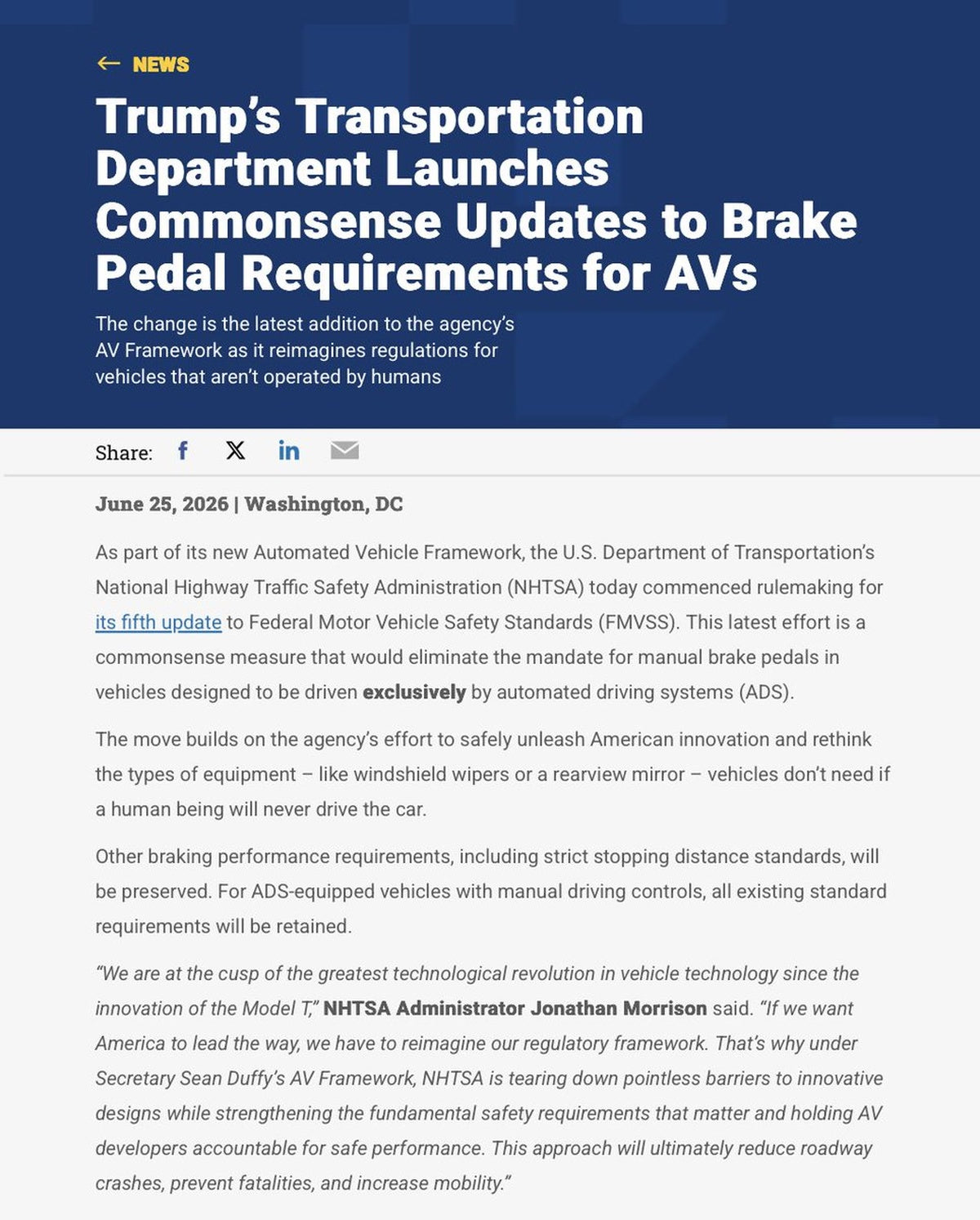
The U.S. National Highway Traffic Safety Administration has officially launched rulemaking to eliminate the manual brake pedal requirement for vehicles designed exclusively for autonomous operation — a regulatory shift that clears one of the most stubborn hardware barriers to purpose-built robotaxis and self-driving shuttles. The announcement came on June 25, 2026, as part of NHTSA's fifth update to the Federal Motor Vehicle Safety Standards.

What exactly did NHTSA change?
The agency updated FMVSS No. 135 — the federal standard governing brake systems — to remove the requirement for hand- or foot-operated brake controls in vehicles that are designed never to be operated by a human driver. Previously, every vehicle sold in the U.S. had to include a manual brake pedal, regardless of whether a human would ever sit behind the wheel. That blanket rule is now gone for purpose-built autonomous vehicles.
Does this mean autonomous vehicles no longer need to stop properly?
No. NHTSA was careful to preserve all braking performance requirements — including strict stopping distance standards. Vehicles that qualify for this exemption must still demonstrate they can stop safely; they just don't have to do it through a pedal a human foot can reach. Alternative testing procedures will be used to verify compliance. The change removes a hardware form-factor requirement, not a safety outcome requirement.
Which vehicles does this actually apply to?
Only vehicles built exclusively for autonomous operation — meaning no human driver controls at all. If an ADS-equipped vehicle retains a steering wheel, pedals, or any manual driving interface, all existing FMVSS requirements remain fully in effect. This is a narrow carve-out aimed at purpose-built robotaxis, autonomous shuttles, and delivery vehicles that were never designed for human operation in the first place.
Why did this matter so much in practice?
The manual brake pedal mandate had become a concrete blocker for companies trying to bring pedal-free autonomous vehicles to market. According to background research, General Motors cited this type of regulatory hurdle when it halted its Origin autonomous shuttle project in 2024. Designing around a pedal that serves no functional purpose in a fully autonomous vehicle added cost, complexity, and interior design constraints — all without any safety benefit for a vehicle no human will ever drive.
What did NHTSA say about the reasoning?
NHTSA Administrator Jonathan Morrison framed the move as tearing down "pointless barriers" to innovative designs. The rulemaking sits within the U.S. Department of Transportation's broader Automated Vehicle Framework, which aims to reduce roadway crashes, prevent fatalities, and expand mobility by modernizing safety standards that were written for a world where every vehicle had a human at the controls.

Is NHTSA done updating AV safety rules after this?
Not remotely. The agency confirmed it is separately developing broader safety performance requirements for autonomous vehicles operating in real-world driving scenarios — covering how AVs behave on public roads, not just whether they can stop. NHTSA also retains its defect enforcement authority, meaning it can investigate unsafe automated driving system behavior and initiate recalls independent of any rulemaking. This brake pedal update is one piece of a longer regulatory buildout, not the finish line.
For the autonomous vehicle industry, today's rule change is less about any single vehicle and more about the signal it sends: the U.S. regulatory framework is actively being rebuilt to accommodate hardware that looks nothing like a traditional car. The next question is how quickly manufacturers — including those with robotaxi programs already in operation — move to design vehicles that take full advantage of the new freedom.
🚕 Following the Robotaxi rollout? See every operating city, launch date and announced market in our Tesla Robotaxi Tracker.
Related Gear
Gear up your Tesla with tested, custom-fit BASENOR accessories — shop Tesla accessories →
Sources & reporting notes
The links below identify the material source records used for this report.
- @SawyerMerritt on X (2026-06-25T14:31:34.000Z) — Direct source
- @SawyerMerritt on X (2026-06-25T14:23:37.000Z) — Direct source
Source links are preserved as published or accessed. See our editorial standards and corrections policy.
The BASENOR Editorial Desk covers Tesla, SpaceX, and related technology, curating reporting from primary sources — official accounts, regulatory filings, and software release data. Every article passes source-record and fact-checking review before publication. About the newsroom.
This report was curated by the BASENOR Editorial Desk from the sources listed above. Read our editorial standards or email editorial@basenor.com to report an error.