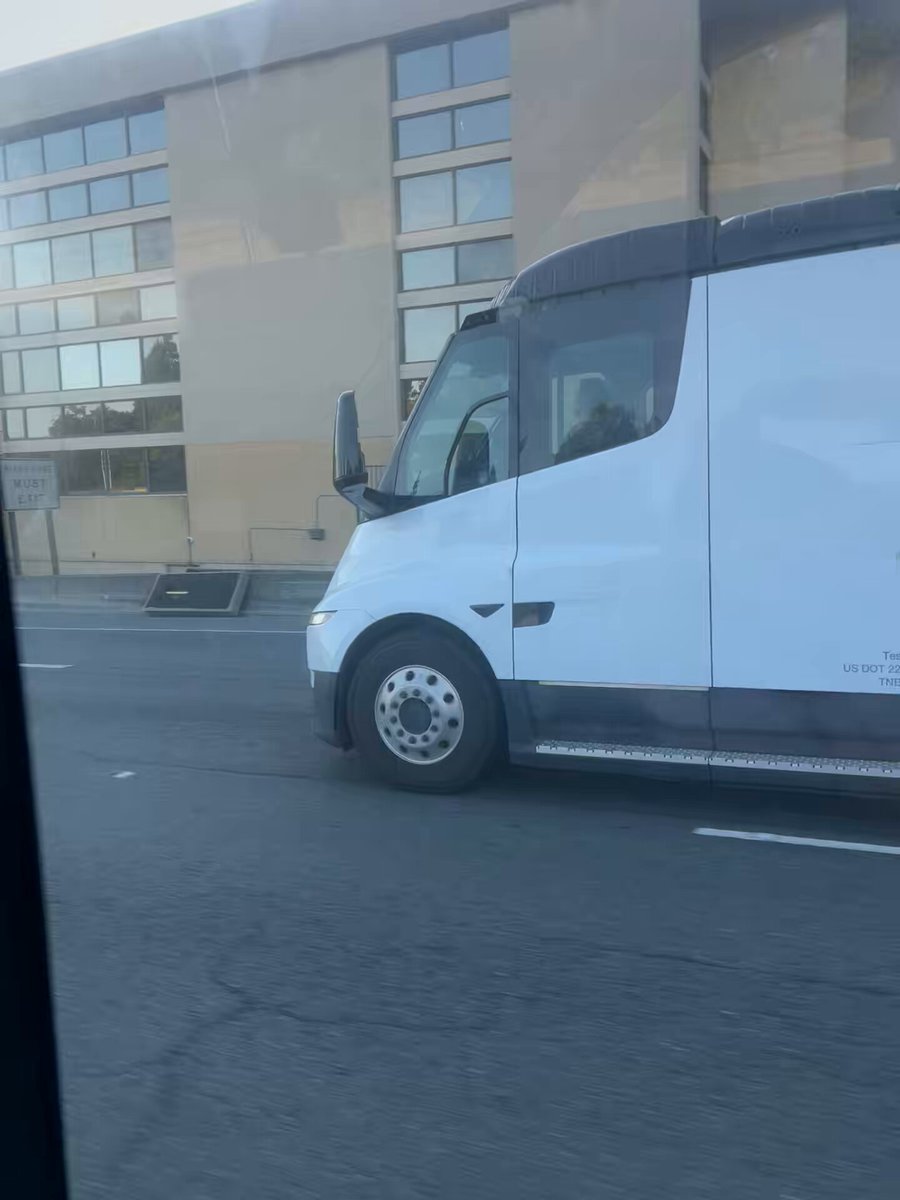
A refreshed Tesla Semi has been caught testing on public roads, offering the clearest look yet at the updated design Tesla unveiled at its 2025 Annual Shareholder Meeting. With volume production now underway at Tesla's Nevada factory, this sighting confirms the refreshed truck — internally code-named 'Atlas' — is moving through real-world validation ahead of broader fleet deployment.

What the Redesign Actually Changed
The Atlas refresh isn't a cosmetic tweak. According to reporting from Teslarati and Tesla's own shareholder presentation, the updated Semi adopts a horizontal light bar integrated into the front fascia — a design language shared with the Model Y Juniper and Cybercab — along with a more aerodynamically refined profile. More consequentially, Tesla engineers stripped approximately 1,000 pounds from the truck's curb weight compared to the original production Semi. That reduction directly translates to higher payload capacity within federal GCW limits, which is the number fleet operators actually care about.
The Long Range variant's curb weight now sits at 23,000 lbs, with a Gross Combination Weight ceiling of 82,000 lbs. The Standard Range version comes in under 20,000 lbs. Both trims share the same three-motor rear-axle powertrain producing up to 800 kW of drive power, and both support MCS 3.2 charging at up to 1.2 MW peak — enough to recover 60% of range in 30 minutes.
Where Production Stands
Tesla officially began volume production of the Semi on April 29, 2026, at its dedicated Sparks, Nevada facility. The production line is currently in a commissioning phase — meaning the system is being validated and optimized rather than running at full capacity. Tesla has stated it aims for an annual run rate of 50,000 units and expects to build "many thousands" of Semis before the end of 2026.
The primary constraint isn't floor space or demand. It's battery supply. The Long Range Semi requires 822 kWh of usable capacity built from 4680 cells, and the pace at which Tesla can scale that cell output is the variable that will determine how quickly the Nevada line accelerates. Real-world pilot data from early fleet partners — including PepsiCo, DHL, ArcBest, Mone, and Saia — is feeding back into Tesla's validation process alongside the on-road testing visible in today's sighting.
Autonomy Is Already in the Picture
Today's road test footage is notable for more than just the refreshed bodywork. A separate Semi equipped with self-driving validation hardware — additional sensor beams and supporting equipment — was observed on California public roads as recently as June 2026. Tesla has designed both Semi variants with autonomy in mind from the ground up, and the testing cadence suggests that capability is being developed in parallel with the production ramp, not sequenced after it.
The Atlas Semi is being validated at Giga Texas as well, with sightings there dating back to March 2026. The combination of factory-adjacent testing and open-road runs indicates Tesla is working through both the manufacturing validation and real-world durability phases simultaneously — an approach consistent with how Tesla handled FSD development on passenger vehicles.
Key Specifications at a Glance
| Spec | Long Range | Standard Range |
|---|---|---|
| Range (at 82,000 lb GCW) | ~500 miles | ~325 miles |
| Curb Weight | 23,000 lbs | <20,000 lbs |
| Energy Use | 1.7 kWh/mi | 1.7 kWh/mi |
| Peak Charge Speed | 1.2 MW | 1.2 MW |
| Drive Power | 800 kW | 800 kW |
| ePTO Output | 25 kW | 25 kW |
| Battery Capacity (LR) | 822 kWh | — |
The road test captured today puts the Atlas Semi's public debut closer than it might have seemed even a few months ago. With the Nevada line commissioning, pilot fleet data accumulating, and autonomous sensor hardware already logging miles, the question is no longer whether the refreshed Semi arrives — it's how fast Tesla can feed the 4680 supply chain to match the demand already waiting for it.
Related Gear
Gear up your Tesla with tested, custom-fit BASENOR accessories — shop Tesla accessories →
Sources & reporting notes
The links below identify the material source records used for this report.
- @TeslaNewswire on X (2026-08-11T18:23:09.000Z) — Direct source
Source links are preserved as published or accessed. See our editorial standards and corrections policy.
The BASENOR Editorial Desk covers Tesla, SpaceX, and related technology, curating reporting from primary sources — official accounts, regulatory filings, and software release data. Every article passes source-record and fact-checking review before publication. About the newsroom.
This report was curated by the BASENOR Editorial Desk from the sources listed above. Read our editorial standards or email editorial@basenor.com to report an error.