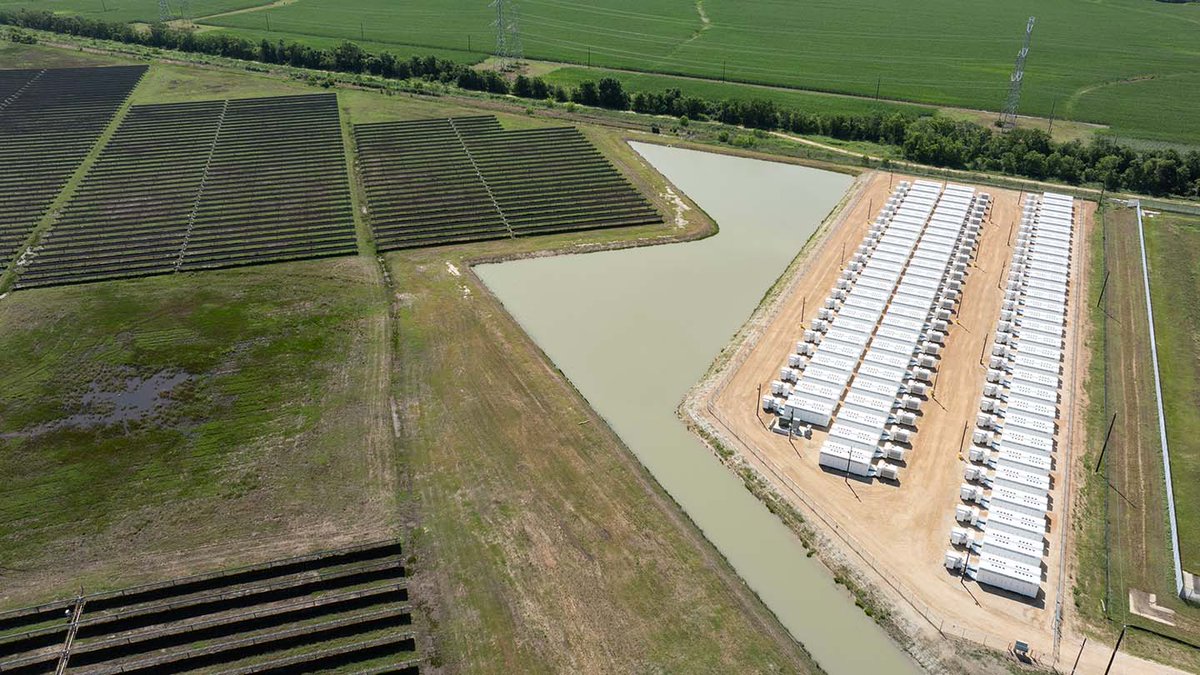
Tesla's Megapack business just added a significant installation to its portfolio. The Old 300 Storage project in Needville, Texas reached commercial operations on August 5, 2026 — a 250 MW/500 MWh battery energy storage facility developed by Danish energy company Ørsted and built with Tesla Megapacks manufactured at the Lathrop, California Megafactory. Here's what makes this project worth paying attention to.

1. The Scale: Two Hours of 250 MW Delivery
The facility carries a 250 MW / 500 MWh rating — meaning it can push 250 megawatts of power continuously for two full hours before depleting. To put that in residential terms, 250 MW is enough to power hundreds of thousands of homes during a demand spike. For ERCOT, a grid that has faced well-documented stress events during Texas heat waves, that kind of dispatchable capacity is exactly what grid operators want available on short notice.
2. The Location: Fort Bend County, Southwest of Houston
Needville sits in Fort Bend County, roughly 40 miles southwest of Houston — deep inside ERCOT territory and in one of the fastest-growing suburban corridors in the country. Placing a large storage asset here isn't accidental. The Houston metro's load growth, combined with ERCOT's ongoing push to add dispatchable resources, makes southwest Houston a logical anchor point for new grid infrastructure.
3. The Solar Partnership: 430 MW Next Door
The storage facility is co-located with the 430 MW Old 300 Solar project, which has been operational since 2024. The two projects share a site but operate independently — the battery system is not directly tethered to the solar output. That independence matters: the Megapack array can charge from the grid at off-peak hours, not just from adjacent panels, giving it full flexibility to respond wherever ERCOT needs it most.
4. The Developer: Ørsted, Not Tesla Energy Directly
This project was developed by Ørsted, the Danish multinational that is one of the world's largest offshore wind developers and an increasingly active player in U.S. utility-scale storage. Tesla's role here is as the hardware supplier — the Megapacks were built at Tesla's Lathrop Megafactory in California. That distinction matters for understanding Tesla Energy's business model: a growing share of Megapack deployments happen through third-party developers rather than Tesla-owned projects, which scales revenue without requiring Tesla to own and operate every facility.
5. The Community Economics: $110 Million in Projected Tax Revenue
According to Ørsted, the combined Old 300 Solar and Old 300 Storage projects are projected to generate approximately $110 million in property tax revenue for Fort Bend County over the life of the projects. That money flows to local infrastructure, public schools, and emergency services — a figure that tends to matter a great deal to county commissioners when evaluating future project permits. Ørsted and Tesla also worked directly with the Needville Fire Department to provide training on battery energy storage safety and emergency response protocols.
6. The Manufacturing Origin: Tesla's Lathrop Megafactory
The Megapacks deployed at Old 300 were manufactured at Tesla's dedicated Megafactory in Lathrop, California — a facility Tesla opened specifically to scale Megapack production. Lathrop was designed with an initial annual production target of 10,000 Megapack units, and projects like Old 300 Storage represent exactly the kind of utility-scale pipeline that justifies that manufacturing investment. Each Megapack unit stores roughly 3.9 MWh, so a 500 MWh facility requires well over 100 units on site.
The Old 300 Storage project is a clean illustration of how Tesla's energy business is maturing: hardware manufactured at scale in California, deployed by major international developers, integrated into critical grid infrastructure across the U.S. With ERCOT continuing to add storage capacity ahead of summer demand peaks, expect more projects like this to follow.
Related Gear
Gear up your Tesla with tested, custom-fit BASENOR accessories — shop Tesla accessories →
Sources & reporting notes
The links below identify the material source records used for this report.
- @SawyerMerritt on X (2026-08-06T22:17:44.000Z) — Direct source
Source links are preserved as published or accessed. See our editorial standards and corrections policy.
The BASENOR Editorial Desk covers Tesla, SpaceX, and related technology, curating reporting from primary sources — official accounts, regulatory filings, and software release data. Every article passes source-record and fact-checking review before publication. About the newsroom.
This report was curated by the BASENOR Editorial Desk from the sources listed above. Read our editorial standards or email editorial@basenor.com to report an error.