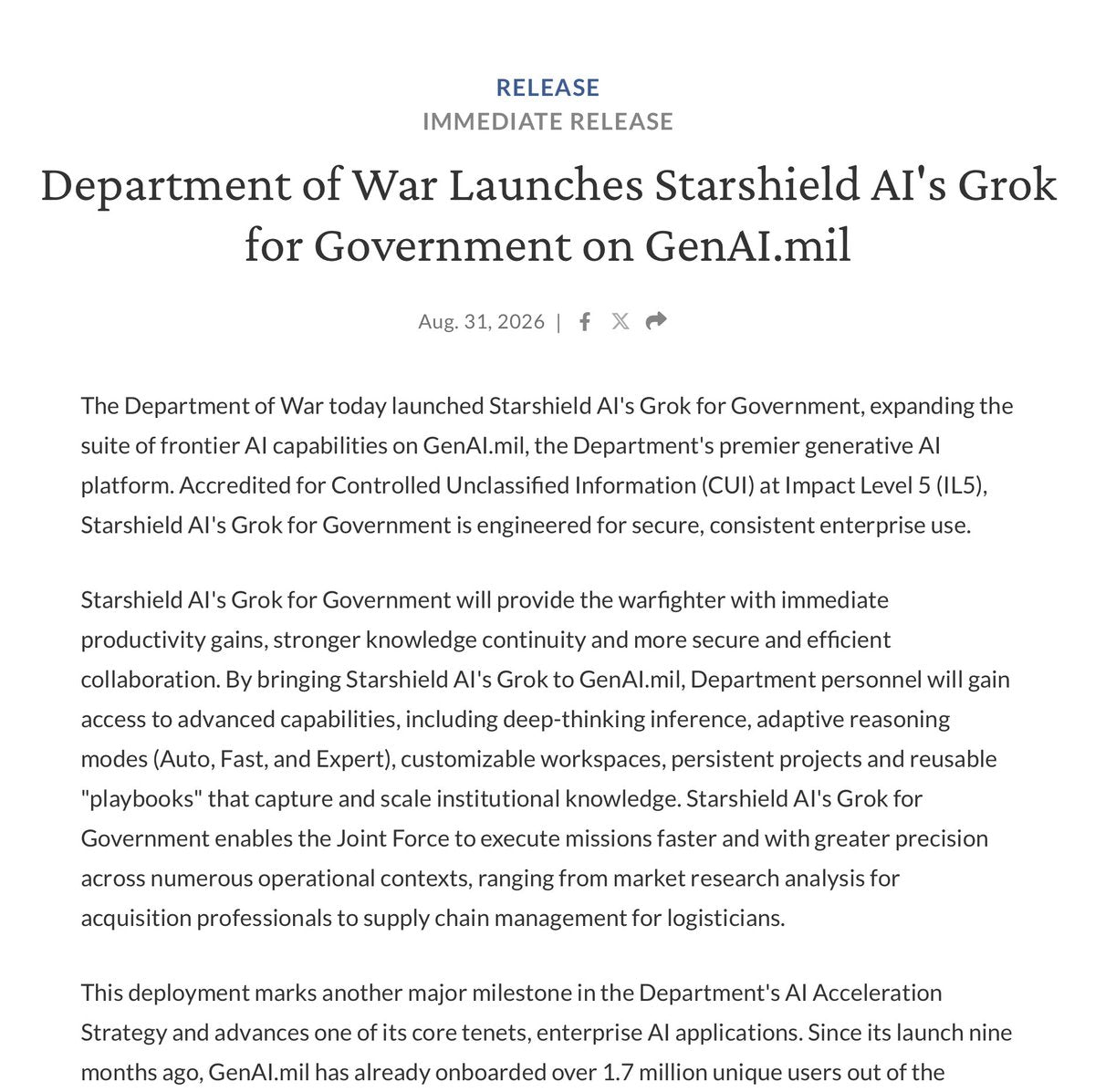
The U.S. Department of War announced on August 31, 2026 that it has launched Starshield AI's Grok for Government on GenAI.mil, the Pentagon's enterprise generative AI platform. The deployment gives xAI's flagship model direct access to a user base of more than 1.7 million personnel — a majority of the roughly 3 million-strong Department workforce — and marks one of the largest single-agency rollouts of a frontier AI system inside the U.S. federal government to date.
The announcement was surfaced by Sawyer Merritt on X, and confirmed by the Department of War's own release on war.gov. The model is accredited for Controlled Unclassified Information (CUI) at Impact Level 5 (IL5), the tier the Department uses for its most sensitive non-classified enterprise workloads.

What Was Launched
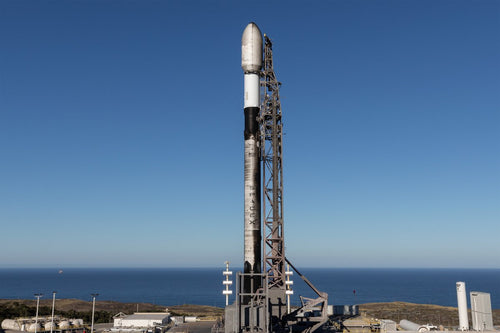
Starshield AI's Grok for Government is a version of xAI's Grok model tailored for federal use and delivered through SpaceX's Starshield — the militarized, security-hardened branch of the Starlink program built specifically for U.S. government and defense customers. Rather than running as a stand-alone chatbot, Grok is being embedded inside GenAI.mil, which the Department describes as its enterprise generative AI platform.
According to war.gov, GenAI.mil launched roughly nine months ago and has already onboarded more than 1.7 million unique users out of the Department's ~3 million total personnel. That is an unusually fast adoption curve for any enterprise software rollout inside the Department, let alone a generative AI product, and it explains why xAI's placement on the platform is a meaningful strategic win rather than a pilot project.
The Grok deployment on GenAI.mil ships with a specific feature set aimed at professional users: deep-thinking inference, adaptive reasoning modes (Auto, Fast, and Expert), customizable workspaces, persistent projects, and reusable "playbooks." The Department's stated use cases include market research analysis, supply chain management, and general knowledge work intended to speed up staff functions across the Joint Force.
Key Figures
| Metric | Value |
|---|---|
| GenAI.mil users onboarded | 1.7 million+ |
| Total Department personnel | ~3 million |
| Coverage of workforce | ~57% |
| Accreditation level | IL5 (Controlled Unclassified Information) |
| Platform age | ~9 months |
| Prior xAI DoD contract ceiling | Up to $200 million |
How We Got Here
This launch is not a standalone deal. Earlier in the year, the Department of Defense awarded contracts of up to $200 million each to xAI, Google, Anthropic, and OpenAI to develop and deliver AI capabilities for federal defense use, according to reporting from CBS News and Business Insider. Those contracts effectively invited the four leading U.S. frontier labs to compete for actual operational footprint inside the Pentagon rather than just running demos.
The GenAI.mil integration is the first visible sign of that competition converting into deployment at scale. It also arrives against the backdrop of the Department's own AI Acceleration Strategy and the White House's AI Action Plan — both of which have pushed for the federal government to move from research pilots into embedded, accredited AI tools inside day-to-day workflows.
The Starshield tie-in is the piece that makes this distinct from a normal cloud AI contract. Starshield, according to SpaceX and prior reporting, is engineered around end-to-end encryption, hardened terminals, and government-controlled network paths — the same security posture the Department expects for classified and sensitive workloads. Naming the product "Starshield AI's Grok for Government" (rather than just "Grok for Government") signals that xAI's federal offering is being routed through SpaceX's secure government stack rather than the commercial xAI infrastructure.
What It Means for xAI, SpaceX, and the AI Market
For xAI, this is arguably the largest single deployment footprint the company has disclosed to date. Beating out — or at minimum landing alongside — Anthropic, OpenAI, and Google inside the Pentagon's own enterprise AI platform gives xAI a reference customer that is genuinely hard to replicate: 1.7 million accredited users on IL5 infrastructure. Any commercial enterprise procurement team evaluating Grok going forward now has a very concrete answer to the "is this actually production-grade?" question.
For SpaceX, the deal deepens Starshield's role as the connective tissue between commercial frontier tech and the U.S. defense customer. The Department of War is not just buying an AI model; it is buying an AI model delivered through a SpaceX-controlled secure stack. That reinforces Starshield as a distribution channel, not just a satellite service — a positioning that could matter as more government agencies look for accredited paths to run frontier AI on sensitive data.
For the broader market, the more interesting signal is speed. GenAI.mil went from launch to 1.7 million users in about nine months. That pace suggests the Department has moved past the exploratory phase of generative AI adoption and into treating it as core productivity infrastructure — which puts pressure on every AI vendor in the federal space to ship accredited, IL5-ready products, not research previews.
What to Watch Next
- Classified expansion. Grok for Government is currently accredited at IL5 (CUI). The obvious next step is IL6 or higher for classified workloads. Any announcement in that direction would be a significant escalation.
- Sister-agency adoption. If GenAI.mil-style deployments spread to other departments (State, DHS, Energy), xAI's federal footprint could grow well beyond the initial 1.7 million user base.
- Competitive placement. Watch whether Anthropic, OpenAI, and Google models also land on GenAI.mil, or whether individual agencies standardize on a single frontier vendor.
- Starshield disclosures. SpaceX has historically said little publicly about Starshield. This announcement is one of the more explicit product-level references to date, and further Starshield-branded AI or comms products could follow.
Mini-FAQ
Is Grok for Government the same as the consumer Grok on X?
No. It is a federal-tailored deployment routed through SpaceX's Starshield secure infrastructure and accredited at Impact Level 5 for Controlled Unclassified Information. The core model is xAI's Grok, but the delivery stack, security posture, and feature set (persistent projects, playbooks, adaptive reasoning modes) are built for enterprise defense users.
Does this mean the Pentagon is using Grok for classified work?
Not at this accreditation level. IL5 covers Controlled Unclassified Information — sensitive but not classified data. Classified use would require IL6 or higher accreditation, which has not been announced.
How does this compare to OpenAI, Anthropic, and Google's Pentagon contracts?
All four labs received DoD contracts of up to $200 million each earlier in 2026, according to CBS News reporting. Grok's placement on GenAI.mil is one of the first visible conversions of those contracts into a real, at-scale user-facing deployment. The other labs may follow with similar integrations.
Why does the Starshield branding matter?
Starshield is SpaceX's government-grade version of Starlink, built with enhanced encryption and security features. Delivering Grok through Starshield rather than commercial xAI infrastructure signals that the model runs on a secure, government-controlled network path — which is what allows the IL5 accreditation in the first place.
Will this affect Tesla or Tesla owners directly?
Not in any immediate operational sense. The deployment is a federal enterprise IT rollout, not a vehicle feature. However, it does reinforce the commercial momentum behind xAI — the same company whose Grok assistant has been integrated into Tesla vehicles as an in-car voice AI — and the tight product coupling between xAI and SpaceX's secure infrastructure.
Sources & reporting notes
The links below identify the material source records used for this report.
- @SawyerMerritt on X (2026-08-31T15:58:18.000Z) — Direct source
- @SawyerMerritt on X (2026-08-31T15:58:18.000Z) — Direct source
Source links are preserved as published or accessed. See our editorial standards and corrections policy.
The BASENOR Editorial Desk covers Tesla, SpaceX, and related technology, curating reporting from primary sources — official accounts, regulatory filings, and software release data. Every article passes source-record and fact-checking review before publication. About the newsroom.
This report was curated by the BASENOR Editorial Desk from the sources listed above. Read our editorial standards or email editorial@basenor.com to report an error.