📌 UPDATE — June 1, 2026
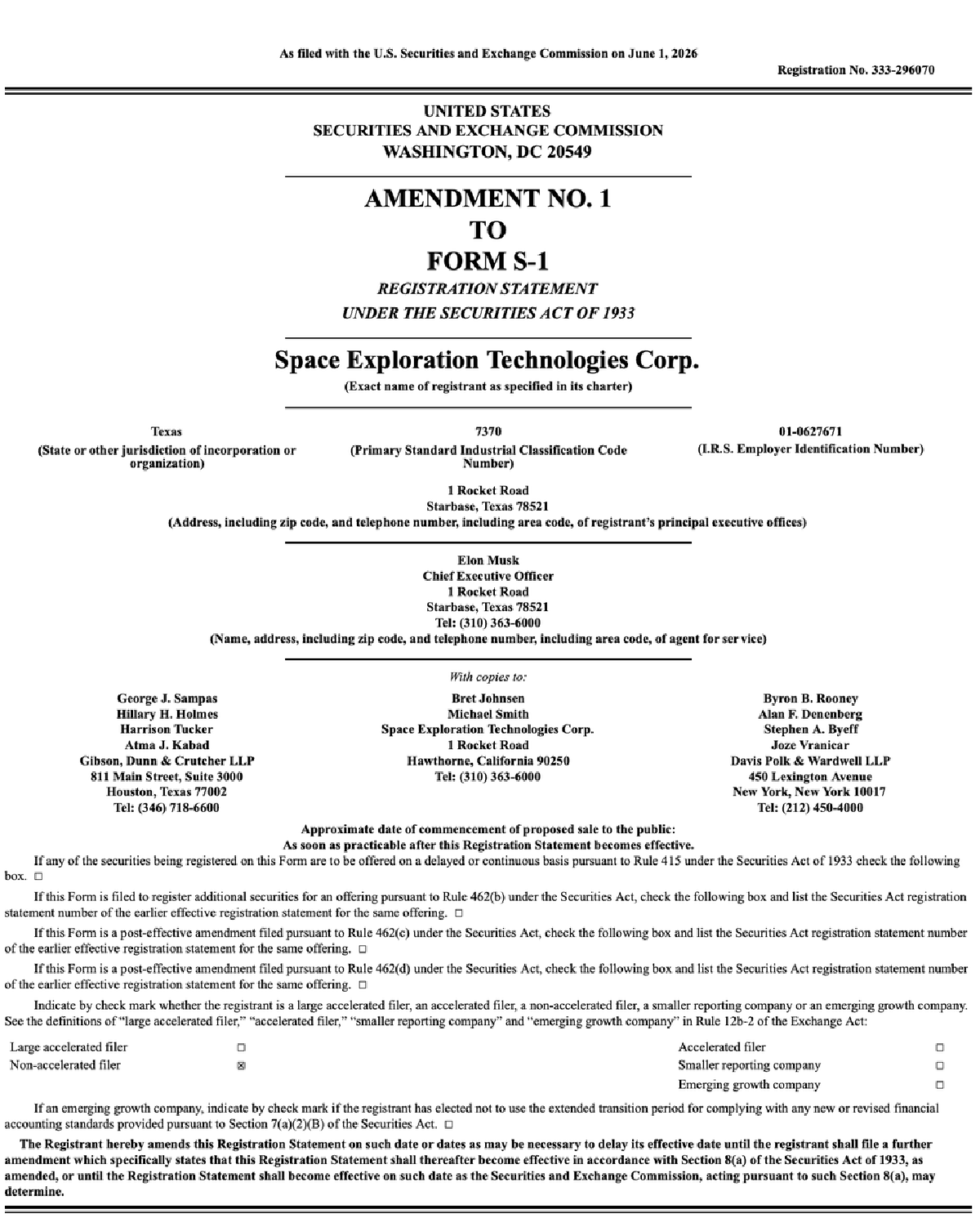
SpaceX has now filed a full IPO prospectus with the SEC, moving beyond the S-1/A amendment stage covered in this article. The new filing confirms SpaceX is actively pursuing a public listing, with underwriters reserving up to 5% of Class A common stock for a directed share program targeting employees and select individuals chosen at the company's discretion — a notable employee-friendly provision not detailed in the earlier amendment. This directed share program signals SpaceX's intent to reward its workforce directly at the IPO price, bypassing the open market for that allocation.

SpaceX filed an amended IPO registration statement (S-1/A) today, and buried inside the updated language is a disclosure that's worth paying close attention to: the company says it "may issue a significant amount of equity in connection with future transactions" — covering acquisitions, divestitures, and other strategic moves. For a company already targeting a valuation of at least $1.8 trillion, that's a statement with real weight.

Where SpaceX Stands in the IPO Process
This amended filing is the latest step in a process that has been moving quickly. According to public filings, SpaceX confidentially submitted its initial S-1 to the SEC on April 1, 2026, before going public with the full registration statement on May 20. The company is targeting a Nasdaq listing under the ticker SPCX, with June 12, 2026 cited as an expected listing date — though that remains subject to change.
The scale of what SpaceX is attempting is difficult to overstate. The company is targeting a raise of up to $75 billion from the IPO itself, at a valuation the filing pegs at a minimum of $1.8 trillion — down from an earlier internal target above $2 trillion, but still among the largest public offerings in history.
The Equity Issuance Disclosure — and What It Signals
The amended S-1/A's language around equity issuance isn't boilerplate. It comes in a context where SpaceX has already demonstrated a willingness to use stock as deal currency. The most concrete example in the filing: the pending acquisition of Cursor, the AI coding assistant, which is structured to close post-IPO and will be paid entirely in Class A common stock — implying an equity value of $60 billion. Cursor is also entitled to a $1.5 billion termination fee and an $8.5 billion deferred services fee under a separate compute agreement.
That deal alone makes clear that SpaceX views its public equity as a strategic tool, not just a fundraising mechanism. The amended filing's broader language — covering future acquisitions and divestitures — suggests the Cursor deal is likely the first of several moves, not a one-off.

The Bigger Picture: AI, xAI, and Tesla
SpaceX's IPO pitch has shifted considerably since the company first began the filing process. Following its February 2026 merger with xAI — which valued the combined entity at approximately $1.25 trillion — SpaceX now describes itself as an "AI services and infrastructure company" rather than a pure-play launch provider. That repositioning matters for how investors will price the stock and how SpaceX intends to deploy the capital it raises.
The filing also outlines plans to deepen strategic collaboration with Tesla and Intel through Terafab, with ambitions to deploy modular orbital AI compute infrastructure before the end of the decade. Longer-term goals include asteroid mining and manufacturing infrastructure on the Moon and Mars — language that reads less like a prospectus and more like a mission statement.
On the ownership side, Elon Musk holds approximately 42% of SpaceX's equity and controls 85% of voting power through a dual-class share structure — meaning the equity issuance strategy, however large it grows, will not meaningfully dilute his control of the company's direction.
Lock-Up and Share Allocation Details
The filing reserves up to 5% of IPO shares for a directed share program covering employees and friends and family of executive officers. Notably, participants in the friends-and-family allocation will not be subject to a lock-up restriction. More than 60% of pre-IPO shares — including those held by Musk — will be under an extended lock-up period, limiting near-term selling pressure from insiders after the listing.
With the expected listing date now less than two weeks away, today's amended filing is likely one of the final regulatory steps before SpaceX begins trading. The equity issuance language added in this amendment will be worth watching closely — it frames how aggressively the company plans to use its public currency to reshape its business well beyond rockets and satellites. For Tesla owners and investors tracking the broader Musk ecosystem, the Terafab collaboration thread in particular is one to follow as SpaceX transitions from pre-IPO to public company.
Sources & reporting notes
The links below identify the material source records used for this report.
- @SawyerMerritt on X (2026-06-01T15:48:42.000Z) — Direct source
- @SawyerMerritt on X (2026-06-01T15:48:42.000Z) — Direct source
- @SawyerMerritt on X (2026-06-01T16:42:19.000Z) — Direct source
Source links are preserved as published or accessed. See our editorial standards and corrections policy.
The BASENOR Editorial Desk covers Tesla, SpaceX, and related technology, curating reporting from primary sources — official accounts, regulatory filings, and software release data. Every article passes source-record and fact-checking review before publication. About the newsroom.
This report was curated by the BASENOR Editorial Desk from the sources listed above. Read our editorial standards or email editorial@basenor.com to report an error.