SpaceX is asking federal regulators for the kind of launch cadence that would turn Starbase, Texas into something closer to a commercial airport than a rocket test site. In a filing flagged Monday, the Federal Aviation Administration announced its intent to prepare a new Programmatic Environmental Impact Statement (PEIS) covering a SpaceX request for up to 456 Starship launches and 912 landings per year from the Boca Chica facility — an eighteen-fold increase over the 25 launches and 50 landings currently authorized.
The proposal, confirmed in FAA Docket FAA-2026-12808, lays out a two-phase ramp that would reshape operations on the South Texas coast and set the physical pace for Elon Musk's Mars architecture.

The Two-Phase Plan
According to the FAA notice and summaries from Quartz and Insurance Journal, SpaceX is proposing a staged expansion rather than an immediate jump to the ceiling.
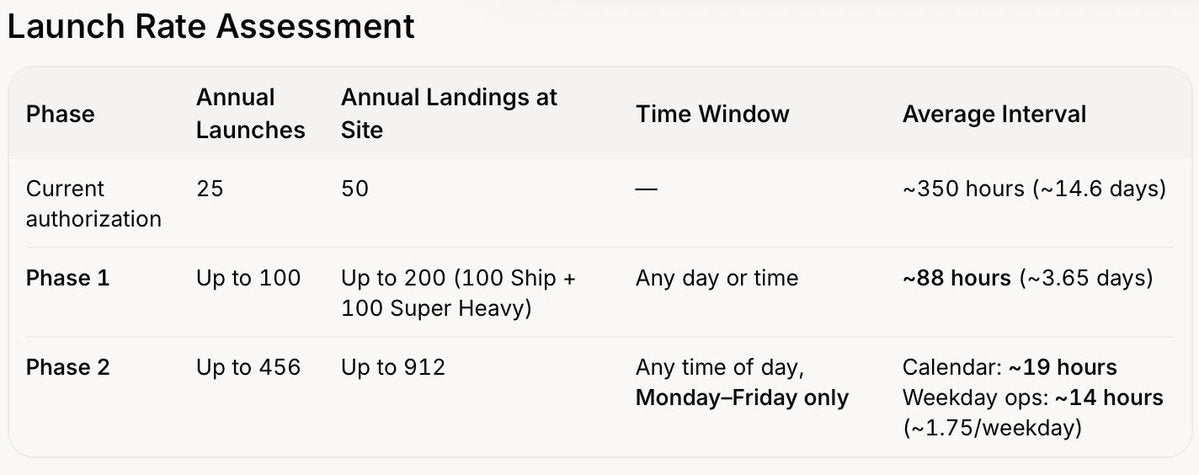
Phase 1 would raise authorized operations to 100 Starship launches and 200 landings per year, with flights permitted any day of the week and at any hour. That alone is roughly four times the current limit, and twenty times the actual Starbase cadence — Starship has flown three times from Texas so far in 2026, and the site has never exceeded five launches in a calendar year.
Phase 2, which SpaceX indicates could follow "within several years," would push the ceiling to 456 launches and 912 landings annually. Launches would still be allowed at any time of day under Phase 2, but only on weekdays — a concession likely aimed at reducing weekend noise exposure for nearby communities in Brownsville and Port Isabel.

Key Figures
| Metric | Today | Phase 1 | Phase 2 |
|---|---|---|---|
| Annual launches | 25 | 100 | 456 |
| Annual landings | 50 | 200 | 912 |
| Operating days | Limited | 7 days | Weekdays |
| 2026 actual launches YTD | 3 | ||
The 912-landing figure is the upper limit for the Texas facility regardless of where the mission originated. Starship upper stages and Super Heavy boosters could touch down at the launch site, offshore in the Gulf of America, or in the open ocean — meaning not every landing would be a return-to-launch-site event over Boca Chica.
Why SpaceX Needs This Headroom
The gap between current authorization and the proposed ceiling isn't about matching near-term demand — it's about building a regulatory envelope that doesn't bottleneck the Mars architecture. Musk has repeatedly described Starship as a vehicle designed for aircraft-like reusability, and the publicly stated goal of launching fleets to Mars during planetary transfer windows mathematically requires hundreds of flights per synodic cycle.
Starbase is also not SpaceX's only site. Joe Tegtmeyer, who first flagged the FAA notice, noted that this filing is in addition to Starship operations planned at facilities in Florida and Louisiana. The Texas request effectively sets the baseline for how large any single Starship launch complex can grow before environmental review becomes the binding constraint.
The Regulatory Path
This is the beginning of a long process, not the end. The FAA's Notice of Intent, scheduled for publication in the Federal Register on October 14, 2026, formally opens the Environmental Impact Statement scoping phase. The review will assess potential impacts on air quality, wildlife, coastal resources, water, noise, and aviation, according to the agency.
Key dates for anyone tracking the proceeding:
- Public comment window: open through November 30, 2026
- In-person scoping meetings: November 17 and 19 in Brownsville and Port Isabel
- Virtual scoping meeting: November 18
A full Environmental Impact Statement typically takes 18 to 24 months to complete, meaning final approval of even Phase 1 is unlikely before late 2027 or 2028. SpaceX can continue operating under its existing 25-launch authorization during that period.
What Owners and Observers Should Watch
For the Tesla and SpaceX enthusiast base, three things matter from here:
1. The scoping comments. Environmental groups and local residents in the Rio Grande Valley have pushed back on previous Starbase expansions, and the comment record filed by November 30 will shape which issues the FAA studies in depth. Noise modeling and Boca Chica State Park impacts are the most likely friction points.
2. The Florida and Louisiana parallel tracks. SpaceX's cadence ambitions aren't contingent on Starbase alone. Progress at the Kennedy Space Center Starship pad and the proposed Louisiana operations will determine how much of this 456-launch envelope SpaceX actually needs to use at Boca Chica.
3. The 2027 flight rate. Phase 1 authorization only matters if SpaceX can actually build and fly 100 vehicles per year. Watching how quickly the Starfactory ramps and how many flights occur in 2026-2027 will reveal whether the regulatory ceiling or the manufacturing floor is the real constraint.
Mini-FAQ
Is this approved yet?
No. The FAA has only issued a Notice of Intent to prepare an Environmental Impact Statement. The agency will accept public comments through November 30, 2026, hold scoping meetings in November, and then conduct a multi-year review. Current operations remain capped at 25 launches and 50 landings per year.
How does 456 launches a year compare to current global activity?
For context, SpaceX conducted 134 Falcon launches company-wide in 2024. A 456-launch Starship cadence from a single site would be unprecedented in commercial spaceflight. Starship has flown three times from Starbase in 2026, and the site has never exceeded five launches in any calendar year.
Why does SpaceX need 912 landings but only 456 launches?
Each Starship mission involves two returning vehicles: the Super Heavy booster and the Starship upper stage. A full-reuse architecture means both come home, which is why landings are proposed at roughly double the launch rate.
Will Phase 2 definitely happen?
Not necessarily. SpaceX describes Phase 2 as a possibility "within several years" of Phase 1 approval, and it would likely require a separate environmental review supplement. The 456-launch ceiling is a long-term authorization request, not a near-term operational plan.
The filing underscores a pattern that's become familiar across SpaceX's regulatory footprint: ask for the full envelope now, build out capacity in phases, and let flight data settle the arguments. Whether the FAA — and the Rio Grande Valley — accept that framing is the question the next twelve months will answer.
🚀 Following the Starship program? See every test flight, official outcome and the next launch window in our SpaceX Starship Tracker.
Sources & reporting notes
The links below identify the material source records used for this report.
- @JoeTegtmeyer on X (2026-10-13T17:11:25.000Z) — Direct source
- @SawyerMerritt on X (2026-10-13T17:36:46.000Z) — Direct source
- @SawyerMerritt on X (2026-10-13T17:36:46.000Z) — Direct source
Source links are preserved as published or accessed. See our editorial standards and corrections policy.
The BASENOR Editorial Desk covers Tesla, SpaceX, and related technology, curating reporting from primary sources — official accounts, regulatory filings, and software release data. Every article passes source-record and fact-checking review before publication. About the newsroom.
This report was curated by the BASENOR Editorial Desk from the sources listed above. Read our editorial standards or email editorial@basenor.com to report an error.