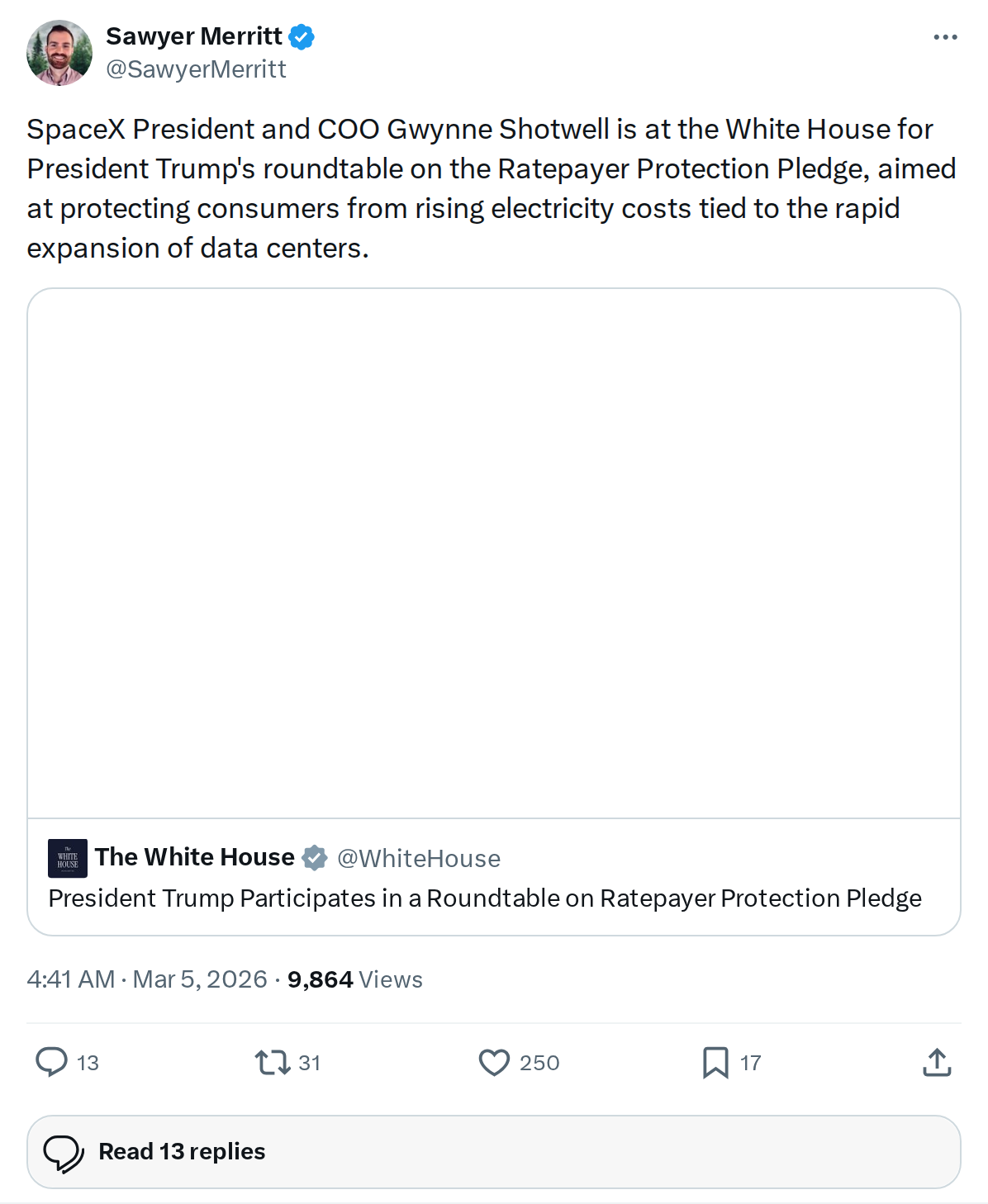
The News: SpaceX President and COO Gwynne Shotwell attended a White House roundtable hosted by President Trump, focused on the Ratepayer Protection Pledge — an initiative aimed at shielding consumers from electricity cost spikes driven by the rapid expansion of AI data centers.
Why It Matters: Data center energy demand is already straining the U.S. grid — and rising electricity costs hit EV owners directly at home charging. SpaceX's seat at this table signals the tech and space industry's growing role in shaping America's energy policy.
Source: @SawyerMerritt on X
SpaceX at the White House — What Happened
On March 4, 2026, Gwynne Shotwell — President and COO of SpaceX — was spotted at the White House for a roundtable convened by President Trump. The focus: the Ratepayer Protection Pledge, a policy initiative designed to protect American electricity consumers from cost increases tied to the explosive growth of AI data centers across the country.

Shotwell's presence is notable. SpaceX is not a traditional energy company — but it operates one of the most power-hungry launch and manufacturing operations in the country, and its Starlink satellite network depends on a healthy, affordable grid. Her inclusion in a policy roundtable of this nature underscores how deeply the tech and aerospace sectors are now intertwined with America's energy infrastructure debate.
The Ratepayer Protection Pledge — What It Is
The core tension driving this roundtable is straightforward: the AI boom has triggered a massive wave of data center construction across the U.S. These facilities consume enormous amounts of electricity — and utilities are increasingly passing those costs on to ordinary consumers through rate hikes.
The Ratepayer Protection Pledge appears to be a White House-level effort to get major tech and industrial players to commit to principles that prevent that cost burden from landing on households. The specifics of any commitments made at this roundtable have not yet been publicly detailed, but the gathering of figures like Shotwell signals that the administration is pulling in voices from across the technology sector — not just traditional energy companies.
🔭 The BASENOR Take
Why should Tesla and EV owners pay attention to a SpaceX executive attending a White House energy meeting? Because the data center electricity demand problem is the same problem that affects your home charging bill.
Grid operators across the U.S. have been warning for years that surging industrial electricity demand — first from crypto mining, now overwhelmingly from AI data centers — is creating capacity constraints and upward pressure on retail electricity rates. For EV owners who charge at home, that translates directly into a higher cost per mile. The Ratepayer Protection Pledge, whatever form it ultimately takes, is an attempt to put guardrails on that dynamic.
SpaceX's seat at the table is also a signal about the broader Musk-affiliated ecosystem's relationship with the current administration. Shotwell has historically been the operational anchor of SpaceX — the executive who keeps the rockets flying while Musk sets the vision. Her presence at a policy roundtable of this nature, rather than a purely technical or regulatory forum, suggests SpaceX is positioning itself as a stakeholder in national energy policy conversations, not just a customer of the grid.
It's also worth noting the context of SpaceX's own energy footprint. Starbase in Texas, SpaceX's primary Starship launch and manufacturing facility, draws significant power. As Starship launch cadence scales — Shotwell herself projected as many as 400 Starship launches over a four-year period in late 2024 — SpaceX's grid demands will grow substantially. Having a voice in how energy policy is shaped is, from a business perspective, entirely rational.
For Tesla owners specifically, the downstream implications depend on how aggressively any Ratepayer Protection commitments are enforced and whether they translate into actual rate relief or stability at the utility level. That's a long policy road from a single roundtable — but the fact that the conversation is happening at the White House level, with major tech and aerospace players in the room, is a more substantive development than it might first appear. For more on how energy policy intersects with the broader EV ecosystem, see our SpaceX coverage.
🚀 Following the Starship program? See every test flight, official outcome and the next launch window in our SpaceX Starship Tracker.
Sources & reporting notes
The links below identify the material source records used for this report.
- @SawyerMerritt on X (2026-03-04T20:41:14.000Z) — Direct source
Source links are preserved as published or accessed. See our editorial standards and corrections policy.
The BASENOR Editorial Desk covers Tesla, SpaceX, and related technology, curating reporting from primary sources — official accounts, regulatory filings, and software release data. Every article passes source-record and fact-checking review before publication. About the newsroom.
This report was curated by the BASENOR Editorial Desk from the sources listed above. Read our editorial standards or email editorial@basenor.com to report an error.