📌 UPDATE — July 30, 2026
Elon Musk has personally declared Starlink V3 a "gamechanger" in a post on X today, just six days after the first 20 V3 satellites were deployed on Starship Flight 13. While Musk did not elaborate on specific metrics, the endorsement signals that early on-orbit performance data from the Flight 13 deployment is meeting or exceeding expectations. The V3 generation is understood to offer dramatically higher per-satellite throughput compared to V2 Mini, leveraging Starship's larger payload fairing to fly bigger, more capable hardware. With 20 satellites already in orbit and Starship's rapid cadence anticipated to continue, a full V3 constellation buildout could meaningfully expand global capacity and reduce congestion on the existing network.

📌 UPDATE — July 30, 2026
Starlink has officially confirmed that all key mission objectives for the first V3 satellites were successfully completed. The satellites deployed their solar arrays, fired thrusters, established both radio frequency and laser inter-satellite links with the existing Starlink constellation, and even captured imagery of Starship during the mission. Michael Nicolls, VP of Starlink Engineering, described their lifespan as "short but extremely useful," confirming the satellites were always intended as a brief but critical validation exercise rather than long-term operational units.

📸 First photos of Starlink V3 satellites in orbit, shared by @Starlink and @michaelnicollsx on July 30, 2026.
📌 UPDATE — July 25, 2026
Rare ground-based footage has emerged showing a Starship Raptor engine igniting while the vehicle was in orbit during Flight 13. The video was captured from Pretoria, South Africa, by a local observer and shared by Sawyer Merritt on X. The clip offers an unusually clear visual of Starship's in-space propulsion in action — a perspective rarely seen from the ground. It provides independent visual confirmation of the orbital burn that accompanied the Starlink V3 deployment on July 24.

📌 UPDATE — July 25, 2026
Additional telemetry from Starship Flight 13 confirms Ship 40 executed a nominal in-space burn, successfully survived atmospheric plasma reentry without issue, and completed all critical maneuvers leading to splashdown — all reported nominal by NASASpaceflight. The clean plasma passage is particularly notable, as reentry heating has been a key engineering focus across recent Starship test flights. Together, these milestones reinforce that the vehicle performed end-to-end as intended during the mission that deployed the first 20 Starlink V3 satellites.


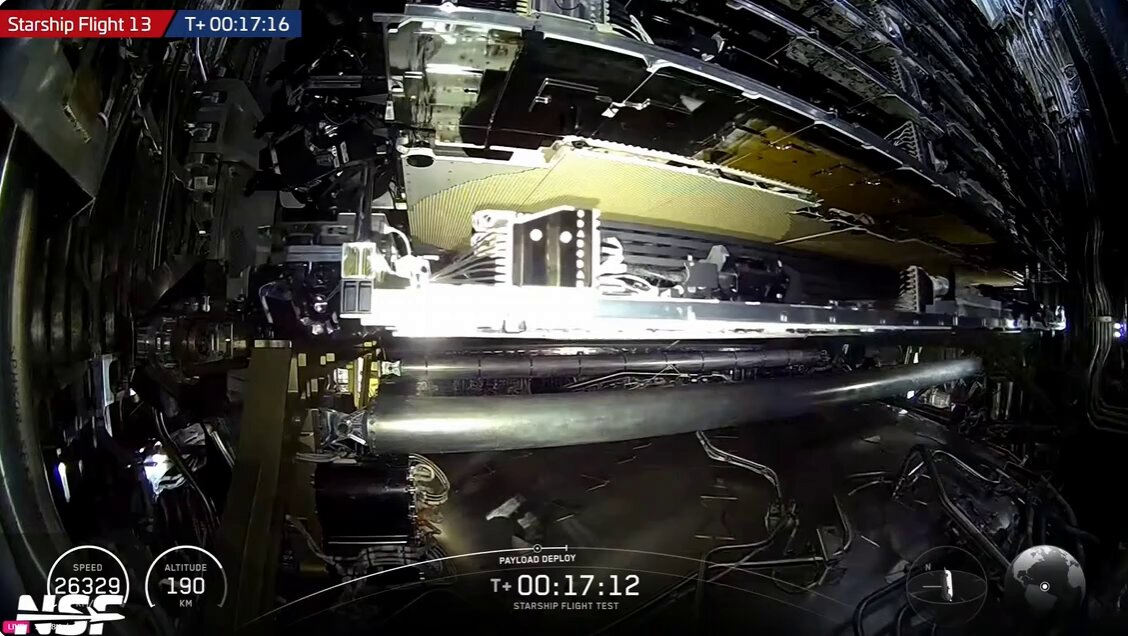
SpaceX crossed a meaningful threshold on Friday evening when Starship Flight 13 released 20 next-generation Starlink V3 satellites into space — the first real deployment of the new hardware that is designed to dramatically expand the network's capacity. The satellites were on a suborbital test trajectory and burned up on re-entry roughly 20 minutes after deployment, but the data collected during that window is what matters.

What Was Actually Being Tested
This was not a routine satellite launch. According to reporting from Space.com, the 20 V3 satellites were tasked with three specific objectives during their brief time in orbit: extending their solar arrays, deploying their antennas, and attempting to link up with the existing Starlink constellation via high-capacity inter-satellite lasers. Six of the 20 units carried onboard cameras pointed back at Starship's heat-shield tiles — transmitting imagery of the thermal protection system to engineers on the ground, a secondary diagnostic mission folded into the deployment.

The deployment itself went cleanly. NASASpaceflight confirmed a 20-for-20 release, meaning all satellites separated successfully from the Starship upper stage.

The V3 Numbers Worth Understanding
The performance gap between V3 and the current V2 Mini satellites is not incremental — it is generational. According to Space.com and PCMag, each V3 satellite is designed to deliver 1 Terabit per second of downlink throughput, more than ten times what a V2 Mini can provide. Uplink capacity is projected at 160–200 Gbps, roughly a 24-fold improvement. Combined RF and laser backhaul capacity per satellite is estimated at nearly 4 Tbps.
| Metric | V2 Mini (current) | V3 (planned) |
|---|---|---|
| Downlink throughput | ~100 Gbps | 1 Tbps |
| Uplink capacity | ~7–8 Gbps | 160–200 Gbps |
| Combined RF + laser backhaul | — | ~4 Tbps |
| Capacity added per full Starship batch | ~3 Tbps (F9 launch) | 60 Tbps |
| Satellite mass / length | ~800 kg / ~4 m | >1,200 kg / 7 m |
A single full Starship V3 deployment batch is expected to add 60 Tbps of capacity to the network — more than 20 times what a Falcon 9 V2 Mini launch contributes. The satellites also incorporate next-generation onboard computers, modems, and beamforming arrays, according to Space.com.
The Rocket Doing the Work
Starship Flight 13 was the second flight of the V3 configuration of the vehicle, which debuted with Flight 12 in May 2026. At 408 feet (124 meters), it remains the tallest rocket ever flown, powered by 33 Raptor 3 engines each producing 250 metric tons of thrust. The mission launched from Starbase in South Texas at 6:45 p.m. EDT on July 24, after scrubs on July 16 (engine ignition issue) and July 23 (weather). This same vehicle configuration is slated to carry NASA astronauts to the lunar surface for Artemis III in 2027.


What It Means for Starlink Customers
Nothing changes for subscribers today. These 20 satellites were always going to burn up — they were instrumented test articles, not operational hardware. The path to customers actually experiencing V3 speeds runs through two gatekeepers: FCC spectrum approval for the new satellite class, and a sustained Starship launch cadence capable of building out a meaningful V3 constellation. Both remain works in progress.
What Friday's flight does establish is that the hardware can survive deployment, extend its arrays, and at least attempt constellation integration — the foundational proof-of-concept that has to come before any of the capacity numbers above translate into real-world service improvements. For Starlink's longer-term trajectory, that's a significant box checked. For our full SpaceX coverage, follow the tag.
🚀 Following the Starship program? See every test flight, official outcome and the next launch window in our SpaceX Starship Tracker.
Sources & reporting notes
The links below identify the material source records used for this report.
- @NASASpaceflight on X (2026-07-24T23:09:17.000Z) — Direct source
- @SawyerMerritt on X (2026-07-24T23:09:36.000Z) — Direct source
- @wholemars on X (2026-07-24T23:10:28.000Z) — Direct source
- @NASASpaceflight on X (2026-07-24T23:19:09.000Z) — Direct source
- @elonmusk on X (2026-07-24T23:30:13.000Z) — Direct source
Source links are preserved as published or accessed. See our editorial standards and corrections policy.
The BASENOR Editorial Desk covers Tesla, SpaceX, and related technology, curating reporting from primary sources — official accounts, regulatory filings, and software release data. Every article passes source-record and fact-checking review before publication. About the newsroom.
This report was curated by the BASENOR Editorial Desk from the sources listed above. Read our editorial standards or email editorial@basenor.com to report an error.