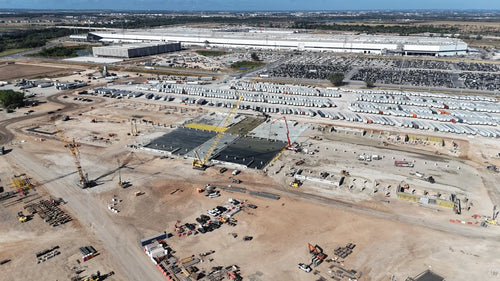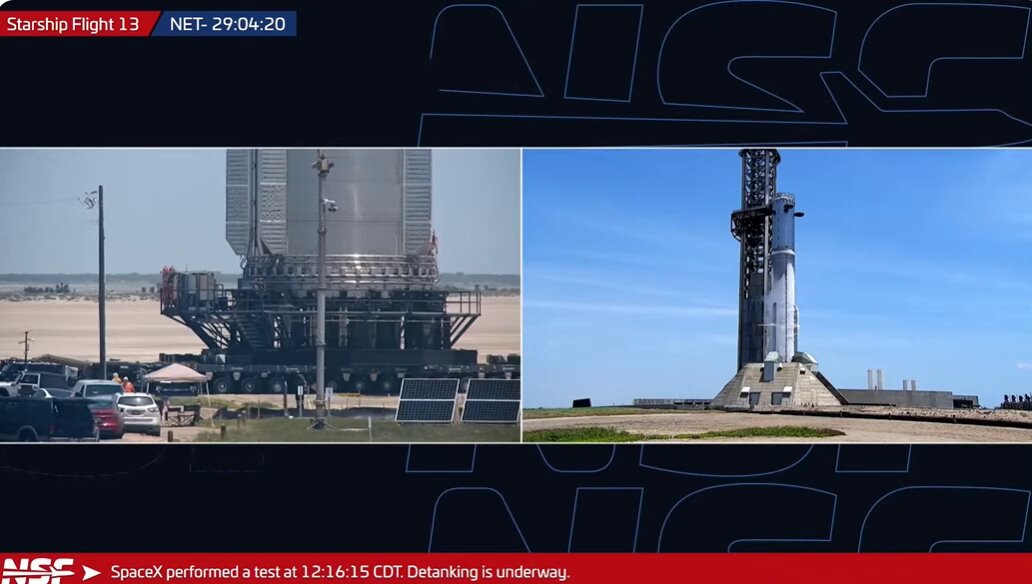
SpaceX has reached a new operational tempo at Starbase. As of July 22, Booster 20 sits on Orbital Launch Pad 2 ahead of Starship Flight 13 while Booster 21 — the vehicle earmarked for Flight 14 — is simultaneously rolling back from Massey's test site after cryogenic proof testing. NASASpaceflight called it "very likely the norm in the future," and the footage backs that up. Two Super Heavy boosters in active processing at once is a meaningful step toward the cadence SpaceX needs for a fully reusable system.

What exactly is "dual flow operations"?
It means two Starship vehicles are moving through different stages of the test and launch pipeline at the same time, rather than sequentially. One booster can be on the pad being prepped for launch while the next is undergoing structural testing at a separate facility. The bottleneck in any launch program is usually the gap between flights — dual flow ops directly compresses that gap by keeping the pipeline full.
What is Booster 20 doing right now?
Booster 20 is on Orbital Launch Pad 2 at Starbase, stacked with Ship 40, and is the flight vehicle for Starship Flight 13. The launch window opens July 23, 2026, at 6:45 p.m. EDT. This comes after a July 16 attempt was aborted at T-0 when four Raptor engines failed to ignite. Following that abort, SpaceX replaced at least two to three Raptor 3 engines on the booster. Booster 20 previously completed a 20-second static fire on July 10 — the longest booster static fire in the Starship program's history, according to Space.com.
What is Booster 21 doing right now?
Booster 21 rolled out to Massey's test site on July 19 for cryogenic proof testing and is now rolling back — meaning that phase is complete. B21 is the designated booster for Starship Flight 14, paired with Ship 41. Its cryo testing confirms SpaceX is actively processing the next vehicle in parallel, not waiting for Flight 13 to conclude before touching the next one.
What is Flight 13 actually trying to accomplish?
Flight 13 is the second flight of Starship Version 3 hardware. The mission profile calls for Booster 20 to attempt a soft splashdown in the Gulf of Mexico rather than a tower catch. Ship 40 aims to deploy 20 Starlink V3 satellites, attempt a single Raptor engine relight in space, and execute a controlled entry and splashdown in the Indian Ocean. The V3 Super Heavy booster carries notable hardware upgrades: the grid fin count drops from four to three, with each fin 50% larger and stronger, and their positions have been re-clocked to improve catch operations on future flights.
What does Flight 14 add on top of that?
Flight 14 is expected to push further toward full reusability. According to an FCC authorization filing, it is described as a "Starship Orbital Return Demo" — with the goal of returning both the Ship and the Booster under the V3 architecture. If Flight 13 validates the hardware, Flight 14 would be the attempt to demonstrate the complete recovery loop. Specific launch dates for Flight 14 have not been announced; B21 is still in the testing phase.
Why does this matter for the broader Starship program?
Running two boosters through the pipeline simultaneously is the operational prerequisite for any serious launch cadence. SpaceX has stated ambitions for Starship to eventually support dozens of flights per year — that is impossible if each vehicle has to wait for the previous one to complete its full cycle before processing begins. Dual flow ops, even at this early stage, is the infrastructure behavior that makes high cadence achievable. NASASpaceflight's note that this is "very likely the norm in the future" reflects what the Starbase facility layout was always designed to support. The fact that it is happening now, with back-to-back flights already scheduled, suggests the operational model is maturing faster than the flight rate alone implies. Follow our SpaceX coverage for updates as Flight 13 approaches its launch window tomorrow.
🚀 Following the Starship program? See every test flight, official outcome and the next launch window in our SpaceX Starship Tracker.
Sources & reporting notes
The links below identify the material source records used for this report.
- @NASASpaceflight on X (2026-07-22T17:42:39.000Z) — Direct source
Source links are preserved as published or accessed. See our editorial standards and corrections policy.
The BASENOR Editorial Desk covers Tesla, SpaceX, and related technology, curating reporting from primary sources — official accounts, regulatory filings, and software release data. Every article passes source-record and fact-checking review before publication. About the newsroom.
This report was curated by the BASENOR Editorial Desk from the sources listed above. Read our editorial standards or email editorial@basenor.com to report an error.